Oregon Research Institute, 1776 Millrace Drive, Eugene, OR 97403, USA.
Behav Res Ther. 2013 Mar;51(3):128-33. doi: 10.1016/j.brat.2012.12.001. Epub 2012 Dec 14.
To investigate factors hypothesized to moderate the effects of a dissonance-based eating disorder prevention program, including initial elevations in thin-ideal internalization, body dissatisfaction, eating disorders symptoms, and older participant age.
Adolescent female high school and college students with body image concerns (N=977; M age=18.6) were randomized to a dissonance-based thin-ideal internalization reduction program or an assessment-only control condition in three prevention trials.
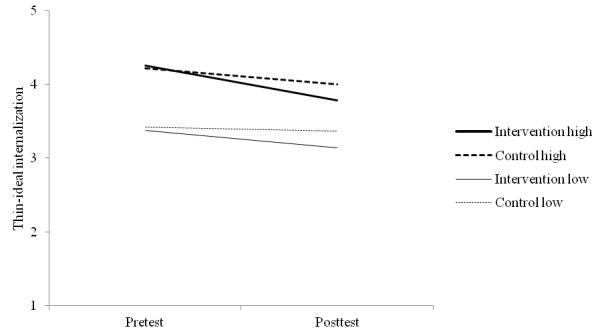
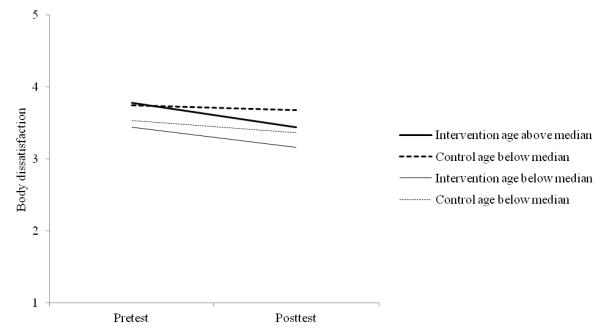
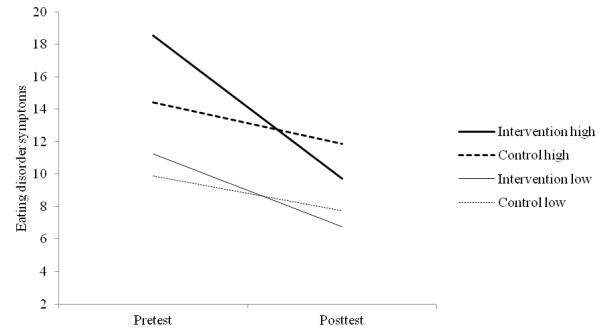
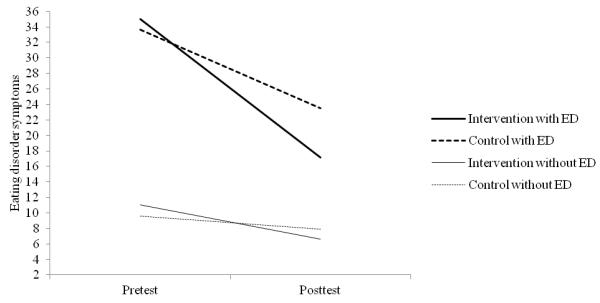
The intervention produced (a) significantly stronger reductions in thin-ideal internalization for participants with initial elevations in thin-ideal internalization and a threshold/subthreshold DSM-5 eating disorder at baseline, (b) significantly greater reductions in eating disorder symptoms for participants with versus without a DSM-5 eating disorder at baseline, and (c) significantly stronger reductions in body dissatisfaction for late adolescence/young adulthood versus mid-adolescent participants. Baseline body dissatisfaction did not moderate the intervention effects.
Overall, intervention effects tended to be amplified for individuals with initial elevations in risk factors and a DSM-5 eating disorder at baseline. Results suggest that this prevention program is effective for a broad range of individuals, but is somewhat more beneficial for the subgroups identified in the moderation analyses.
探究假设的调节因素对基于不和谐的饮食障碍预防计划效果的影响,包括对瘦理想内化、身体不满、饮食障碍症状的初始升高,以及参与者年龄较大。
对有身体形象问题的青少年女高中生和大学生(N=977;M 年龄=18.6)进行了三项预防试验,将他们随机分配到基于不和谐的瘦理想内化减少计划或仅评估对照组中。
该干预措施产生了以下结果:(a)对于基线时瘦理想内化初始升高且存在 DSM-5 饮食障碍阈下/亚阈值的参与者,瘦理想内化的减少明显更强;(b)对于基线时有或没有 DSM-5 饮食障碍的参与者,饮食障碍症状的减少明显更大;(c)对于青春期后期/成年早期的参与者,身体不满的减少明显更强。基线身体不满并没有调节干预效果。
总体而言,对于基线时风险因素初始升高和 DSM-5 饮食障碍的个体,干预效果倾向于放大。结果表明,该预防计划对广泛的个体有效,但对调节分析中确定的亚组更有益。