Integrated Biosystems and Biomechanics Laboratory, University of Michigan, Ann Arbor, MI 48109, USA.
Integr Biol (Camb). 2013 Mar;5(3):450-7. doi: 10.1039/c2ib20256e.
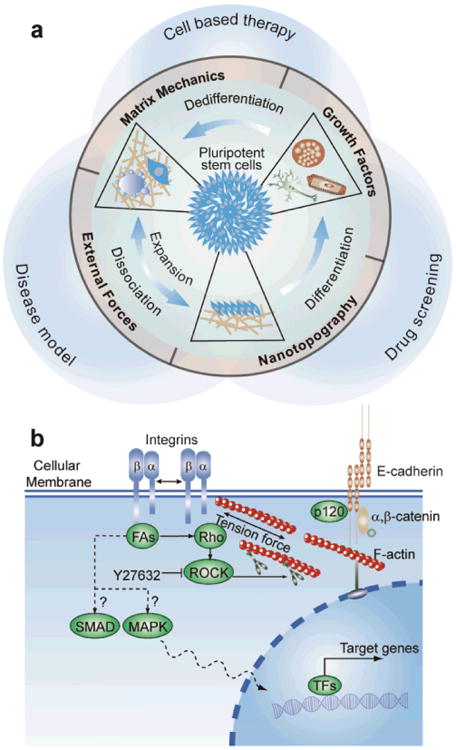
Research on human pluripotent stem cells (hPSCs) has expanded rapidly over the last two decades, owing to the promises of hPSCs for applications in regenerative medicine, disease modeling, and developmental biology studies. While most studies of hPSCs have so far focused on identifying extrinsic soluble factors, intracellular signaling pathways, and transcriptional networks that are involved in regulating hPSC self-renewal and differentiation, a few promising studies have emerged in recent years to reveal some unique mechano-sensitive and -responsive properties of hPSCs and the effect of the physical aspects of the local cellular microenvironment on regulating hPSC behaviors. This Frontier Review is to highlight these recent studies of mechanobiology in hPSCs and to discuss the impact of advancing our understanding of mechanoregulation of hPSC behaviors on improving survival, self-renewal and differentiation of hPSCs using well-controlled synthetic micro/nanoscale cell culture tools.
在过去的二十年中,由于人类多能干细胞(hPSCs)在再生医学、疾病建模和发育生物学研究中的应用前景,其研究迅速发展。虽然目前大多数 hPSC 研究都集中在鉴定参与调节 hPSC 自我更新和分化的外在可溶性因子、细胞内信号通路和转录网络,但近年来出现了一些有前途的研究,揭示了 hPSC 的一些独特的机械敏感和响应特性,以及细胞微环境的物理方面对调节 hPSC 行为的影响。本综述重点介绍 hPSCs 中机械生物学的这些最新研究,并讨论深入了解 hPSC 行为的机械调节对使用经过良好控制的合成微/纳米级细胞培养工具提高 hPSC 的存活率、自我更新和分化的影响。