Section for Medical Information Management and Imaging, Centre for Medical Statistics, Informatics and Intelligent Systems, Medical University of Vienna, Vienna, Austria.
BMC Med Inform Decis Mak. 2013 Jan 22;13:11. doi: 10.1186/1472-6947-13-11.
The dual model approach represents a promising solution for achieving semantically interoperable standardized electronic health record (EHR) exchange. Its acceptance, however, will depend on the effort required for integrating archetypes into legacy EHR systems.
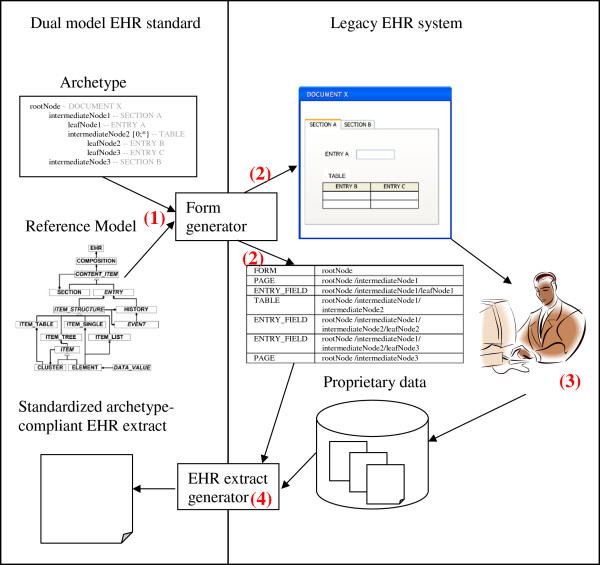
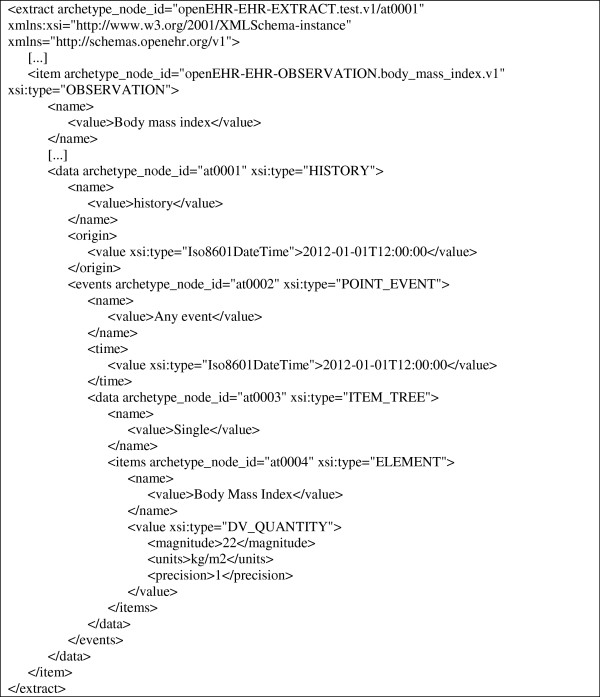
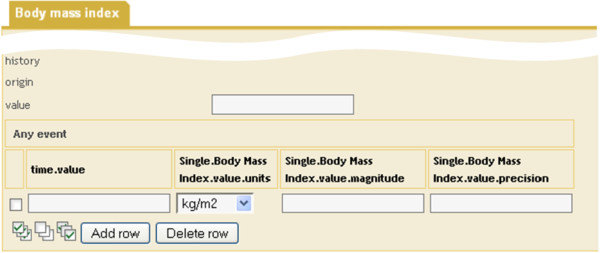
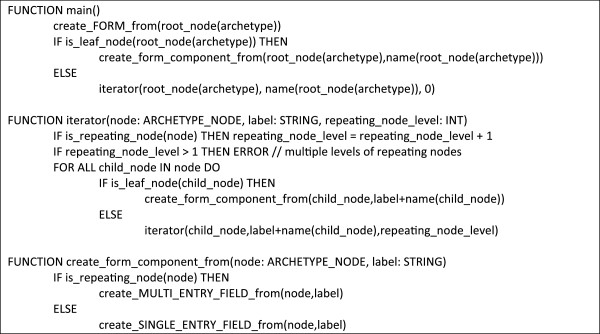
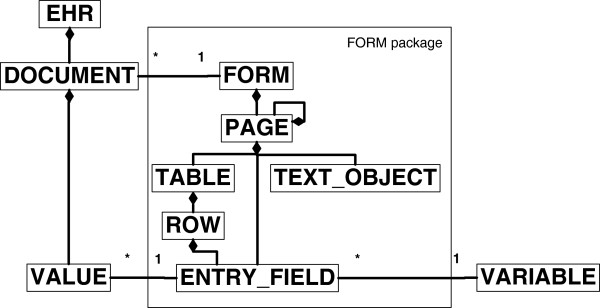
We propose a corresponding approach that: (a) automatically generates entry forms in legacy EHR systems from archetypes; and (b) allows the immediate export of EHR documents that are recorded via the generated forms and stored in the EHR systems' internal format as standardized and archetype-compliant EHR extracts. As a prerequisite for applying our approach, we define a set of basic requirements for the EHR systems.
We tested our approach with an EHR system called ArchiMed and were able to successfully integrate 15 archetypes from a test set of 27. For 12 archetypes, the form generation failed owing to a particular type of complex structure (multiple repeating subnodes), which was prescribed by the archetypes but not supported by ArchiMed's data model.
Our experiences show that archetypes should be customized based on the planned application scenario before their integration. This would allow problematic structures to be dissolved and irrelevant optional archetype nodes to be removed. For customization of archetypes, openEHR templates or specialized archetypes may be employed. Gaps in the data types or terminological features supported by an EHR system will often not preclude integration of the relevant archetypes. More work needs to be done on the usability of the generated forms.
双模式方法代表了实现语义互操作的标准化电子健康记录 (EHR) 交换的一种有前途的解决方案。然而,其接受程度将取决于将原型集成到传统 EHR 系统中所需的努力。
我们提出了一种相应的方法:(a) 从原型自动生成传统 EHR 系统中的输入表单;(b) 允许通过生成的表单记录的 EHR 文档立即以标准化和原型兼容的 EHR 提取形式导出并存储在 EHR 系统的内部格式中。作为应用我们方法的前提,我们为 EHR 系统定义了一组基本要求。
我们使用名为 ArchiMed 的 EHR 系统对我们的方法进行了测试,并能够成功集成来自 27 个测试集的 15 个原型。对于 12 个原型,由于原型规定但 ArchiMed 的数据模型不支持的特定类型的复杂结构(多个重复子节点),表单生成失败。
我们的经验表明,在集成原型之前,应根据计划的应用场景对其进行定制。这将允许溶解有问题的结构并删除不相关的可选原型节点。可以使用 openEHR 模板或专门的原型进行原型定制。EHR 系统支持的数据类型或术语特征的差距通常不会排除相关原型的集成。需要进一步改进生成表单的可用性。