Pearce Christopher Martin, de Lusignan Simon, Phillips Christine, Hall Sally, Travaglia Joanne
Inner East Melbourne Medicare Local, Burwood East, Australia.
Interact J Med Res. 2013 Aug 12;2(2):e26. doi: 10.2196/ijmr.2700.
Computerized medical records (CMR) are used in most Australian general practices. Although CMRs have the capacity to amalgamate and provide data to the clinician about their standard of care, there is little research on the way in which they may be used to support clinical governance: the process of ensuring quality and accountability that incorporates the obligation that patients are treated according to best evidence.
The objective of this study was to explore the capability, capacity, and acceptability of CMRs to support clinical governance.
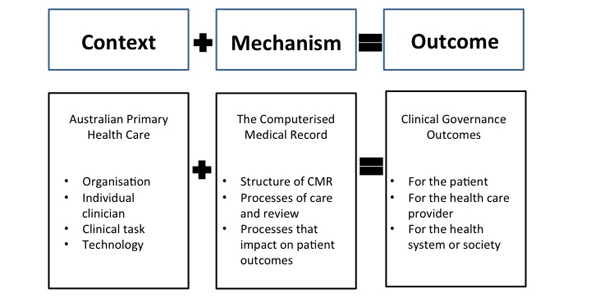
We conducted a realist review of the role of seven CMR systems in implementing clinical governance, developing a four-level maturity model for the CMR. We took Australian primary care as the context, CMR to be the mechanism, and looked at outcomes for individual patients, localities, and for the population in terms of known evidence-based surrogates or true outcome measures.
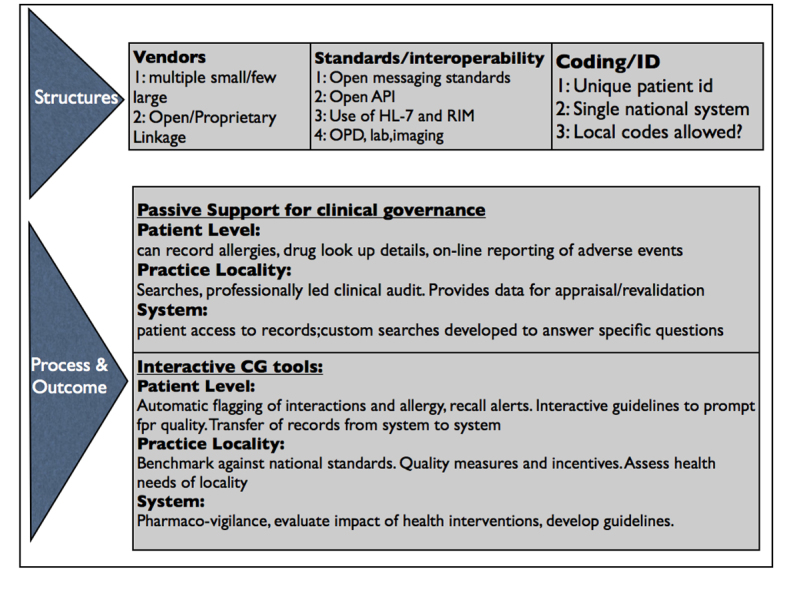
The lack of standardization of CMRs makes national and international benchmarking challenging. The use of the CMR was largely at level two of our maturity model, indicating a relatively simple system in which most of the process takes place outside of the CMR, and which has little capacity to support benchmarking, practice comparisons, and population-level activities. Although national standards for coding and projects for record access are proposed, they are not operationalized.
The current CMR systems can support clinical governance activities; however, unless the standardization and data quality issues are addressed, it will not be possible for current systems to work at higher levels.
澳大利亚大多数普通诊所都使用计算机化医疗记录(CMR)。尽管CMR有能力整合并向临床医生提供有关其医疗标准的数据,但对于如何利用CMR支持临床治理(即确保医疗质量和问责制的过程,其中包括根据最佳证据治疗患者的义务)的研究却很少。
本研究的目的是探讨CMR支持临床治理的能力、容量和可接受性。
我们对七个CMR系统在实施临床治理中的作用进行了实证性综述,为CMR开发了一个四级成熟度模型。我们以澳大利亚初级医疗为背景,以CMR为机制,并根据已知的循证替代指标或真实结果指标,考察个体患者、地区和人群的结果。
CMR缺乏标准化使得国家和国际基准测试具有挑战性。CMR的使用大多处于我们成熟度模型的二级,这表明该系统相对简单,大部分流程在CMR之外进行,几乎没有能力支持基准测试、实践比较和人群层面的活动。尽管提出了编码国家标准和记录访问项目,但这些标准并未实施。
当前的CMR系统能够支持临床治理活动;然而,除非解决标准化和数据质量问题,否则当前系统将无法在更高水平上运行。