
展示黑素瘤特异性 CD44 可变剪接模式的定性稳定性,但在肿瘤进展过程中表现出定量变化。
Demonstration of a melanoma-specific CD44 alternative splicing pattern that remains qualitatively stable, but shows quantitative changes during tumour progression.
机构信息
Department of Tumour Progression, 2 Institute of Pathology, Semmelweis University, Budapest, Hungary.
出版信息
PLoS One. 2013;8(1):e53883. doi: 10.1371/journal.pone.0053883. Epub 2013 Jan 14.
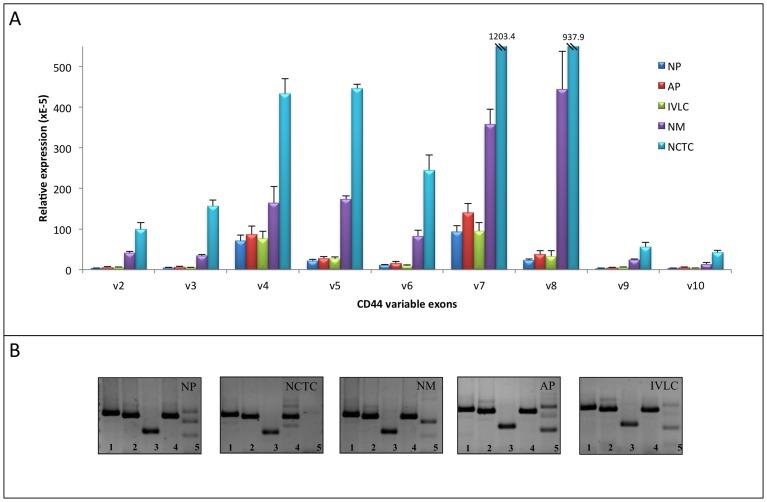
The role of CD44 in the progression of human melanoma has mostly been characterised by qualitative changes in expression of its individual variable exons. These exons however, may be expressed to form a number of molecules, the alternative splice variants of CD44, which may be structurally and functionally different. Using real-time PCR measurements with variable exon specific primers we have determined that all are expressed in human melanoma. To permit comparison between different tumours we identified a stable CD44 variable exon (CD44v) expression pattern, or CD44 'fingerprint'. This was found to remain unchanged in melanoma cell lines cultured in different matrix environments. To evaluate evolution of this fingerprint during tumour progression we established a scid mouse model, in which the pure expression pattern of metastatic primary tumours, circulating cells and metastases, non-metastatic primary tumours and lung colonies could be studied. Our analyses demonstrated, that although the melanoma CD44 fingerprint is qualitatively stable, quantitative changes are observed suggesting a possible role in tumour progression.
CD44 在人类黑色素瘤中的作用主要表现为其个体可变外显子表达的定性变化。然而,这些外显子可能会表达形成多种分子,即 CD44 的可变剪接变体,它们在结构和功能上可能不同。使用带有可变外显子特异性引物的实时 PCR 测量,我们已经确定所有这些分子都在人类黑色素瘤中表达。为了能够在不同的肿瘤之间进行比较,我们确定了一个稳定的 CD44 可变外显子(CD44v)表达模式,或 CD44“指纹”。在不同基质环境中培养的黑色素瘤细胞系中,发现这种指纹保持不变。为了评估在肿瘤进展过程中这种指纹的演变,我们建立了一个 scid 小鼠模型,其中可以研究转移性原发性肿瘤、循环细胞和转移灶、非转移性原发性肿瘤和肺集落的纯表达模式。我们的分析表明,尽管黑色素瘤 CD44 指纹在定性上是稳定的,但观察到定量变化,表明其可能在肿瘤进展中发挥作用。


 Zotero 插件