Groupe d'Imagerie Neurofonctionnelle, UMR 5296, Univ. Bordeaux, Bordeaux, Aquitaine, France.
PLoS One. 2013;8(1):e54400. doi: 10.1371/journal.pone.0054400. Epub 2013 Jan 16.
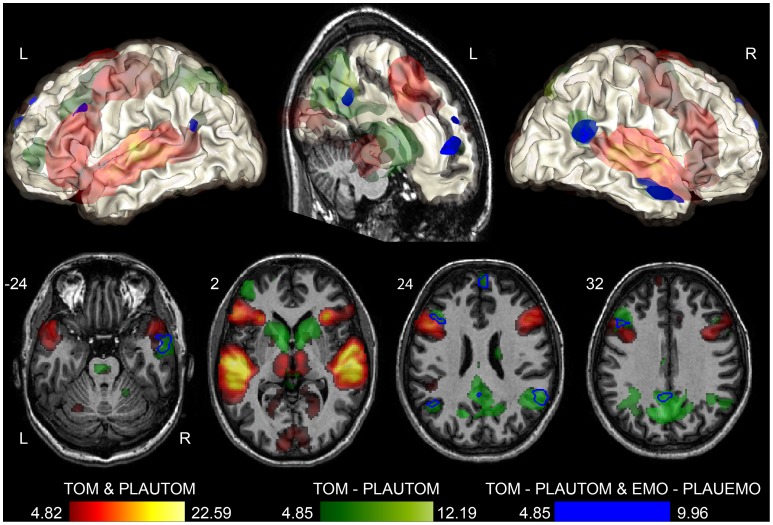
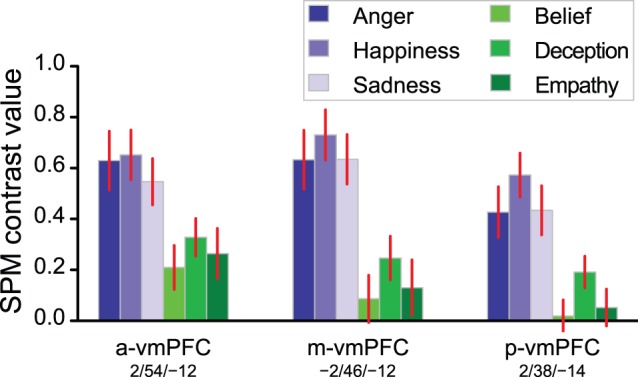
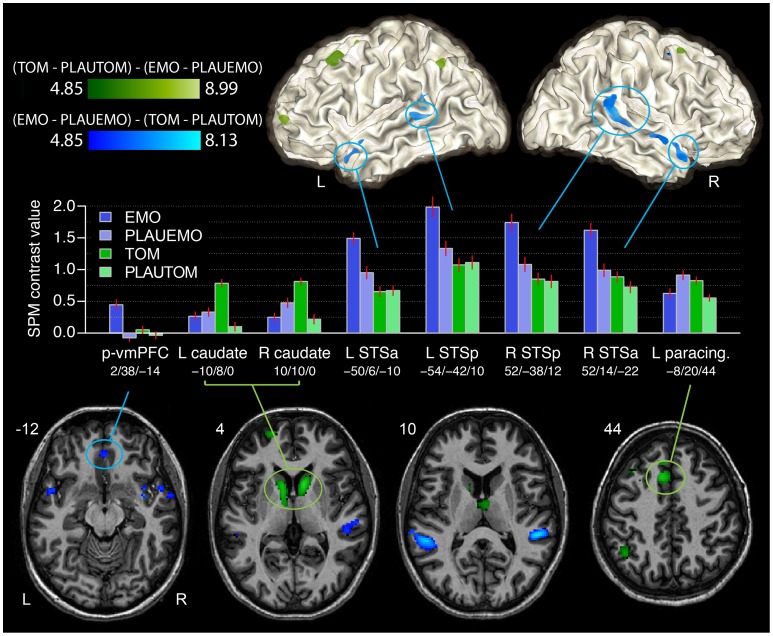
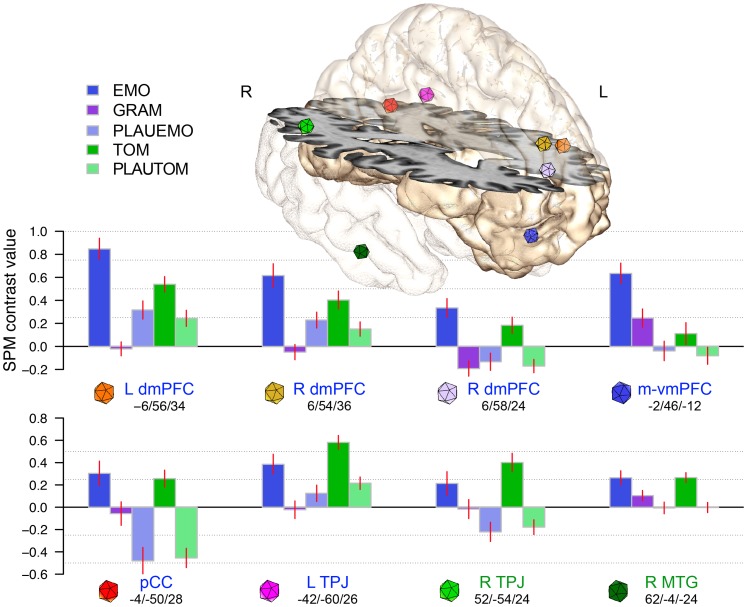
Using event-related fMRI in a sample of 42 healthy participants, we compared the cerebral activity maps obtained when classifying spoken sentences based on the mental content of the main character (belief, deception or empathy) or on the emotional tonality of the sentence (happiness, anger or sadness). To control for the effects of different syntactic constructions (such as embedded clauses in belief sentences), we subtracted from each map the BOLD activations obtained during plausibility judgments on structurally matching sentences, devoid of emotions or ToM. The obtained theory of mind (ToM) and emotional speech comprehension networks overlapped in the bilateral temporo-parietal junction, posterior cingulate cortex, right anterior temporal lobe, dorsomedial prefrontal cortex and in the left inferior frontal sulcus. These regions form a ToM network, which contributes to the emotional component of spoken sentence comprehension. Compared with the ToM task, in which the sentences were enounced on a neutral tone, the emotional sentence classification task, in which the sentences were play-acted, was associated with a greater activity in the bilateral superior temporal sulcus, in line with the presence of emotional prosody. Besides, the ventromedial prefrontal cortex was more active during emotional than ToM sentence processing. This region may link mental state representations with verbal and prosodic emotional cues. Compared with emotional sentence classification, ToM was associated with greater activity in the caudate nucleus, paracingulate cortex, and superior frontal and parietal regions, in line with behavioral data showing that ToM sentence comprehension was a more demanding task.
我们使用事件相关 fMRI 在 42 名健康参与者的样本中进行比较,根据主要角色的心理内容(信念、欺骗或同理心)或句子的情绪基调(幸福、愤怒或悲伤)对口语句子进行分类时,比较获得的大脑活动图谱。为了控制不同句法结构(如信念句中的嵌入从句)的影响,我们从每个图谱中减去在结构匹配的句子上进行似然性判断时获得的 BOLD 激活,这些句子没有情绪或 ToM。获得的心理理论 (ToM) 和情绪言语理解网络在双侧颞顶联合区、后扣带皮层、右侧颞前叶、背内侧前额叶和左侧下额沟重叠。这些区域形成一个 ToM 网络,有助于理解口语句子的情绪成分。与句子以中性语调陈述的 ToM 任务相比,句子以角色扮演的方式呈现的情绪句子分类任务与双侧颞上回的更大活动相关,这与情绪韵律的存在一致。此外,腹内侧前额叶在情绪句子处理中比 ToM 句子处理更活跃。这个区域可能将心理状态表示与言语和韵律情绪线索联系起来。与情绪句子分类相比,ToM 与尾状核、旁中央皮质以及额顶区域的更大活动相关,这与行为数据一致,表明 ToM 句子理解是一项更具挑战性的任务。