Rheumatology Department, AP-HP, St-Antoine Hospital, , Paris, France.
Ann Rheum Dis. 2014 Feb;73(2):376-84. doi: 10.1136/annrheumdis-2012-202485. Epub 2013 Jan 23.
To assess the ability of avocado-soybean unsaponifiable-Expanscience (ASU-E) to slow radiographic progression in symptomatic hip osteoarthritis (OA).
Prospective, randomised, double blind, parallel group, placebo controlled 3 year trial. Patients with symptomatic (painful ≥1 year, Lequesne Index between 3 and 10) hip OA (American College of Rheumatology criteria) and a minimum joint space width (JSW) of the target hip between 1 and 4 mm on a pelvic radiograph were randomly assigned to 300 mg/day ASU-E or placebo. Standing pelvis, target hip anteroposterior (AP) and oblique views were taken annually. The primary outcome was JSW change at year 3, measured at the narrowest point on pelvic or target hip AP view (manual measure using a 0.1 mm graduated magnifying glass). The full analysis dataset (FAS) included all patients having at least two successive radiographs. An analysis of covariance Mixed Model for Repeated Measurements with Missing at Random (for missing data) was performed to compare adjusted 3 year JSW changes (primary outcome) and the percentages of 'progressors' (JSW loss≥0.5 mm) between groups.
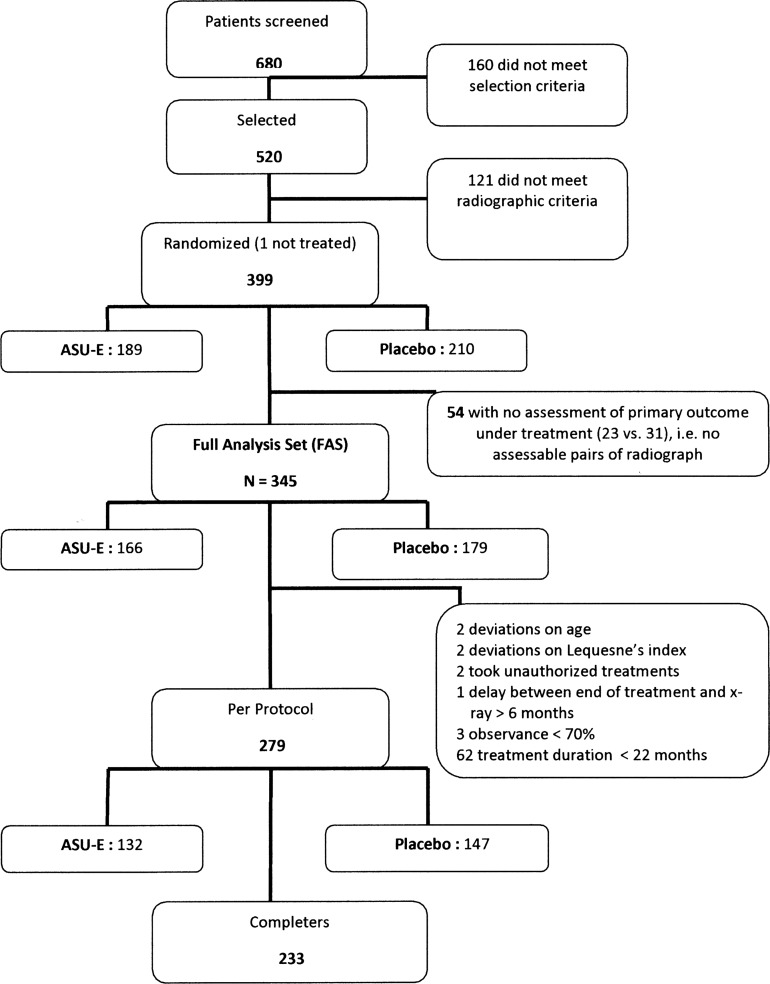
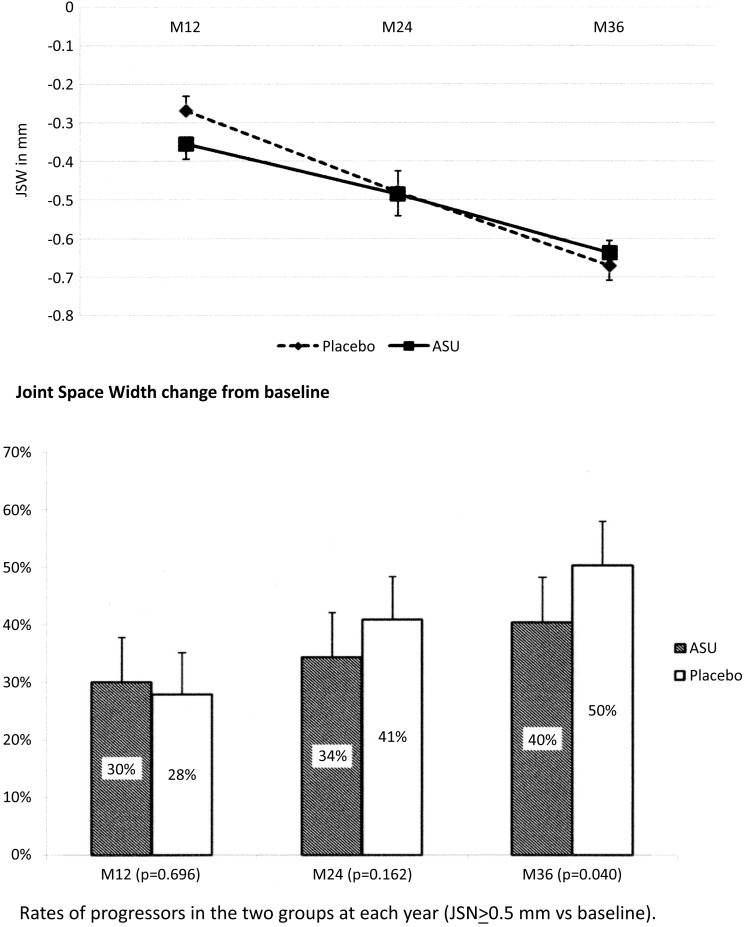
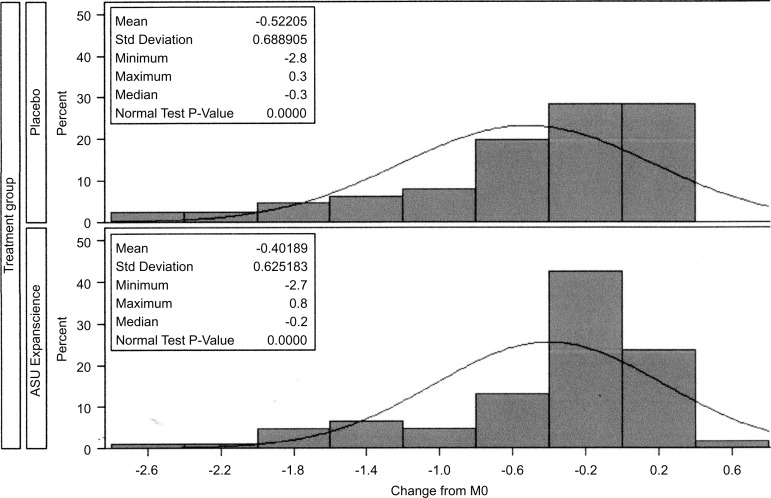
399 patients were randomised (345 kept in the FAS), aged 62 (35-84) years, 54% women, mean body mass index 27 (SD 4) kg/m(2), mean symptom duration 4 (SD 5) years, 0-100 normalised Lequesne Index 30 (SD 9) and global pain visual analogue scale 37 (SD 23) mm. Mean baseline JSW was 2.8 (0.9) mm. There was no significant difference on mean JSW loss (-0.638 mm vs -0.672 mm, p=0.72, in the ASU-E and placebo groups, respectively) but there were 20% less progressors in the ASU-E than in the placebo group (40% vs 50%, respectively, p=0.040). No difference was observed on clinical outcomes. Safety was excellent.
3 year treatment with ASU-E reduces the percentage of JSW progressors, indicating a potential structure modifying effect in hip OA to be confirmed, and the clinical relevance requires further assessment.
评估鳄梨-大豆不皂化物-Expanscience(ASU-E)在减缓有症状髋关节骨关节炎(OA)放射学进展方面的能力。
前瞻性、随机、双盲、平行组、安慰剂对照 3 年试验。入组患者为有症状(疼痛≥1 年,Lequesne 指数为 3 至 10)髋关节 OA(美国风湿病学会标准),且骨盆 X 线片上目标髋关节最小关节间隙宽度(JSW)为 1 至 4mm。将患者随机分配至 300mg/天 ASU-E 或安慰剂组。每年拍摄站立骨盆、目标髋关节前后位(AP)和斜位 X 线片。主要结局为 3 年时 JSW 变化,在骨盆或目标髋关节 AP 位最窄处测量(使用 0.1mm 刻度放大镜进行手动测量)。全分析数据集(FAS)包括至少连续两次拍摄 X 线片的所有患者。采用协方差分析混合模型对重复测量的缺失数据(缺失数据)进行分析,以比较组间调整后 3 年 JSW 变化(主要结局)和“进展者”(JSW 损失≥0.5mm)的百分比。
399 名患者被随机分配(345 名患者保留在 FAS 中),年龄 62(35-84)岁,54%为女性,平均体重指数 27(SD 4)kg/m2,平均症状持续时间 4(SD 5)年,0-100 归一化 Lequesne 指数 30(SD 9)和整体疼痛视觉模拟量表 37(SD 23)mm。平均基线 JSW 为 2.8(0.9)mm。ASU-E 组和安慰剂组的平均 JSW 损失无显著差异(分别为-0.638mm 和-0.672mm,p=0.72),但 ASU-E 组的进展者比例比安慰剂组低 20%(分别为 40%和 50%,p=0.040)。临床结局无差异。安全性极好。
3 年 ASU-E 治疗可降低 JSW 进展者的比例,表明其在髋关节 OA 中具有潜在的结构修饰作用,其临床相关性需要进一步评估。