Key Laboratory of Space Bioscience and Biotechnology, School of Life Science, Northwestern Polytechnical University, Xi'an, China.
Int J Nanomedicine. 2013;8:337-50. doi: 10.2147/IJN.S38635. Epub 2013 Jan 18.
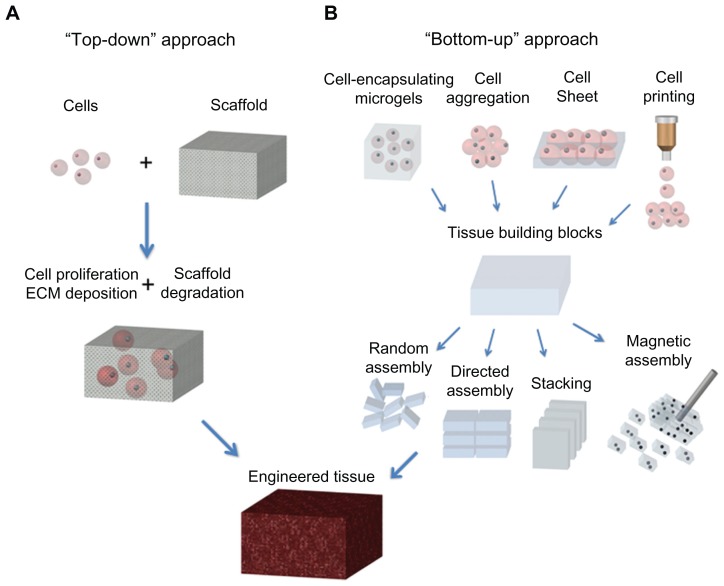
Three-dimensional biomimetic scaffolds have widespread applications in biomedical tissue engineering because of their nanoscaled architecture, eg, nanofibers and nanopores, similar to the native extracellular matrix. In the conventional "top-down" approach, cells are seeded onto a biocompatible and biodegradable scaffold, in which cells are expected to populate in the scaffold and create their own extracellular matrix. The top-down approach based on these scaffolds has successfully engineered thin tissues, including skin, bladder, and cartilage in vitro. However, it is still a challenge to fabricate complex and functional tissues (eg, liver and kidney) due to the lack of vascularization systems and limited diffusion properties of these large biomimetic scaffolds. The emerging "bottom-up" method may hold great potential to address these challenges, and focuses on fabricating microscale tissue building blocks with a specific microarchitecture and assembling these units to engineer larger tissue constructs from the bottom up. In this review, state-of-the-art methods for fabrication of three-dimensional biomimetic scaffolds are presented, and their advantages and drawbacks are discussed. The bottom-up methods used to assemble microscale building blocks (eg, microscale hydrogels) for tissue engineering are also reviewed. Finally, perspectives on future development of the bottom-up approach for tissue engineering are addressed.
三维仿生支架由于其纳米级结构,如纳米纤维和纳米孔,类似于天然细胞外基质,因此在生物医学组织工程中得到了广泛的应用。在传统的“自上而下”方法中,细胞被接种到生物相容性和可生物降解的支架上,期望细胞在支架中定植并产生自己的细胞外基质。基于这些支架的自上而下方法已经成功地在体外工程化了薄组织,包括皮肤、膀胱和软骨。然而,由于缺乏血管化系统和这些大型仿生支架的有限扩散特性,仍然难以制造复杂和功能性组织(如肝和肾)。新兴的“自下而上”方法可能具有解决这些挑战的巨大潜力,它侧重于制造具有特定微观结构的微尺度组织构建块,并将这些单元组装起来,从底层向上工程化更大的组织构建体。在这篇综述中,介绍了制造三维仿生支架的最新方法,并讨论了它们的优缺点。还回顾了用于组织工程的微尺度构建块(例如微尺度水凝胶)的自下而上组装方法。最后,讨论了自下而上方法在组织工程中的未来发展前景。