Department of Biology, Institute of Molecular Evolutionary Genetics, and the Huck Institutes of the Life Sciences, 201 Life Sciences Building, Pennsylvania State University, University Park, PA 16802, USA.
BMC Plant Biol. 2013 Jan 24;13:13. doi: 10.1186/1471-2229-13-13.
Previous studies in basal angiosperms have provided insight into the diversity within the angiosperm lineage and helped to polarize analyses of flowering plant evolution. However, there is still not an experimental system for genetic studies among basal angiosperms to facilitate comparative studies and functional investigation. It would be desirable to identify a basal angiosperm experimental system that possesses many of the features found in existing plant model systems (e.g., Arabidopsis and Oryza).
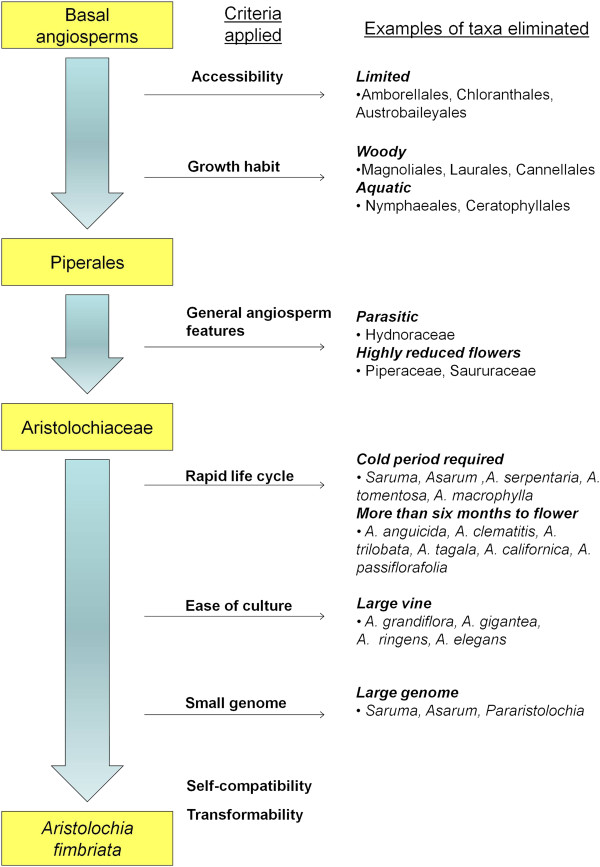
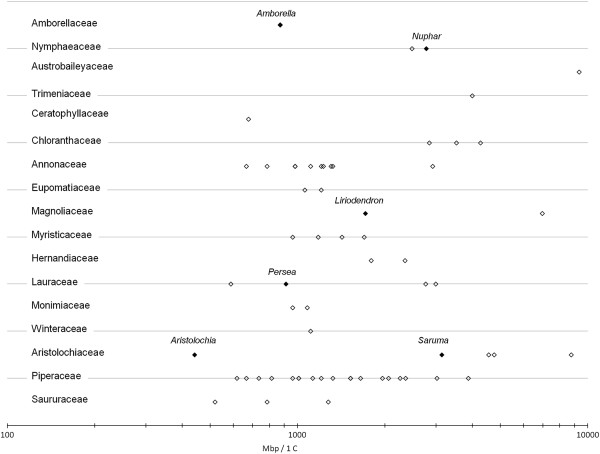
We have considered all basal angiosperm families for general characteristics important for experimental systems, including availability to the scientific community, growth habit, and membership in a large basal angiosperm group that displays a wide spectrum of phenotypic diversity. Most basal angiosperms are woody or aquatic, thus are not well-suited for large scale cultivation, and were excluded. We further investigated members of Aristolochiaceae for ease of culture, life cycle, genome size, and chromosome number. We demonstrated self-compatibility for Aristolochia elegans and A. fimbriata, and transformation with a GFP reporter construct for Saruma henryi and A. fimbriata. Furthermore, A. fimbriata was easily cultivated with a life cycle of just three months, could be regenerated in a tissue culture system, and had one of the smallest genomes among basal angiosperms. An extensive multi-tissue EST dataset was produced for A. fimbriata that includes over 3.8 million 454 sequence reads.
Aristolochia fimbriata has numerous features that facilitate genetic studies and is suggested as a potential model system for use with a wide variety of technologies. Emerging genetic and genomic tools for A. fimbriata and closely related species can aid the investigation of floral biology, developmental genetics, biochemical pathways important in plant-insect interactions as well as human health, and various other features present in early angiosperms.
以前在基干被子植物中的研究为被子植物谱系的多样性提供了深入的了解,并有助于对有花植物进化进行两极分化分析。然而,基干被子植物中仍然没有一个用于遗传研究的实验系统,以促进比较研究和功能研究。最好能确定一个具有许多现有植物模式系统(如拟南芥和水稻)所具有的特征的基干被子植物实验系统。
我们考虑了所有基干被子植物家族的一般特征,这些特征对于实验系统很重要,包括对科学界的可用性、生长习性以及在表现出广泛表型多样性的大基干被子植物群体中的成员身份。大多数基干被子植物是木本或水生的,因此不适合大规模种植,因此被排除在外。我们进一步研究了马兜铃科的成员,以了解其培养的容易程度、生命周期、基因组大小和染色体数目。我们证明了 A. elegans 和 A. fimbriata 的自交亲和性,以及 Saruma henryi 和 A. fimbriata 的 GFP 报告基因构建体的转化。此外,A. fimbriata 很容易在仅三个月的生命周期中进行培养,可以在组织培养系统中再生,并且其基因组大小在基干被子植物中是最小的之一。我们为 A. fimbriata 生成了一个广泛的多组织 EST 数据集,其中包含超过 380 万个 454 序列读数。
Aristolochia fimbriata 具有许多促进遗传研究的特征,被建议作为一种潜在的模型系统,可用于多种技术。A. fimbriata 和密切相关物种的新兴遗传和基因组工具可以帮助研究花生物学、发育遗传学、在植物-昆虫相互作用以及人类健康中重要的生化途径,以及早期被子植物中存在的各种其他特征。