Department of Biology, Brigham Young University, Provo, UT, United States of America.
PLoS One. 2019 Jul 16;14(7):e0219832. doi: 10.1371/journal.pone.0219832. eCollection 2019.
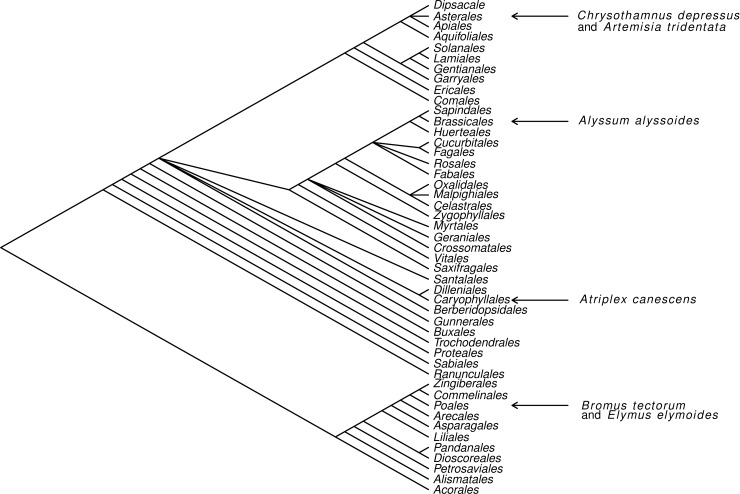
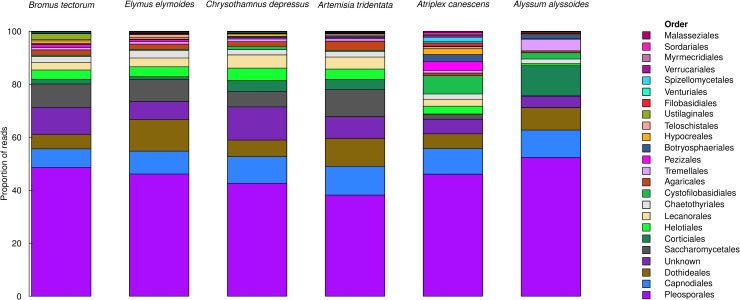
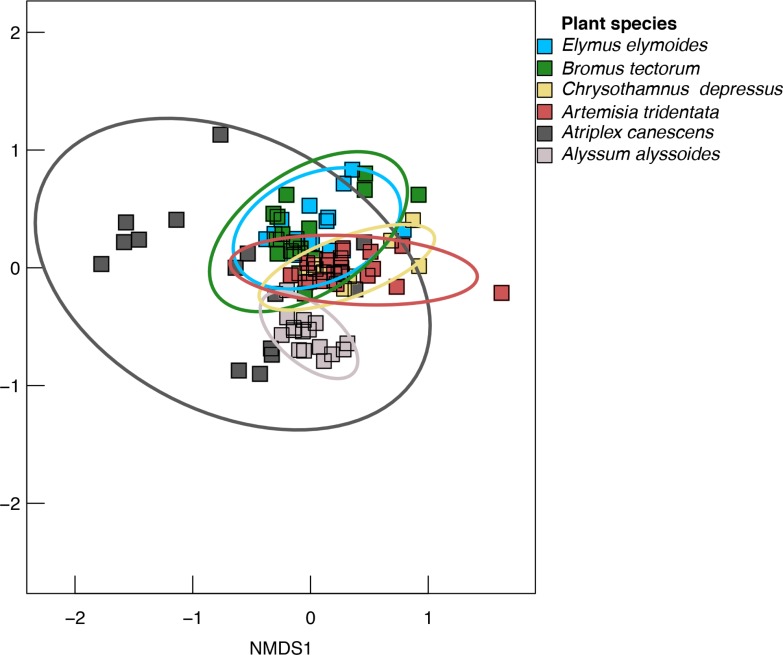
Because of disturbance and plant species loss at the local level, many arid ecosystems in the western USA benefit from revegetation. There is a growing interest in improving revegetation success by purposefully inoculating revegetation plants with mutualistic endophytic fungi that increase plant stress tolerance. However, inoculant fungi must compete against fungi that indigenous to the habitat, many of which may not be mutualistic. Our overall goal, therefore, is to learn how to efficiently colonize revegetation plants using endophytic fungal inoculum. The goal will be facilitated by understanding the factors that limit colonization of plants by endophytic fungi, including inoculum dispersal and host compatibility. We analyzed endophytic fungal communities in leaves of Bromus tectorum and Elymus elymoides (Poaceae), Chrysothamnus depressus and Artemisia tridentata (Asteraceae), Alyssum alyssoides (Brassicaceae) and Atriplex canescens (Amaranthaceae), each occurring in each of 18 field plots. We found that dispersal limitation was significant for endophytic fungal communities of Atriplex canescens and Bromus tectorum, accounting for 9 and 17%, respectively, of the variation in endophytic fungal community structure, even though the maximum distance between plots was only 350 m. Plant species identity accounted for 33% of the variation in endophytic fungal community structure. These results indicate that the communities of endophytic fungi assembling in these plant species depend significantly on proximity to inoculum source as well as the identity of the plant species. Therefore, if endophytic fungi are to be used to facilitate revegetation by these plant species, land managers may find it profitable to consider both the proximity of inoculum to revegetation plants and the suitability of the inoculum to targeted host plant species.
由于当地的干扰和物种丧失,美国西部的许多干旱生态系统受益于植被恢复。人们越来越感兴趣的是,通过有目的地用增加植物抗胁迫能力的互惠共生内生真菌接种植被恢复植物,来提高植被恢复的成功率。然而,接种真菌必须与栖息在那里的真菌竞争,其中许多可能不是共生的。因此,我们的总体目标是学习如何利用内生真菌接种剂有效地使植被恢复植物定殖。这一目标将通过了解限制内生真菌定殖植物的因素来实现,包括接种剂的传播和宿主的兼容性。我们分析了藜科的冰草和芨芨草、菊科的半日花和刺儿菜、十字花科的荠和藜科的滨藜的叶片内生真菌群落,这些物种分别出现在 18 个野外样地中。我们发现,对于滨藜和冰草的内生真菌群落,扩散限制是显著的,分别占内生真菌群落结构变异的 9%和 17%,尽管样地之间的最大距离仅为 350 米。植物物种的身份占内生真菌群落结构变异的 33%。这些结果表明,在这些植物物种中组装的内生真菌群落,很大程度上取决于与接种剂源的接近程度以及植物物种的身份。因此,如果要利用内生真菌来促进这些植物物种的植被恢复,土地管理者可能会发现,考虑到接种剂与植被恢复植物的接近程度以及接种剂对目标宿主植物物种的适宜性,是有利可图的。