Tissue Engineering and Stem Cell Research Group, Singapore Eye Research Institute, Singapore, Singapore.
J Mater Sci Mater Med. 2013 Apr;24(4):967-77. doi: 10.1007/s10856-012-4848-3. Epub 2013 Jan 26.
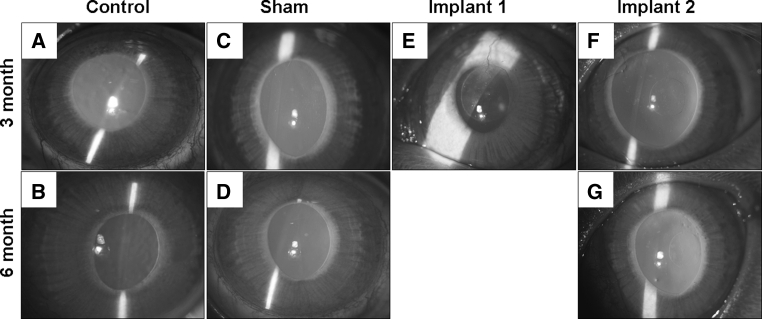
This study compared the effects of implanting two interpenetrating polymer networks (IPNs) into rabbit corneas. The first (Implant 1) was based on PEG-diacrylate, the second (Implant 2) was based on PEG-diacrylamide. There were inserted into deep stromal pockets created using a manual surgical technique for either 3 or 6 months. The implanted corneas were compared with normal and sham-operated corneas through slit lamp observation, anterior segment optical coherence tomography, in vivo confocal scanning and histological examination. Corneas with Implant 1 (based on PEG-diacrylate) developed diffuse haze, ulcers and opacities within 3 months, while corneas with Implant 2 (based on PEG-diacrylamide) remained clear at 6 months. They also exhibited normal numbers of epithelial cell layers, without any immune cell infiltration, inflammation, oedema or neovascularisation at post-operative 6 month. Morphological studies showed transient epithelial layer thinning over the hydrogel inserted area and elevated keratocyte activity at 3 months; however, the epithelium thickness and keratocyte morphology were improved at 6 months. Implant 2 exhibited superior in vivo biocompatibility and higher optical clarity than Implant 1. PEG-diacrylamide-based IPN hydrogel is therefore a potential candidate for corneal inlays to correct refractive error.
本研究比较了将两种互穿聚合物网络(IPN)植入兔眼角膜的效果。第一种(植入物 1)基于聚乙二醇二丙烯酸酯,第二种(植入物 2)基于聚乙二醇二丙烯酰胺。使用手动手术技术在深层基质袋中插入 3 或 6 个月。通过裂隙灯观察、眼前段光学相干断层扫描、活体共聚焦扫描和组织学检查,将植入的角膜与正常和假手术角膜进行比较。植入物 1(基于聚乙二醇二丙烯酸酯)的角膜在 3 个月内出现弥漫性混浊、溃疡和混浊,而植入物 2(基于聚乙二醇二丙烯酰胺)的角膜在 6 个月时仍保持透明。它们还表现出正常数量的上皮细胞层,在术后 6 个月时没有任何免疫细胞浸润、炎症、水肿或新生血管形成。形态学研究显示,在水凝胶插入区域上皮层暂时变薄,在 3 个月时角膜细胞活性升高;然而,在 6 个月时,上皮层厚度和角膜细胞形态得到改善。植入物 2 表现出优于植入物 1 的体内生物相容性和更高的光学清晰度。因此,基于聚乙二醇二丙烯酰胺的 IPN 水凝胶是一种潜在的角膜嵌体候选材料,可用于矫正屈光不正。