Department of Research, Cancer Registry of Norway, Norway.
Int J Cancer. 2013 Aug 1;133(3):705-12. doi: 10.1002/ijc.28052. Epub 2013 Feb 25.
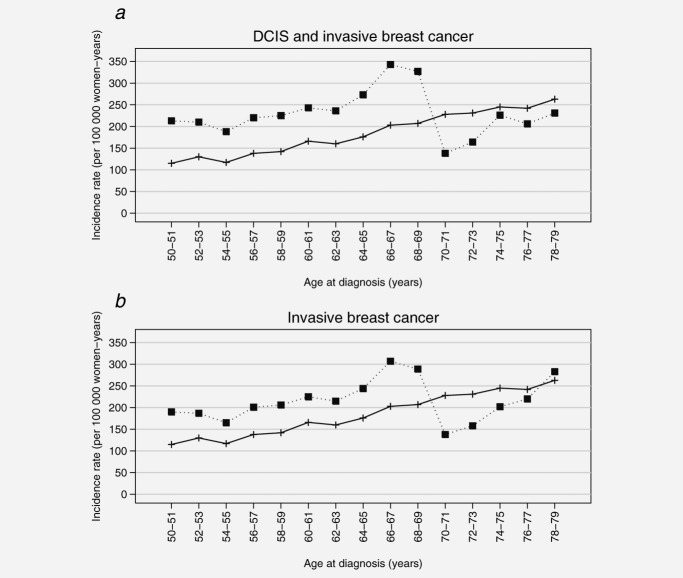
Increased incidence of ductal carcinoma in situ (DCIS) and invasive breast cancer (IBC) after introduction of organized screening has prompted debate about overdiagnosis. The aim was to examine the excess in incidence of DCIS and IBC during the screening period and the deficit after women left the program, and thereby to estimate the proportion of overdiagnosis. Women invited to the Norwegian Breast Cancer Screening Program were analyzed for DCIS or IBC during the period 1995-2009. Incidence rate ratios (IRRs) were calculated for attended vs. never attended women. The IRRs were adjusted by Mantel-Haenszel (MH) method and applied to a set of reference rates and a reference population to estimate the proportion of overdiagnosis during the women's lifespan after the age of 50 years. A total of 702,131 women were invited to the program. An excess of DCIS and IBC was observed among women who attended screening during the screening period; prevalently invited women aged 50-51 years had a MH IRR of 1.86 (95% CI 1.65-2.09) and subsequently invited women aged 52-69 years had a MH IRR of 1.56 (95% CI 1.45-1.68). In women aged 70-79 years, a deficit of 30% (MH IRR 0.70, 95% CI 0.62-0.80) was observed 1-10 years after they left the screening program. The estimated proportion of overdiagnosis varied from 10 to 20% depending on outcome and whether the women were invited or actually screened. The results highlight the need for individual data with longitudinal screening history and long-term follow-up as a basis for estimating overdiagnosis.
组织化筛查引入后,导管原位癌(DCIS)和浸润性乳腺癌(IBC)的发病率增加,这引发了关于过度诊断的争论。本研究旨在检查筛查期间 DCIS 和 IBC 的发病率增加以及女性离开该项目后的发病率减少,并据此估计过度诊断的比例。分析了参加挪威乳腺癌筛查项目的女性在 1995-2009 年期间患 DCIS 或 IBC 的情况。计算了参加与未参加女性的发病率比(IRR)。通过 Mantel-Haenszel(MH)方法对 IRR 进行了调整,并将其应用于一组参考率和参考人群,以估计女性 50 岁后寿命期间的过度诊断比例。共有 702131 名女性被邀请参加该项目。在筛查期间参加筛查的女性中观察到 DCIS 和 IBC 的发病率增加;普遍邀请的 50-51 岁女性的 MH IRR 为 1.86(95%CI 1.65-2.09),随后邀请的 52-69 岁女性的 MH IRR 为 1.56(95%CI 1.45-1.68)。在 70-79 岁的女性中,在她们离开筛查项目 1-10 年后,观察到发病率减少了 30%(MH IRR 0.70,95%CI 0.62-0.80)。过度诊断的估计比例取决于结果以及女性是否被邀请或实际接受筛查,范围为 10%至 20%。结果强调了需要基于个体数据和纵向筛查史以及长期随访来估计过度诊断。