Department of Prevention Sciences, Centre for Mental Health and Wellbeing Research and School of Psychology, Deakin University, Burwood, Victoria, Australia.
BMJ Open. 2013 Jan 24;3(1):e002423. doi: 10.1136/bmjopen-2012-002423.
Throughout the world, alcohol consumption is common among adolescents. Adolescent alcohol use and misuse have prognostic significance for several adverse long-term outcomes, including alcohol problems, alcohol dependence, school disengagement and illicit drug use. The aim of this study was to evaluate whether randomisation to a community mobilisation and social marketing intervention reduces the proportion of adolescents who initiate alcohol use before the Australian legal age of 18, and the frequency and amount of underage adolescent alcohol consumption.
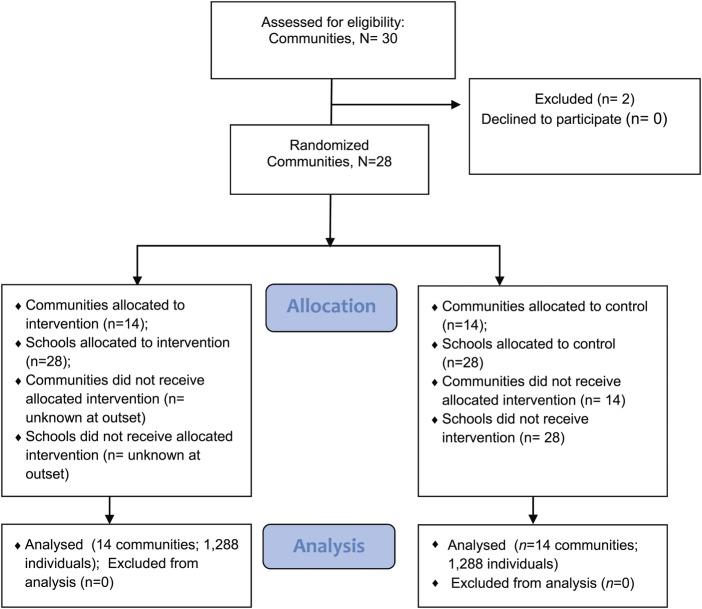
The study comprises 14 communities matched with 14 non-contiguous communities on socioeconomic status (SES), location and size. One of each pair was randomly allocated to the intervention. Baseline levels of adolescent alcohol use were estimated through school surveys initiated in 2006 (N=8500). Community mobilisation and social marketing interventions were initiated in 2011 to reduce underage alcohol supply and demand. The setting is communities in three Australian states (Victoria, Queensland and Western Australia). Students (N=2576) will complete school surveys in year 8 in 2013 (average age 12).
(1) lifetime initiation and (2) monthly frequency of alcohol use. Reports of social marketing and family and community alcohol supply sources will also be assessed. Point estimates with 95% CIs will be compared for student alcohol use in intervention and control communities. Changes from 2006 to 2013 will be examined; multilevel modelling will assess whether random assignment of communities to the intervention reduced 2013 alcohol use, after accounting for community level differences. Analyses will also assess whether exposure to social marketing activities increased the intervention target of reducing alcohol supply by parents and community members.
ACTRN12612000384853.
在全世界范围内,青少年饮酒现象普遍存在。青少年饮酒和滥用与多种不良长期后果有关,包括酒精问题、酒精依赖、辍学和非法药物使用。本研究旨在评估社区动员和社会营销干预是否能降低青少年在澳大利亚法定 18 岁以下开始饮酒的比例,以及减少未成年青少年饮酒的频率和数量。
该研究包括 14 个社区,根据社会经济地位(SES)、位置和规模与 14 个非相邻社区相匹配。每对中的一个社区被随机分配到干预组。通过 2006 年开始的学校调查(N=8500)估计青少年饮酒的基线水平。2011 年启动了社区动员和社会营销干预措施,以减少未成年饮酒的供应和需求。研究地点是澳大利亚三个州(维多利亚州、昆士兰州和西澳大利亚州)的社区。学生(N=2576)将在 2013 年(平均年龄 12 岁)八年级完成学校调查。
(1)终生起始和(2)每月饮酒频率。还将评估社会营销以及家庭和社区酒精供应源的报告。将对干预组和对照组学生的饮酒情况进行点估计和 95%置信区间比较。将检查从 2006 年到 2013 年的变化;多层次模型将评估社区是否随机分配到干预组减少了 2013 年的饮酒量,同时考虑了社区层面的差异。分析还将评估接触社会营销活动是否增加了父母和社区成员减少酒精供应的干预目标。
ACTRN12612000384853。