Division of Preventive Medicine, Clinical Research Institute, National Hospital Organization Kyoto Medical Center, Kyoto, Japan.
BMC Public Health. 2013 Jan 29;13:81. doi: 10.1186/1471-2458-13-81.
Lifestyle modifications are considered the most effective means of delaying or preventing the development of type 2 diabetes (T2DM). To contain the growing population of T2DM, it is critical to clarify effective and efficient settings for intervention and modalities for intervention delivery with a wide population reach.The Japan Diabetes Outcome Intervention Trial-1 (J-DOIT1) is a cluster randomized controlled trial to test whether goal-focused lifestyle coaching delivered by telephone can prevent the development of T2DM in high-risk individuals in a real-world setting. This paper describes the study design and recruitment of the study subjects.
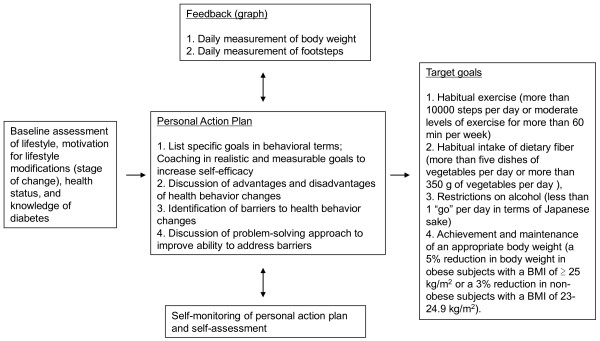
For the recruitment of study subjects and their follow-up annually over 3 years, we employed health checkups conducted annually at communities and worksites. Health care divisions recruited from communities and companies across Japan formed groups as a cluster randomization unit. Candidates for the study, aged 20-65 years with fasting plasma glucose (FPG) of 5.6-6.9 mmol/l, were recruited from each group using health checkups results in 2006. Goal-focused lifestyle support is delivered by healthcare providers via telephone over a one-year period. Study subjects will be followed-up for three years by annual health checkups. Primary outcome is the development of diabetes defined as FPG≥7.0 mmol/l on annual health checkup or based on self-report, which is confirmed by referring to medical cards.
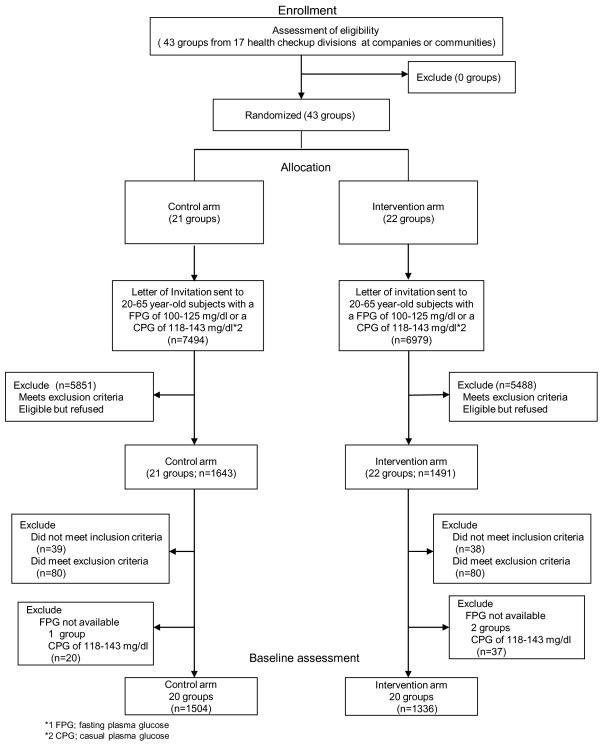
Forty-three groups (clusters), formed from 17 health care divisions, were randomly assigned to an intervention arm (22 groups) or control arm (21 clusters) between March 2007 and February 2008. A total of 2840 participants, 1336 from the intervention and 1504 from the control arm, were recruited. Consent rate was about 20%, with no difference between the intervention and control arms. There were no differences in cluster size and characteristics of cluster between the groups. There were no differences in individual characteristics between the study arms.
We have launched J-DOIT1, a nation-wide trial to prevent the development of T2DM in high-risk individuals using telephone-delivered intervention. This trial is expected to contribute to evidence-based real-world preventive practices.
UMIN000000662.
生活方式的改变被认为是延缓或预防 2 型糖尿病(T2DM)发展的最有效手段。为了控制不断增长的 T2DM 人群,明确具有广泛人群覆盖范围的有效和高效的干预措施设置以及干预措施的实施方式至关重要。日本糖尿病结局干预试验-1(J-DOIT1)是一项整群随机对照试验,旨在测试在现实环境中,通过电话进行以目标为导向的生活方式指导是否可以预防高危人群发生 T2DM。本文介绍了该研究的设计和研究对象的招募过程。
为了招募研究对象并在 3 年内每年对其进行随访,我们利用每年在社区和工作场所进行的健康检查。全日本各地的社区和公司的医疗保健部门组成小组作为整群随机分组单位。从每个小组中招募年龄在 20-65 岁之间、空腹血糖(FPG)为 5.6-6.9mmol/L 的候选人,使用 2006 年的健康检查结果进行招募。通过电话在一年的时间内为医疗保健提供者提供以目标为导向的生活方式支持。研究对象将通过每年的健康检查随访 3 年。主要结局是通过年度健康检查发现糖尿病的发展,定义为 FPG≥7.0mmol/L,或根据自我报告确定,然后通过查阅医疗卡进行确认。
2007 年 3 月至 2008 年 2 月,从 17 个医疗保健部门组成的 43 个小组(整群)中随机分配到干预组(22 个小组)或对照组(21 个整群)。共招募了 2840 名参与者,其中干预组 1336 名,对照组 1504 名。同意率约为 20%,干预组和对照组之间无差异。组间的群规模和群特征无差异。研究组间的个体特征也无差异。
我们已经启动了 J-DOIT1,这是一项全国性试验,旨在通过电话干预预防高危人群发生 T2DM。该试验有望为循证的实际预防实践做出贡献。
UMIN000000662。