Department of Infectious Diseases, Peking Union Medical College Hospital, Chinese Academy of Medical Sciences, Beijing, China.
PLoS One. 2013;8(1):e52950. doi: 10.1371/journal.pone.0052950. Epub 2013 Jan 24.
To investigate the potential of nevirapine 200 mg once-daily regimen and evaluate the influence of patient characteristics on nevirapine concentrations.
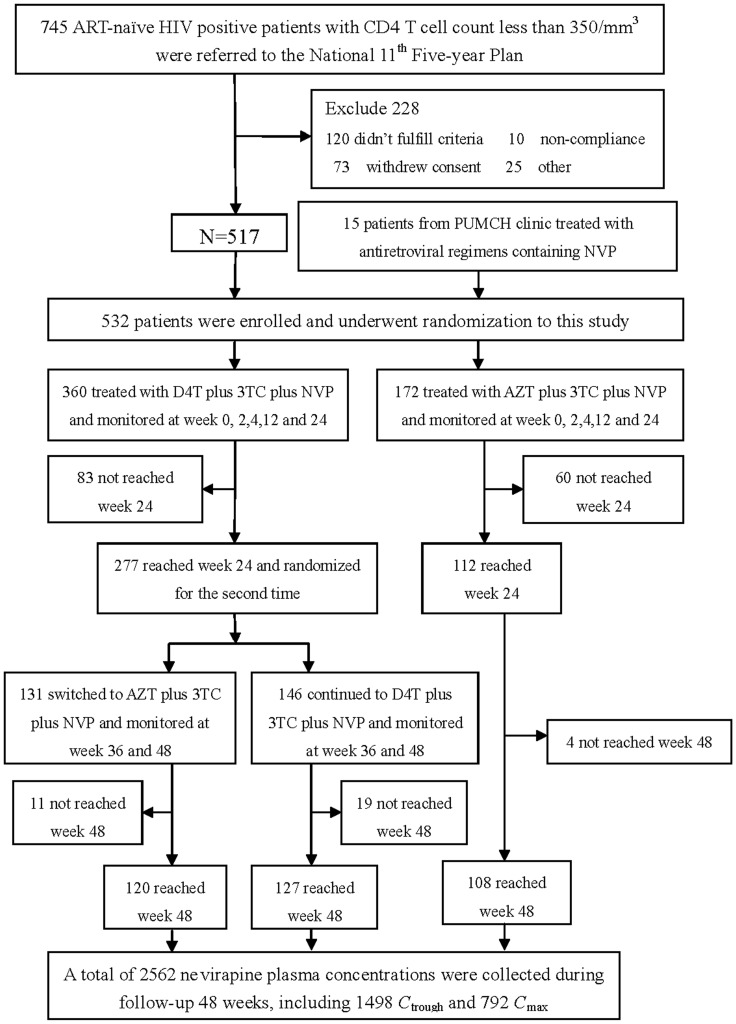
This was a prospective, multicentre cohort study with 532 HIV-infected patients receiving nevirapine as a part of their initial antiretroviral therapy. Plasma samples were collected at trough or peak time at the end of week 2 (lead-in period) and week 4, 12, 24, 36, and 48 (steady-state period), and nevirapine concentrations were determined using a validated HPLC method. Potential influencing factors associated with nevirapine concentrations were evaluated using univariate and multivariate logistic regression.
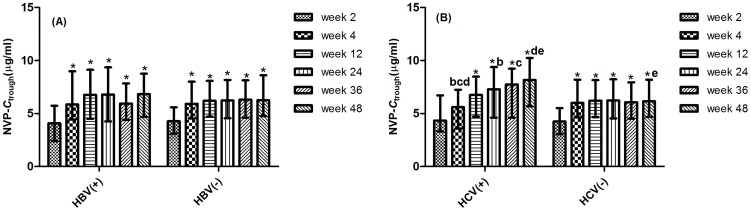
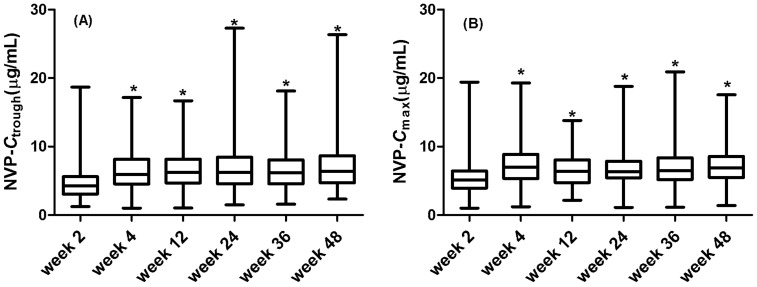
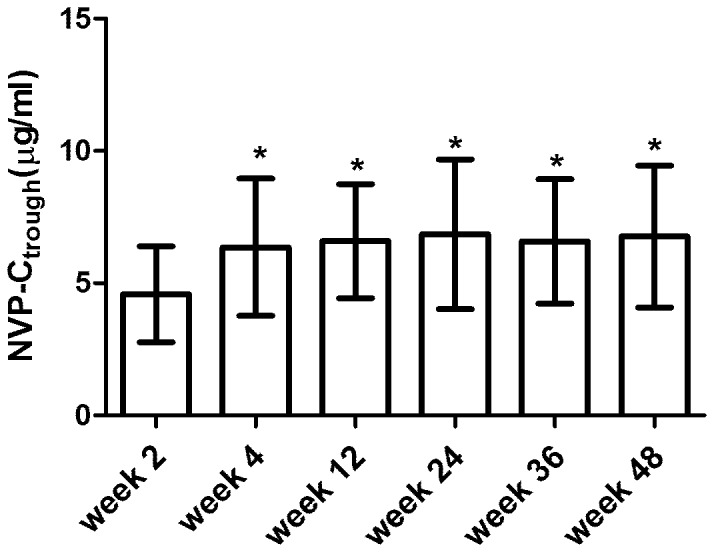
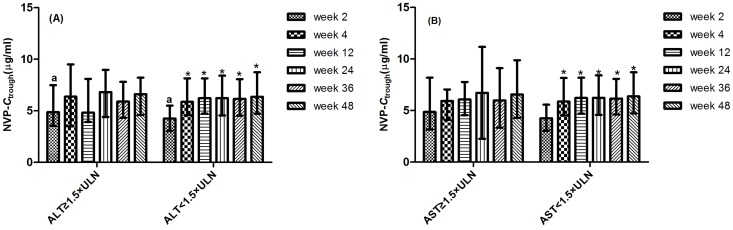
A total of 2348 nevirapine plasma concentrations were collected, including 1510 trough and 838 peak values. The median nevirapine trough and peak concentration during the lead-in period were 4.26 µg/mL (IQR 3.05-5.61) and 5.07 µg/mL (IQR 3.92-6.44) respectively, which both exceeded the recommended thresholds of nevirapine plasma concentrations. Baseline hepatic function had a moderate effect on median nevirapine trough concentrations at week 2 (4.25 µg/mL v.s. 4.86 µg/mL, for ALT <1.5 × ULN and ≥ 1.5 × ULN, respectively, P = 0.045). No significant difference was observed in median nevirapine trough concentration between lead-in and steady-state periods in patients with baseline ALT and AST level ≥ 1.5 × ULN (P = 0.171, P = 0.769), which was different from the patients with ALT/AST level <1.5ULN. The median trough concentrations were significantly higher in HIV/HCV co-infected patients than those without HCV at week 48 (8.16 µg/mL v.s. 6.15 µg/mL, P = 0.004).
The 200 mg once-daily regimen of nevirapine might be comparable to twice-daily in plasma pharmacokinetics in Chinese population. Hepatic function prior to nevirapine treatment and HIV/HCV coinfection were significantly associated with nevirapine concentrations.
研究奈韦拉平 200mg 每日 1 次方案的潜力,并评估患者特征对奈韦拉平浓度的影响。
这是一项前瞻性、多中心队列研究,共纳入 532 例接受奈韦拉平作为初始抗逆转录病毒治疗一部分的 HIV 感染患者。在导入期(第 2 周末)和稳态期(第 4、12、24、36 和 48 周末)结束时采集奈韦拉平谷浓度或峰浓度的血浆样本。使用验证的 HPLC 方法测定奈韦拉平浓度。使用单变量和多变量逻辑回归评估与奈韦拉平浓度相关的潜在影响因素。
共采集了 2348 份奈韦拉平血药浓度,包括 1510 份谷浓度和 838 份峰浓度。导入期奈韦拉平谷浓度和峰浓度的中位数分别为 4.26μg/ml(IQR 3.05-5.61)和 5.07μg/ml(IQR 3.92-6.44),均超过了奈韦拉平血浆浓度的推荐阈值。基线肝功能对第 2 周末奈韦拉平谷浓度的中位数有中度影响(4.25μg/ml vs. 4.86μg/ml,ALT<1.5×ULN 和≥1.5×ULN 分别,P=0.045)。在基线 ALT 和 AST 水平≥1.5×ULN 的患者中,导入期和稳态期奈韦拉平谷浓度的中位数无显著差异(P=0.171,P=0.769),与 ALT/AST 水平<1.5ULN 的患者不同。在第 48 周末,HIV/HCV 合并感染患者的奈韦拉平谷浓度中位数明显高于无 HCV 感染患者(8.16μg/ml vs. 6.15μg/ml,P=0.004)。
在中国人群中,奈韦拉平 200mg 每日 1 次方案与每日 2 次方案在血浆药代动力学方面可能相当。奈韦拉平治疗前的肝功能和 HIV/HCV 合并感染与奈韦拉平浓度显著相关。