Kittner Eye Center, University of North Carolina Hospitals, Chapel Hill, North Carolina, USA.
PLoS One. 2013;8(1):e55079. doi: 10.1371/journal.pone.0055079. Epub 2013 Jan 24.
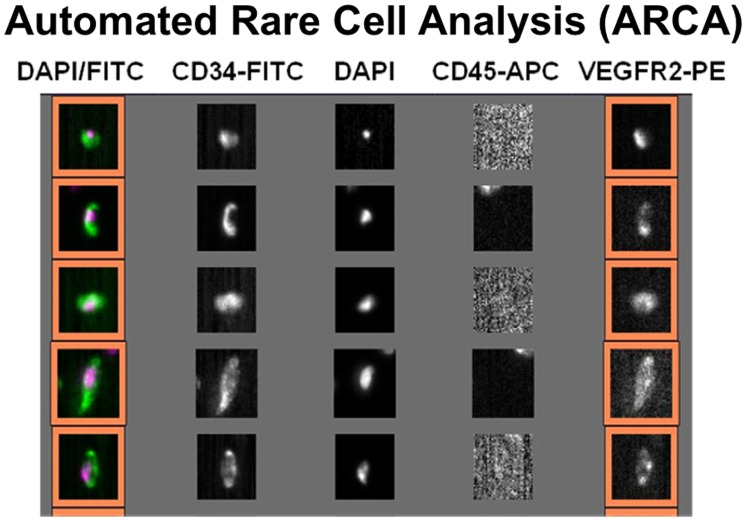
Patients with age-related macular degeneration (ARMD) begin with non-neovascular (NNV) phenotypes usually associated with good vision. Approximately 20% of NNV-ARMD patients will convert to vision debilitating neovascular (NV) ARMD, but precise timing of this event is unknown. Developing a clinical test predicting impending conversion to NV-ARMD is necessary to prevent vision loss. Endothelial progenitor cells (EPCs), defined as CD34(+)VEGR2(+) using traditional fluorescence activated cell sorting (FACS), are rare cell populations known to be elevated in patients with NV-ARMD compared to NNV-ARMD. FACS has high inter-observer variability and subjectivity when measuring rare cell populations precluding development into a diagnostic test. We hypothesized that automated rare cell analysis (ARCA), a validated and FDA-approved technology for reproducible rare cell identification, can enumerate EPCs in ARMD patients more reliably. This pilot study serves as the first step in developing methods for reproducibly predicting ARMD phenotype conversion.
We obtained peripheral venous blood samples in 23 subjects with NNV-ARMD or treatment naïve NV-ARMD. Strict criteria were used to exclude subjects with known angiogenic diseases to minimize confounding results. Blood samples were analyzed in masked fashion in two separate laboratories. EPCs were independently enumerated using ARCA and FACS within 24 hours of blood sample collection, and p<0.2 was considered indicative of a trend for this proof of concept study, while statistical significance was established at 0.05.
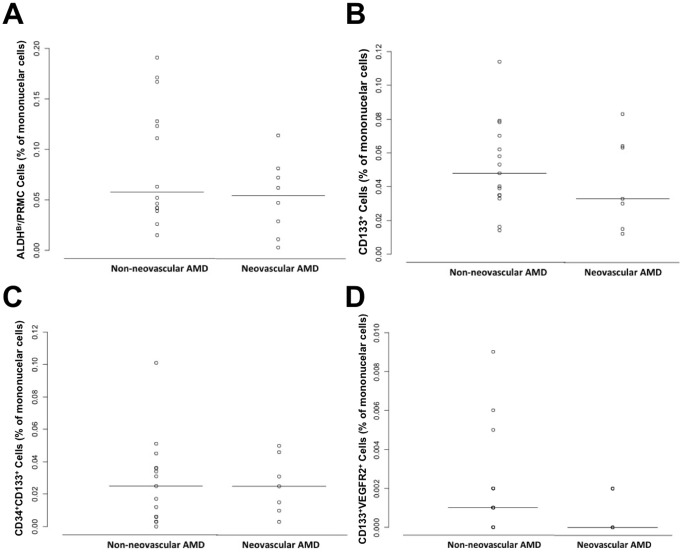
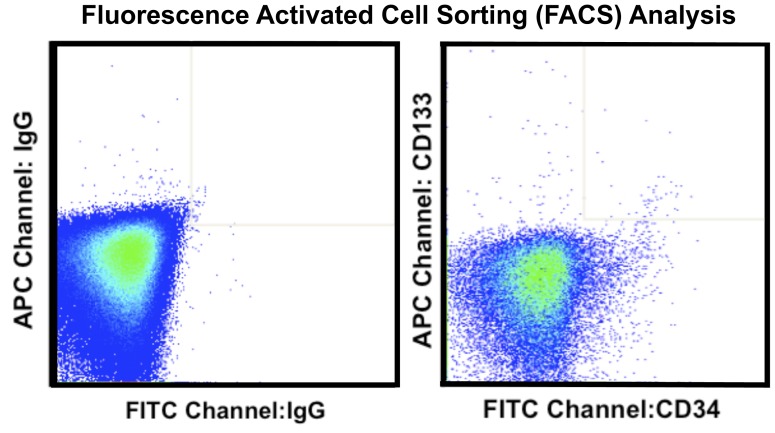
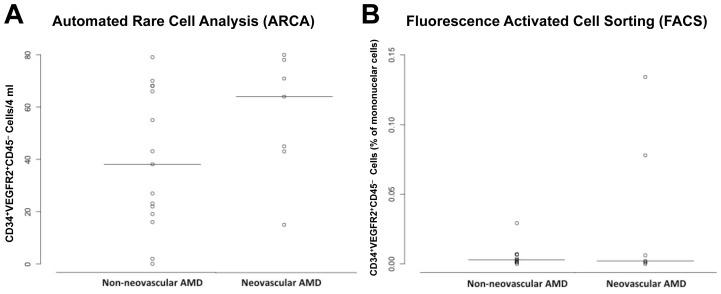
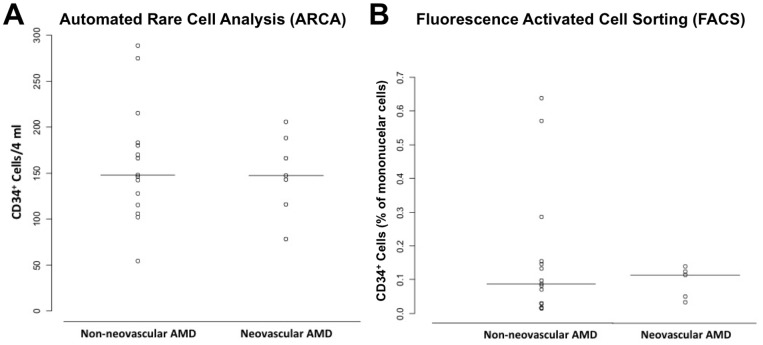
We measured levels of CD34(+)VEGFR2(+) EPCs suggestive of a trend with higher values in patients with NV compared to NNV-ARMD (p = 0.17) using ARCA. Interestingly, CD34(+)VEGR2(+) EPC analysis using FACS did not produce similar results (p = 0.94).
CD34(+)VEGR2(+) may have predictive value for EPC enumeration in future ARCA studies. EPC measurements in a small sample size were suggestive of a trend in ARMD using ARCA but not FACS. ARCA could be a helpful tool for developing a predictive test for ARMD phenotype conversion.
年龄相关性黄斑变性(AMD)患者最初表现为非新生血管(NNV)表型,通常与良好的视力相关。大约 20%的 NNV-AMD 患者将转化为致盲性新生血管(NV)AMD,但这种情况的确切时间尚不清楚。开发一种预测即将发生 NV-AMD 转化的临床测试对于防止视力丧失是必要的。内皮祖细胞(EPCs),使用传统的荧光激活细胞分选(FACS)定义为 CD34(+)VEGR2(+),是一种在 NV-AMD 患者中升高的罕见细胞群体,与 NNV-AMD 相比。FACS 在测量罕见细胞群体时具有很高的观察者间变异性和主观性,这排除了将其发展为诊断测试的可能性。我们假设,自动化稀有细胞分析(ARCA)是一种经过验证且获得 FDA 批准的用于可重复识别稀有细胞的技术,可更可靠地计数 AMD 患者中的 EPCs。这项初步研究是开发可重复性预测 AMD 表型转化方法的第一步。
我们在 23 名 NNV-AMD 或未经治疗的 NV-AMD 患者中获得外周静脉血样本。严格排除已知血管生成疾病的患者,以尽量减少混杂结果。血液样本在两个独立的实验室中以掩蔽方式进行分析。在采血后 24 小时内,使用 ARCA 和 FACS 独立计数 EPCs,p<0.2 被认为是本概念验证研究的趋势指标,而统计学意义则设定为 0.05。
我们使用 ARCA 测量了 NV 患者中 CD34(+)VEGFR2(+)EPC 水平,表明与 NNV-AMD 相比具有升高的趋势(p=0.17)。有趣的是,使用 FACS 进行的 CD34(+)VEGR2(+)EPC 分析并未产生类似的结果(p=0.94)。
CD34(+)VEGR2(+)可能对未来的 ARCA 研究中 EPC 计数具有预测价值。使用 ARCA 的 AMD 小样本量 EPC 测量表明存在趋势,但使用 FACS 则没有。ARCA 可能是开发 AMD 表型转化预测性测试的有用工具。