Clinical Psychology & Neuropsychology, University of Konstanz, Konstanz, Germany.
BMC Psychiatry. 2013 Jan 29;13:40. doi: 10.1186/1471-244X-13-40.
Posttraumatic stress disorder (PTSD) is associated with an enhanced risk for cardiovascular and other inflammatory diseases. Chronic low-level inflammation has been suggested as a potential mechanism linking these conditions.
We investigated plasma cytokine levels as well as spontaneous and lipopolysaccharide (LPS)-stimulated cytokine production by peripheral blood mononuclear cells (PBMCs) in a group of 35 severely traumatized PTSD patients compared to 25 healthy controls.
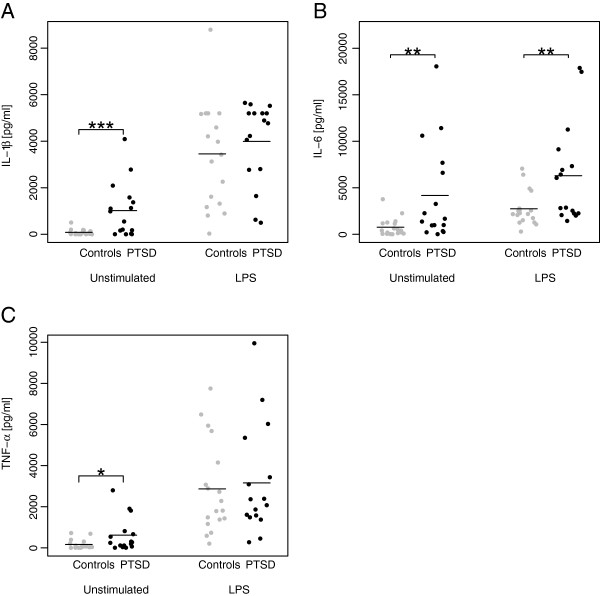
Spontaneous production of interleukin (IL)-1β, IL-6 and tumor necrosis factor (TNF)-α by isolated PBMCs was significantly higher in the PTSD compared to the control group and even correlated with PTSD symptom severity within the PTSD group. In contrast, circulating plasma levels of pro- and anti-inflammatory cytokines such as IL-6, IL-8, IL-10, TNF-α, or monocyte chemotactic protein (MCP)-1 were not significantly altered in PTSD patients compared to healthy controls.
Our findings indicate that PBMCs of PTSD patients are already pre-activated in vivo, providing further evidence for low-grade inflammation in PTSD. This might possibly represent one psychobiological pathway from PTSD to poor physical health.
创伤后应激障碍(PTSD)与心血管疾病和其他炎症性疾病的风险增加有关。慢性低度炎症被认为是将这些疾病联系起来的潜在机制。
我们研究了 35 名严重创伤后 PTSD 患者和 25 名健康对照组的血浆细胞因子水平以及外周血单个核细胞(PBMC)中自发性和脂多糖(LPS)刺激的细胞因子产生。
与对照组相比,PTSD 组分离的 PBMC 中白细胞介素(IL)-1β、IL-6 和肿瘤坏死因子(TNF)-α的自发性产生明显更高,甚至与 PTSD 组内的 PTSD 症状严重程度相关。相比之下,与健康对照组相比,PTSD 患者的循环血浆中促炎和抗炎细胞因子(如 IL-6、IL-8、IL-10、TNF-α或单核细胞趋化蛋白(MCP)-1 的水平没有明显改变。
我们的研究结果表明,PTSD 患者的 PBMC 已经在体内预先激活,为 PTSD 中的低度炎症提供了进一步的证据。这可能代表了从 PTSD 到身体健康不良的一种心理生物学途径。