Division of Hematology-Oncology, Department of Medicine, Medical University of South Carolina, 86 Jonathan Lucas Street, Hollings Cancer Center Rm# HO307, Charleston, SC 29425, USA.
J Hematol Oncol. 2013 Jan 29;6:12. doi: 10.1186/1756-8722-6-12.
Pim (proviral insertion in murine lymphoma) kinases are a small family of constitutively active, highly conservative serine/threonine oncogenic kinases and have 3 members: Pim1, Pim2, and Pim3. Pim kinases are also implicated in the regulation of B- and T- cell responses to cytokines and hematopoietic growth factors. The roles of Pim kinases in the regulation of primitive hematopoietic stem cells (HSCs) are largely unknown.
In the current study, Pim1-/-2-/-3-/- triple knockout (TKO) mice were used to determine the role of Pim kinases in hematopoiesis. Peripheral blood hematological parameters were measured in Pim TKO mice and age-matched wild-type (WT) controls. Primary, secondary, and competitive transplantations were performed to assay the long-term repopulating HSCs in Pim TKO mice. In vivo BrdU incorporation assay and ex vivo Ki67 staining and caspase 3 labeling were performed to evaluate the proliferation and apoptosis of HSCs in Pim TKO mice.
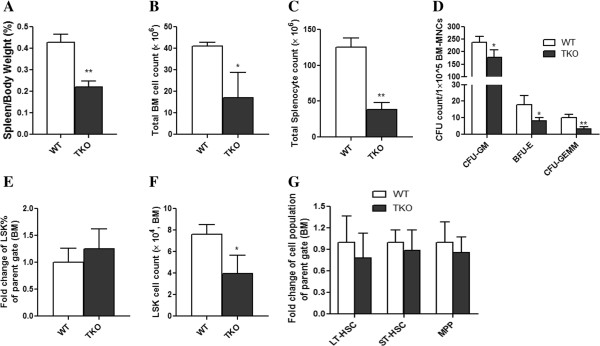
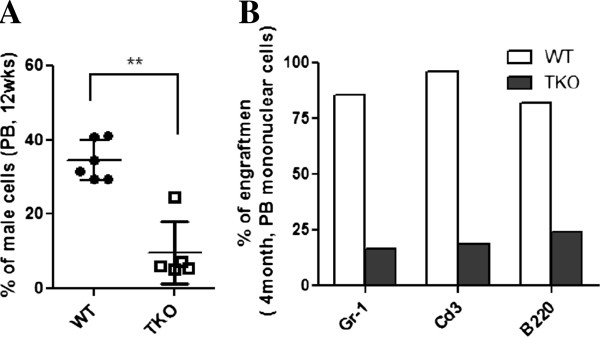
Compared to age-matched WT controls, Pim TKO mice had lower peripheral blood platelet count and exhibited erythrocyte hypochromic microcytosis. The bone marrow cells from Pim TKO mice demonstrated decreased hematopoietic progenitor colony-forming ability. Importantly, Pim TKO bone marrow cells had significantly impaired capacity in rescuing lethally irradiated mice and reconstituting hematopoiesis in primary, secondary and competitive transplant models. In vivo BrdU incorporation in long-term HSCs was reduced in Pim TKO mice. Finally, cultured HSCs from Pim TKO mice showed reduced proliferation evaluated by Ki67 staining and higher rate of apoptosis via caspase 3 activation.
Pim kinases are not only essential in the hematopoietic lineage cell development, but also important in HSC expansion, self-renewal, and long-term repopulation.
Pim(鼠淋巴瘤中的前病毒插入)激酶是一小族组成性激活的高度保守丝氨酸/苏氨酸致癌激酶,有 3 个成员:Pim1、Pim2 和 Pim3。Pim 激酶也参与了 B 和 T 细胞对细胞因子和造血生长因子的反应的调节。Pim 激酶在调节原始造血干细胞(HSCs)中的作用在很大程度上是未知的。
在目前的研究中,使用 Pim1-/-2-/-3-/-三重敲除(TKO)小鼠来确定 Pim 激酶在造血中的作用。测量 Pim TKO 小鼠和年龄匹配的野生型(WT)对照的外周血血液学参数。进行原发性、继发性和竞争性移植,以检测 Pim TKO 小鼠中的长期重编程 HSCs。进行体内 BrdU 掺入测定和体外 Ki67 染色和 caspase 3 标记,以评估 Pim TKO 小鼠中 HSCs 的增殖和凋亡。
与年龄匹配的 WT 对照相比,Pim TKO 小鼠的外周血血小板计数较低,并表现出红细胞低色素性微细胞。Pim TKO 小鼠的骨髓细胞造血祖细胞集落形成能力下降。重要的是,Pim TKO 骨髓细胞在挽救致死性照射小鼠和在原发性、继发性和竞争性移植模型中重建造血方面的能力显著受损。Pim TKO 小鼠的长期 HSCs 中的 BrdU 掺入减少。最后,通过 Ki67 染色评估,Pim TKO 小鼠的培养 HSCs 增殖减少,通过 caspase 3 激活,凋亡率更高。
Pim 激酶不仅在造血谱系细胞发育中是必不可少的,而且在 HSC 扩增、自我更新和长期重编程中也是重要的。