Division of Clinical Epidemiology and Aging Research, German Cancer Research Center, Heidelberg, Germany.
Diabetes Care. 2013 Jun;36(6):1703-11. doi: 10.2337/dc12-1416. Epub 2013 Feb 1.
Inflammatory processes contribute to both diabetes and cardiovascular risk. We wanted to investigate whether circulating concentrations of proinflammatory immune mediators and adiponectin in diabetic patients are associated with incident cardiovascular events.
In 1,038 participants with diabetes of the population-based ESTHER study, of whom 326 showed signs of renal dysfunction, Cox proportional hazards models were used to estimate hazard ratios (HRs) and 95% CIs for the association of increasing concentrations of C-reactive protein (CRP), interleukin-6 (IL-6), IL-18, macrophage migration inhibitory factor (MIF), adiponectin, and leptin with cardiovascular events (myocardial infarction, stroke, or fatal cardiovascular event) during a follow-up period of 8 years.
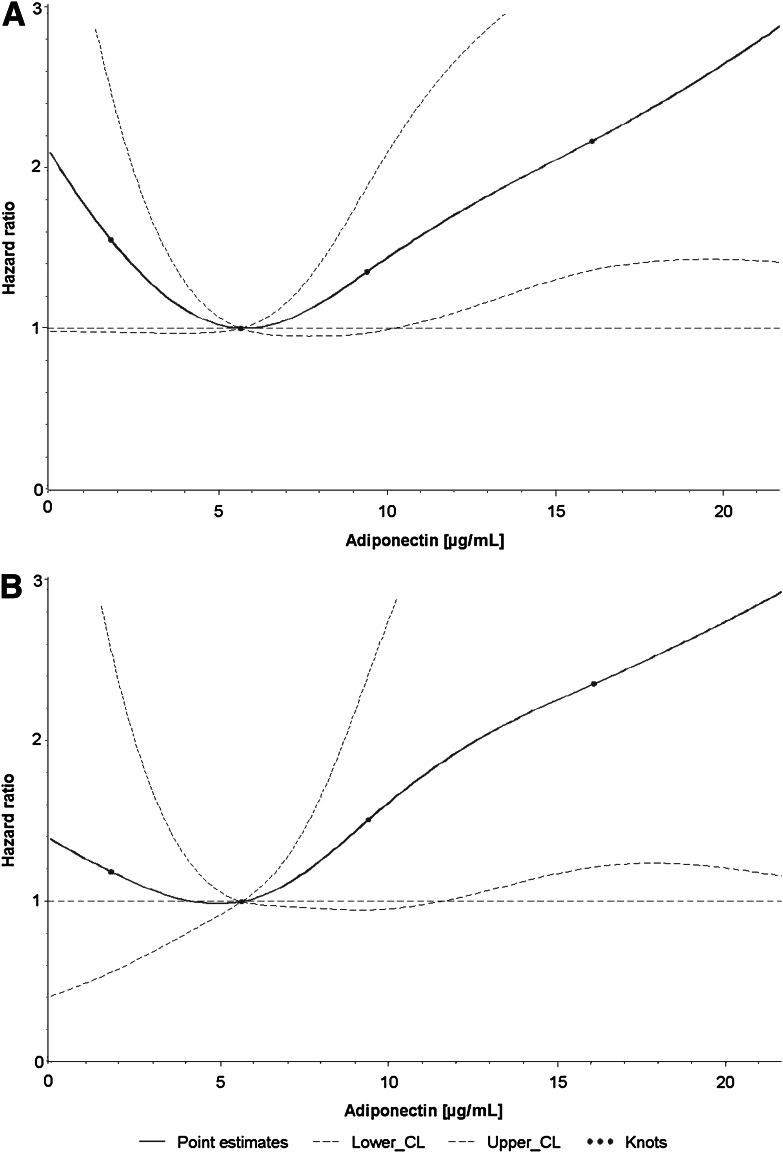
During follow-up, 161 subjects with diabetes experienced a primary cardiovascular event. Proinflammatory markers were not associated with a higher risk for primary cardiovascular events in the total study population after adjustment for multiple confounders. However, IL-6 and MIF were associated with cardiovascular events in subjects with renal dysfunction (HR for the comparison of top vs. bottom tertile 1.98 [95% CI 1.12-3.52], P [trend] = 0.10 for IL-6; 1.48 [0.87-2.51], P [trend] = 0.04 for MIF). Adiponectin levels were associated with cardiovascular events in the total population (1.48 [1.01-2.21], P [trend] = 0.03), and the association was even more pronounced in the subgroup with renal dysfunction (1.97 [1.08-3.57], P [trend] = 0.02).
In particular, the absence of an association between CRP and a U-shaped association of adiponectin levels with incident cardiovascular events show that associations between circulating immune mediators and cardiovascular risk differ between diabetic patients and subjects of the general population.
炎症过程既与糖尿病有关,也与心血管风险有关。我们想研究糖尿病患者循环中促炎免疫介质和脂联素的浓度是否与心血管事件的发生有关。
在基于人群的 ESTHER 研究的 1038 名糖尿病患者中,其中 326 名患者有肾功能障碍的迹象,我们使用 Cox 比例风险模型来估计 C 反应蛋白(CRP)、白细胞介素-6(IL-6)、白细胞介素-18(IL-18)、巨噬细胞移动抑制因子(MIF)、脂联素和瘦素浓度升高与心血管事件(心肌梗死、中风或致命心血管事件)之间的关联的风险比(HR)和 95%可信区间。在 8 年的随访期间。
在随访期间,161 名糖尿病患者发生了主要心血管事件。在调整了多种混杂因素后,在整个研究人群中,促炎标志物与主要心血管事件的发生风险之间没有相关性。然而,在肾功能障碍患者中,IL-6 和 MIF 与心血管事件相关(最高与最低三分位组的比较 HR 为 1.98[95%CI 1.12-3.52],P[趋势]=0.10 对于 IL-6;1.48[0.87-2.51],P[趋势]=0.04 对于 MIF)。脂联素水平与总人群中的心血管事件相关(1.48[1.01-2.21],P[趋势]=0.03),在肾功能障碍亚组中的相关性更为明显(1.97[1.08-3.57],P[趋势]=0.02)。
特别是 CRP 之间缺乏关联以及脂联素水平与心血管事件发生之间呈 U 形关联表明,循环免疫介质与心血管风险之间的关联在糖尿病患者和普通人群之间存在差异。