• 文献检索
  • 文档翻译
  • 深度研究
  • 学术资讯
  • Suppr Zotero 插件Zotero 插件
  • 邀请有礼
  • 套餐&价格
  • 历史记录
应用&插件
Suppr Zotero 插件Zotero 插件浏览器插件Mac 客户端Windows 客户端微信小程序
定价
高级版会员购买积分包购买API积分包
服务
文献检索文档翻译深度研究API 文档MCP 服务
关于我们
关于 Suppr公司介绍联系我们用户协议隐私条款
关注我们

Suppr 超能文献

核心技术专利:CN118964589B侵权必究
粤ICP备2023148730 号-1Suppr @ 2026

文献检索

告别复杂PubMed语法,用中文像聊天一样搜索,搜遍4000万医学文献。AI智能推荐,让科研检索更轻松。

立即免费搜索

文件翻译

保留排版,准确专业,支持PDF/Word/PPT等文件格式,支持 12+语言互译。

免费翻译文档

深度研究

AI帮你快速写综述,25分钟生成高质量综述,智能提取关键信息,辅助科研写作。

立即免费体验

胃癌患者肿瘤大小预后意义的分层分析。

Stage-stratified analysis of prognostic significance of tumor size in patients with gastric cancer.

机构信息

Department of Gastroenterologic Surgery, The Third Affiliated Hospital of Harbin Medical University, Harbin, 2) Department of General Surgery, Daqing Oilfield General Hospital, Daqing, Heilongjiang Province,China.

出版信息

PLoS One. 2013;8(1):e54502. doi: 10.1371/journal.pone.0054502. Epub 2013 Jan 30.

DOI:10.1371/journal.pone.0054502
PMID:23382906
原文链接:https://pmc.ncbi.nlm.nih.gov/articles/PMC3559879/
Abstract

BACKGROUND

The prognostic significance of tumor size in gastric cancer is not well defined. The objective of this study was to identify the prognostic value of tumor size in patients with gastric cancer.

METHODS

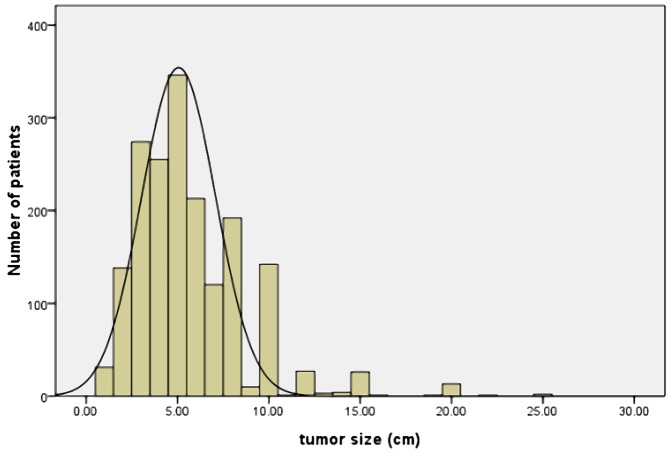
We retrospectively reviewed a total of 1800 patients with gastric cancer admitted to our hospital between 1997 and 2007. These patients were divided into two groups according to tumor size: small size group (SSG, tumor ≤5 cm) and large size group (LSG, tumor >5 cm). We compared clinico-pathologic features of the two groups and investigated the prognostic factors by performing univariate, multivariate, and stage- stratified analyses according to tumor size.

RESULTS

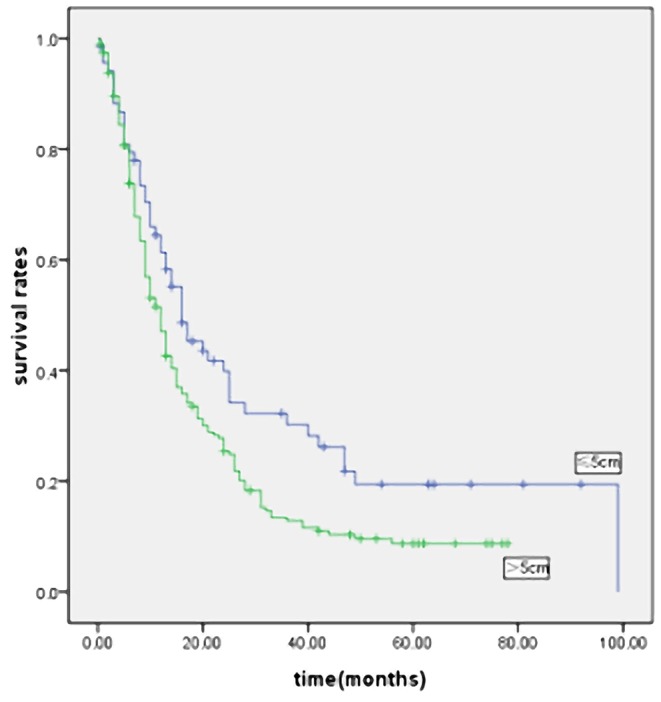
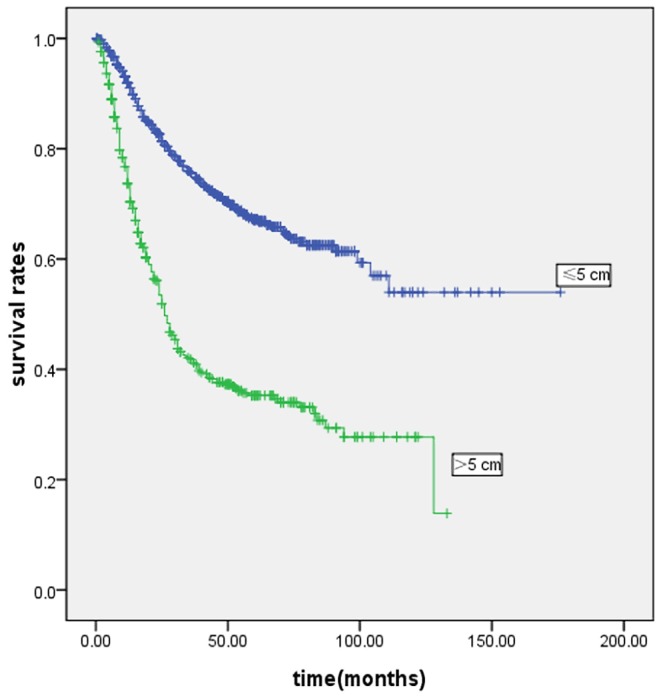
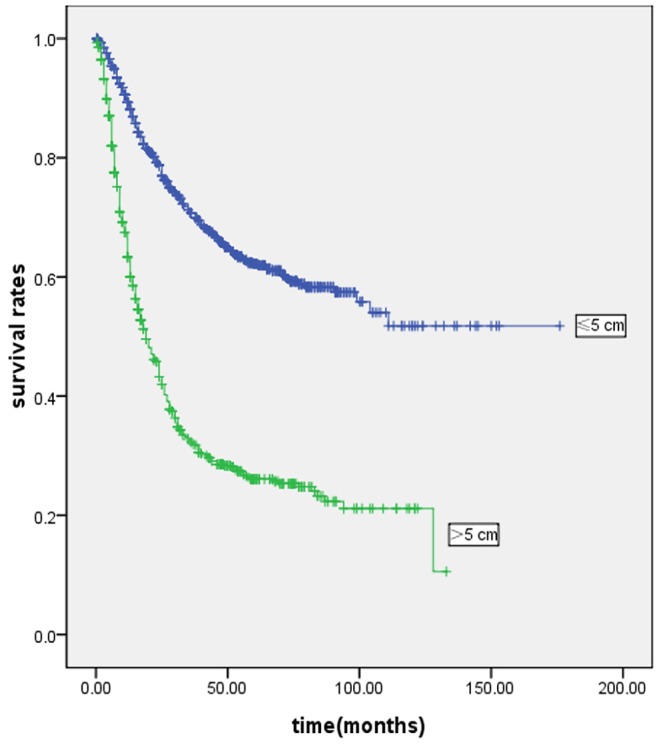
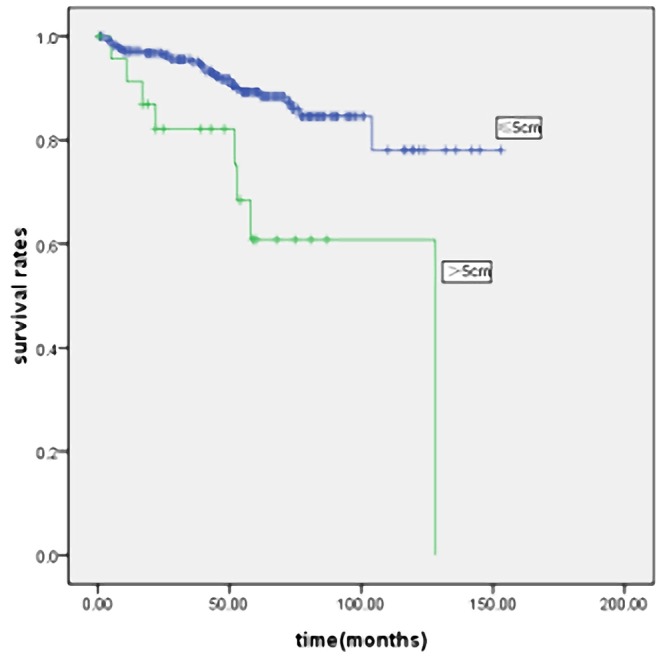
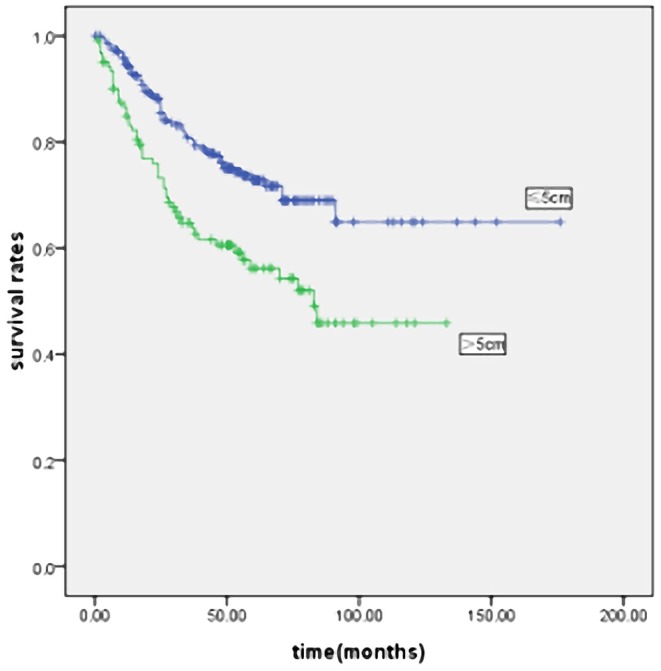
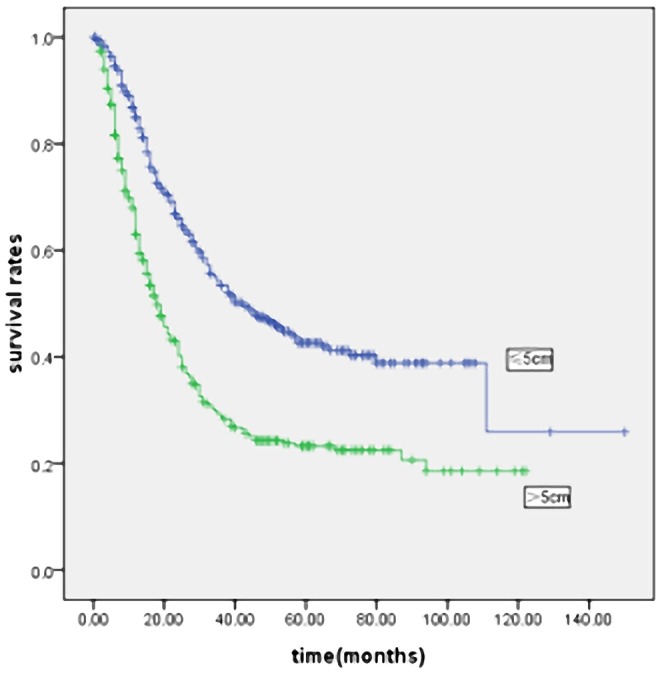
LSG had more aggressive clinico-pathologic features than SSG. Tumor size was an independent prognostic indicator in patients with gastric cancer. In a stratified-pT, pN, and pTNM analysis, survival of patients with LSG was significantly worse than that of patients with SSG and advanced stage. Tumor size was not a significant predictor of survival in patients with early stage tumors. Large tumor size was associated with shorter survival in patients with stages N0, N1, N2, and N3, and stages I, II, III, and IV.

CONCLUSIONS

Tumor size is a simple and practical prognostic factor in patients with gastric cancer. Tumor size could supplement clinical staging in the future.

摘要

背景

肿瘤大小在胃癌中的预后意义尚未明确。本研究旨在确定肿瘤大小对胃癌患者的预后价值。

方法

我们回顾性分析了 1997 年至 2007 年间我院收治的 1800 例胃癌患者。根据肿瘤大小将这些患者分为两组:小肿瘤组(SSG,肿瘤≤5cm)和大肿瘤组(LSG,肿瘤>5cm)。我们比较了两组的临床病理特征,并根据肿瘤大小进行单因素、多因素和分期分层分析,探讨预后因素。

结果

LSG 具有更具侵袭性的临床病理特征。肿瘤大小是胃癌患者的独立预后指标。在分层的 pT、pN 和 pTNM 分析中,LSG 患者的生存明显差于 SSG 患者和晚期患者。肿瘤大小不是早期肿瘤患者生存的显著预测因素。大肿瘤大小与 N0、N1、N2 和 N3 期以及 I、II、III 和 IV 期患者的较短生存期相关。

结论

肿瘤大小是胃癌患者的一个简单实用的预后因素。肿瘤大小未来可能会补充临床分期。
https://cdn.ncbi.nlm.nih.gov/pmc/blobs/7216/3559879/c1f8832a0747/pone.0054502.g007.jpg
https://cdn.ncbi.nlm.nih.gov/pmc/blobs/7216/3559879/4d4ec4559bcc/pone.0054502.g001.jpg
https://cdn.ncbi.nlm.nih.gov/pmc/blobs/7216/3559879/dbe00d5632ab/pone.0054502.g002.jpg
https://cdn.ncbi.nlm.nih.gov/pmc/blobs/7216/3559879/98fbc20a2ae7/pone.0054502.g003.jpg
https://cdn.ncbi.nlm.nih.gov/pmc/blobs/7216/3559879/9367dd2fa813/pone.0054502.g004.jpg
https://cdn.ncbi.nlm.nih.gov/pmc/blobs/7216/3559879/4da10384e954/pone.0054502.g005.jpg
https://cdn.ncbi.nlm.nih.gov/pmc/blobs/7216/3559879/99793c4ea7f3/pone.0054502.g006.jpg
https://cdn.ncbi.nlm.nih.gov/pmc/blobs/7216/3559879/c1f8832a0747/pone.0054502.g007.jpg
https://cdn.ncbi.nlm.nih.gov/pmc/blobs/7216/3559879/4d4ec4559bcc/pone.0054502.g001.jpg
https://cdn.ncbi.nlm.nih.gov/pmc/blobs/7216/3559879/dbe00d5632ab/pone.0054502.g002.jpg
https://cdn.ncbi.nlm.nih.gov/pmc/blobs/7216/3559879/98fbc20a2ae7/pone.0054502.g003.jpg
https://cdn.ncbi.nlm.nih.gov/pmc/blobs/7216/3559879/9367dd2fa813/pone.0054502.g004.jpg
https://cdn.ncbi.nlm.nih.gov/pmc/blobs/7216/3559879/4da10384e954/pone.0054502.g005.jpg
https://cdn.ncbi.nlm.nih.gov/pmc/blobs/7216/3559879/99793c4ea7f3/pone.0054502.g006.jpg
https://cdn.ncbi.nlm.nih.gov/pmc/blobs/7216/3559879/c1f8832a0747/pone.0054502.g007.jpg

相似文献

1
Stage-stratified analysis of prognostic significance of tumor size in patients with gastric cancer.胃癌患者肿瘤大小预后意义的分层分析。
PLoS One. 2013;8(1):e54502. doi: 10.1371/journal.pone.0054502. Epub 2013 Jan 30.
2
Macroscopic tumor size as a simple prognostic indicator in patients with gastric cancer.宏观肿瘤大小作为胃癌患者的一个简单预后指标。
Am J Surg. 2006 Sep;192(3):296-300. doi: 10.1016/j.amjsurg.2006.03.004.
3
[Clinical significance of prognostic nutritional index in patients with advanced gastric cancer].[预后营养指数在进展期胃癌患者中的临床意义]
Zhonghua Wei Chang Wai Ke Za Zhi. 2018 Feb 25;21(2):180-184.
4
Prognostic significance of tumor size in T3 gastric cancer.肿瘤大小在T3期胃癌中的预后意义
Ann Surg Oncol. 2009 Jul;16(7):1875-82. doi: 10.1245/s10434-009-0449-x. Epub 2009 Apr 17.
5
[The prognostic analysis of tumor size in T4a stage gastric cancer].[T4a期胃癌肿瘤大小的预后分析]
Zhonghua Wai Ke Za Zhi. 2013 Mar;51(3):230-4.
6
Tumor size as a prognostic factor in patients with advanced gastric cancer in the lower third of the stomach.胃下部进展期胃癌患者肿瘤大小作为预后因素。
World J Gastroenterol. 2012 Oct 14;18(38):5470-5. doi: 10.3748/wjg.v18.i38.5470.
7
Is tumor size a predictor of preoperative N staging in T2-T4a stage advanced gastric cancer?肿瘤大小是否为T2-T4a期进展期胃癌术前N分期的预测指标?
Surg Oncol. 2014 Mar;23(1):5-10. doi: 10.1016/j.suronc.2014.01.003. Epub 2014 Jan 27.
8
Impact of extranodal tumor deposits on prognosis and N stage in gastric cancer.胃外肿瘤沉积对胃癌预后和 N 分期的影响。
Surgery. 2019 Sep;166(3):305-313. doi: 10.1016/j.surg.2019.04.027. Epub 2019 Jun 18.
9
Clinico-pathological features and prognostic analysis of gastric cancer patients in different age groups.不同年龄组胃癌患者的临床病理特征及预后分析
Hepatogastroenterology. 2015 Jan-Feb;62(137):225-30.
10
The prognostic role of tumor size in patients with gastric cancer.肿瘤大小在胃癌患者中的预后作用。
Ann Ital Chir. 2017;88:478-484.

引用本文的文献

1
Establishment and evaluation of a prognostic model for patients with unresectable gastric cancer liver metastases.不可切除胃癌肝转移患者预后模型的建立与评估
World J Clin Cases. 2024 May 6;12(13):2182-2193. doi: 10.12998/wjcc.v12.i13.2182.
2
Development and validation of a nomogram to predict cancer-specific survival of elderly patients with unresected gastric cancer who received chemotherapy.开发和验证列线图预测未接受手术切除的接受化疗的老年胃癌患者的癌症特异性生存。
Sci Rep. 2024 Apr 19;14(1):9008. doi: 10.1038/s41598-024-59516-3.
3
Safety and feasibility of minimally invasive gastrectomy following preoperative chemotherapy for highly advanced gastric cancer.

本文引用的文献

1
Macroscopic tumor size as an independent prognostic factor for stage II/III gastric cancer patients who underwent D2 gastrectomy followed by adjuvant chemotherapy with S-1.对于接受 D2 胃切除术和 S-1 辅助化疗的 II/III 期胃癌患者,肿瘤宏观大小是独立的预后因素。
Gastric Cancer. 2011 Aug;14(3):274-8. doi: 10.1007/s10120-011-0038-0. Epub 2011 Apr 2.
2
Global cancer statistics.全球癌症统计数据。
CA Cancer J Clin. 2011 Mar-Apr;61(2):69-90. doi: 10.3322/caac.20107. Epub 2011 Feb 4.
3
Clinicopathologic characteristics and prognosis of mucinous gastric carcinoma.
术前化疗后高度进展期胃癌行微创胃切除术的安全性和可行性。
BMC Gastroenterol. 2024 Feb 15;24(1):74. doi: 10.1186/s12876-024-03155-5.
4
Comprehensive survival nomograms for locally advanced gastric cancer: a large population-based real-world study.局部晚期胃癌的综合生存列线图:一项基于大人群的真实世界研究。
Transl Cancer Res. 2023 Nov 30;12(11):2989-3006. doi: 10.21037/tcr-22-1255. Epub 2023 Nov 24.
5
IRAK2, an Immune and Radiation-Response Gene, Correlates with Advanced Disease Features but Predicts Higher Post-Irradiation Local Control in Non-Metastatic and Resected Oral Cancer Patients.IRAK2,一种免疫和辐射反应基因,与晚期疾病特征相关,但预测非转移性和切除的口腔癌患者放疗后局部控制率更高。
Int J Mol Sci. 2023 Apr 7;24(8):6903. doi: 10.3390/ijms24086903.
6
Characterization of the Prognostic Values of CXCL Family in Epstein-Barr Virus Associated Gastric Cancer.CXCL 家族在 Epstein-Barr 病毒相关胃癌中的预后价值特征。
Oxid Med Cell Longev. 2022 Jun 1;2022:2218140. doi: 10.1155/2022/2218140. eCollection 2022.
7
Preoperative Platelet-to-Lymphocyte Ratio (PLR) for Predicting the Survival of Stage I-III Gastric Cancer Patients with a MGC Component.术前血小板与淋巴细胞比值(PLR)预测具有 MGC 成分的 I-III 期胃癌患者的生存。
Biomed Res Int. 2021 May 3;2021:9678363. doi: 10.1155/2021/9678363. eCollection 2021.
8
Investigating the association between rs6983267 polymorphism and susceptibility to gastrointestinal cancers in Iranian population.研究 rs6983267 多态性与伊朗人群胃肠道癌症易感性的关系。
Mol Biol Rep. 2021 Mar;48(3):2273-2284. doi: 10.1007/s11033-021-06249-5. Epub 2021 Mar 13.
9
The Predictive and Prognostic Factors in Patients with Gastric Cancer Accompanied by Gastric Outlet Obstruction.伴有胃出口梗阻的胃癌患者的预测和预后因素
Gastroenterol Res Pract. 2020 Jul 25;2020:6529563. doi: 10.1155/2020/6529563. eCollection 2020.
10
FLOT Neoadjuvant Chemotherapy Followed by Laparoscopic D2 Gastrectomy in the Treatment of Locally Resectable Advanced Gastric Cancer.FLOT 新辅助化疗联合腹腔镜 D2 胃切除术治疗局部可切除的进展期胃癌。
Can J Gastroenterol Hepatol. 2020 May 29;2020:1702823. doi: 10.1155/2020/1702823. eCollection 2020.
黏液型胃癌的临床病理特征与预后
J Surg Oncol. 2010 Jul 1;102(1):64-7. doi: 10.1002/jso.21533.
4
Prognostic indicators in node-negative advanced gastric cancer patients.淋巴结阴性的晚期胃癌患者的预后指标。
J Surg Oncol. 2010 Jun 1;101(7):622-5. doi: 10.1002/jso.21562.
5
Prognostic significance of tumor size in T3 gastric cancer.肿瘤大小在T3期胃癌中的预后意义
Ann Surg Oncol. 2009 Jul;16(7):1875-82. doi: 10.1245/s10434-009-0449-x. Epub 2009 Apr 17.
6
Risk factors of survival and surgical treatment for advanced gastric cancer with large tumor size.肿瘤体积较大的进展期胃癌生存及手术治疗的危险因素
J Gastrointest Surg. 2009 May;13(5):881-5. doi: 10.1007/s11605-009-0800-3. Epub 2009 Jan 31.
7
Cancer statistics, 2008.2008年癌症统计数据。
CA Cancer J Clin. 2008 Mar-Apr;58(2):71-96. doi: 10.3322/CA.2007.0010. Epub 2008 Feb 20.
8
Tumor size: a non-neglectable independent prognostic factor for gastric cancer.肿瘤大小:胃癌不可忽视的独立预后因素。
J Surg Oncol. 2008 Mar 1;97(3):236-40. doi: 10.1002/jso.20951.
9
Predictors of long-term survival in node-positive gastric carcinoma patients with curative resection.根治性切除的淋巴结阳性胃癌患者长期生存的预测因素。
Langenbecks Arch Surg. 2007 Mar;392(2):131-4. doi: 10.1007/s00423-006-0114-9. Epub 2006 Nov 7.
10
Macroscopic tumor size as a simple prognostic indicator in patients with gastric cancer.宏观肿瘤大小作为胃癌患者的一个简单预后指标。
Am J Surg. 2006 Sep;192(3):296-300. doi: 10.1016/j.amjsurg.2006.03.004.