Institute of Behavioral Sciences, University of Helsinki, Helsinki, Finland.
PLoS One. 2013;8(1):e54707. doi: 10.1371/journal.pone.0054707. Epub 2013 Jan 30.
To examine whether the adverse effects of slow prenatal and postnatal growth on cognitive function persist to old age and predict age related cognitive decline.
A longitudinal birth cohort study of men born in Helsinki, Finland 1934-44.
Nine-hundred-thirty-one men of the Helsinki Birth Cohort Study, with detailed data on growth from birth to adulthood, aged 20.1 (SD = 1.4) at the first and 67.9 (SD = 2.5) years at the second cognitive testing.
The Finnish Defense Forces Basic Intellectual Ability Test assessed twice over nearly five decades apart.
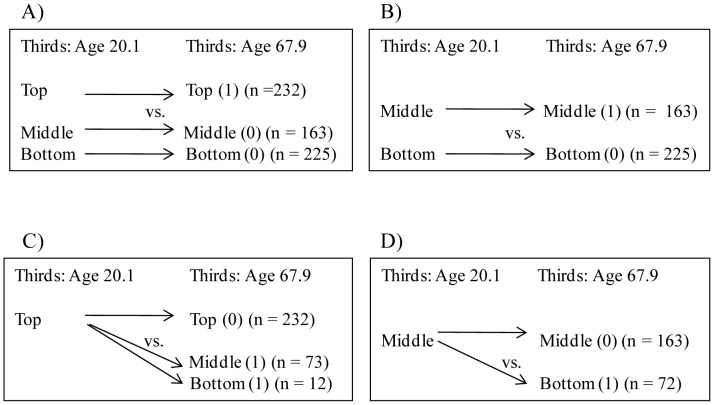
Lower weight, length and head circumference at birth were associated with lower cognitive ability at 67.9 years (1.04-1.55 points lower ability per each standard deviation [SD] unit decrease in body size, 95% Confidence Interval [95%CI]: 0.05 to 2.72) and with cognitive decline after 20.1 years (0.07-0.11 SD decline over time per each SD decrease in body size, 95%CI:0.00 to 0.19). Men who were born larger were more likely to perform better in the cognitive ability test over time (1.22-1.43 increase in odds to remain in the top relative to the lower two thirds in ability over time per each SD increase in body size, 95%CI:1.04 to 1.79) and were more resilient to cognitive decline after 20.1 years (0.69 to 0.76 decrease in odds to decline from than remain in the top third of ability over time per each SD increase in body size, 95%CI:0.49 to 0.99). Slower growth between birth and two years in weight, height and body mass index was associated with lower cognitive ability at 67.9 years, but not with cognitive decline.
Poorer lifetime cognitive ability is predicted by slower growth before and after birth. In predicting resilience to age related cognitive decline, the period before birth seems to be more critical.
探讨胎儿期和出生后生长缓慢对认知功能的不良影响是否持续到老年,并预测与年龄相关的认知能力下降。
一项对芬兰赫尔辛基出生于 1934-44 年的男性进行的纵向出生队列研究。
931 名赫尔辛基出生队列研究的男性,他们在出生至成年期间的生长数据详细,第一次认知测试时年龄为 20.1(SD=1.4),第二次为 67.9(SD=2.5)。
芬兰国防军基本智力能力测试,近五十年间测试两次。
出生时体重、身高和头围较低与 67.9 岁时的认知能力较低相关(每标准偏差单位的身体尺寸减少 1.04-1.55 分,95%置信区间[95%CI]:0.05 至 2.72),与 20.1 年后的认知衰退相关(每标准偏差单位的身体尺寸减少 0.07-0.11 分,95%CI:0.00 至 0.19)。出生时较大的男性在认知能力测试中随着时间的推移更有可能表现更好(每标准偏差单位的身体尺寸增加 1.22-1.43 分,95%CI:1.04 至 1.79),并且在 20.1 年后的认知衰退后更具弹性(每标准偏差单位的身体尺寸增加 0.69-0.76 分,95%CI:0.49 至 0.99),认知能力下降的可能性降低。出生后两年内体重、身高和体重指数的生长较慢与 67.9 岁时的认知能力较低相关,但与认知能力下降无关。
出生前和出生后生长缓慢预测终生认知能力较差。在预测与年龄相关的认知能力下降的弹性方面,出生前的时期似乎更为关键。