Department of Psychology, University of Sheffield, Western Bank, Sheffield S10 2TP, UK.
BMC Public Health. 2013 Feb 5;13:107. doi: 10.1186/1471-2458-13-107.
Too few young people engage in behaviors that reduce the risk of morbidity and premature mortality, such as eating healthily, being physically active, drinking sensibly and not smoking. The present research developed an online intervention to target these health behaviors during the significant life transition from school to university when health beliefs and behaviors may be more open to change. This paper describes the intervention and the proposed approach to its evaluation.
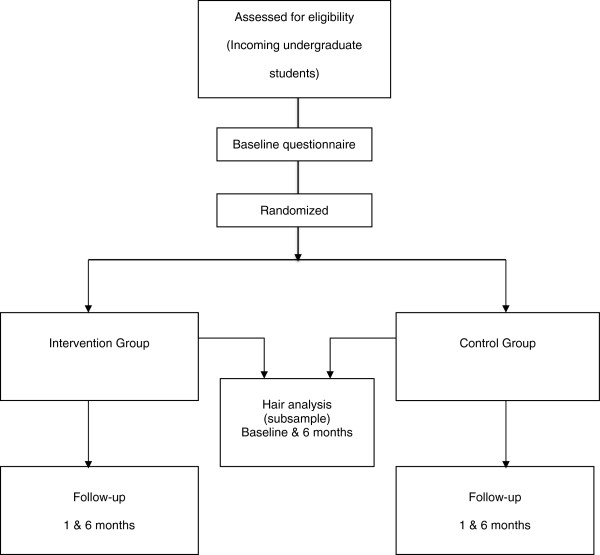
METHODS/DESIGN: Potential participants (all undergraduates about to enter the University of Sheffield) will be emailed an online questionnaire two weeks before starting university. On completion of the questionnaire, respondents will be randomly assigned to receive either an online health behavior intervention (U@Uni) or a control condition. The intervention employs three behavior change techniques (self-affirmation, theory-based messages, and implementation intentions) to target four heath behaviors (alcohol consumption, physical activity, fruit and vegetable intake, and smoking). Subsequently, all participants will be emailed follow-up questionnaires approximately one and six months after starting university. The questionnaires will assess the four targeted behaviors and associated cognitions (e.g., intentions, self-efficacy) as well as socio-demographic variables, health status, Body Mass Index (BMI), health service use and recreational drug use. A sub-sample of participants will provide a sample of hair to assess changes in biochemical markers of health behavior. A health economic evaluation of the cost effectiveness of the intervention will also be conducted.
The findings will provide evidence on the effectiveness of online interventions as well as the potential for intervening during significant life transitions, such as the move from school to university. If successful, the intervention could be employed at other universities to promote healthy behaviors among new undergraduates.
Current Controlled Trials, ISRCTN67684181.
很少有年轻人会采取健康行为,如健康饮食、积极运动、适度饮酒和不吸烟,从而降低患病和过早死亡的风险。本研究开发了一种在线干预措施,旨在针对从学校到大学这一重要人生过渡期的健康行为,因为在此期间健康信念和行为可能更容易改变。本文介绍了干预措施以及对其进行评估的方法。
方法/设计:即将进入谢菲尔德大学的所有本科生将在入学前两周通过电子邮件收到一份在线问卷。完成问卷后,参与者将被随机分配到接受在线健康行为干预(U@Uni)或对照组。该干预措施运用了三种行为改变技术(自我肯定、基于理论的信息和实施意图)来针对四种健康行为(饮酒、身体活动、水果和蔬菜摄入以及吸烟)。随后,所有参与者将在入学后大约一个月和六个月后通过电子邮件收到后续问卷。问卷将评估四个目标行为及其相关认知(例如,意图、自我效能)以及社会人口统计学变量、健康状况、体重指数(BMI)、卫生服务使用情况和娱乐性药物使用情况。一部分参与者将提供头发样本,以评估健康行为的生化标志物变化。还将对干预措施的成本效益进行健康经济学评估。
研究结果将提供有关在线干预措施有效性的证据,以及在重要生活过渡期间(如从学校到大学的过渡)进行干预的潜力。如果成功,该干预措施可在其他大学中用于促进新生的健康行为。
当前对照试验,ISRCTN67684181。