School of Life Sciences, Kingston University, UK.
Subst Abuse Treat Prev Policy. 2011 Aug 3;6:20. doi: 10.1186/1747-597X-6-20.
An advantage of randomised response and non-randomised models investigating sensitive issues arises from the characteristic that individual answers about discriminating behaviour cannot be linked to the individuals. This study proposed a new fuzzy response model coined 'Single Sample Count' (SSC) to estimate prevalence of discriminating or embarrassing behaviour in epidemiologic studies.
The SSC was tested and compared to the established Forced Response (FR) model estimating Mephedrone use. Estimations from both SSC and FR were then corroborated with qualitative hair screening data. Volunteers (n = 318, mean age = 22.69 ± 5.87, 59.1% male) in a rural area in north Wales and a metropolitan area in England completed a questionnaire containing the SSC and FR in alternating order, and four questions canvassing opinions and beliefs regarding Mephedrone. Hair samples were screened for Mephedrone using a qualitative Liquid Chromatography-Mass Spectrometry method.
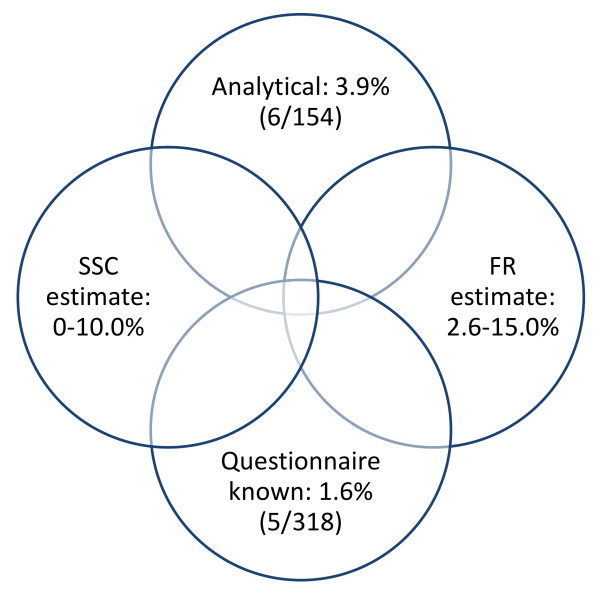
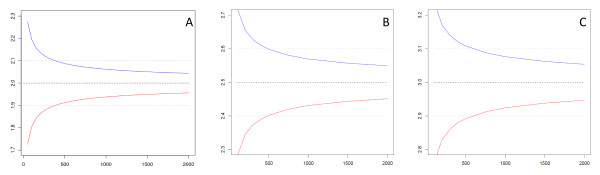
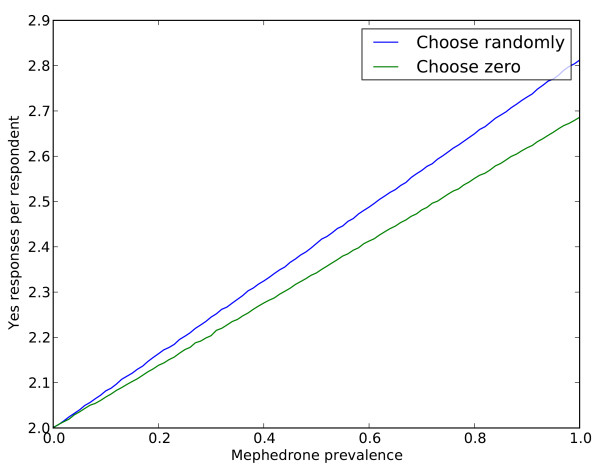
The SSC algorithm improves upon the existing item count techniques by utilizing known population distributions and embeds the sensitive question among four unrelated innocuous questions with binomial distribution. Respondents are only asked to indicate how many without revealing which ones are true. The two probability models yielded similar estimates with the FR being between 2.6% - 15.0%; whereas the new SSC ranged between 0% - 10%. The six positive hair samples indicated that the prevalence rate in the sample was at least 4%. The close proximity of these estimates provides evidence to support the validity of the new SSC model. Using simulations, the recommended sample sizes as the function of the statistical power and expected prevalence rate were calculated.
The main advantages of the SSC over other indirect methods are: simple administration, completion and calculation, maximum use of the data and good face validity for all respondents. Owing to the key feature that respondents are not required to answer the sensitive question directly, coupled with the absence of forced response or obvious self-protective response strategy, the SSC has the potential to cut across self-protective barriers more effectively than other estimation models. This elegantly simple, quick and effective method can be successfully employed in public health research investigating compromising behaviours.
随机响应和非随机模型在调查敏感问题方面具有优势,因为个体关于歧视行为的回答特征不能与个体相关联。本研究提出了一种新的模糊响应模型,称为“单样本计数”(SSC),用于估计流行病学研究中歧视或尴尬行为的流行率。
测试了 SSC 并将其与估计美普他酚使用的既定强制响应(FR)模型进行了比较。然后,使用定性头发筛查数据对 SSC 和 FR 的估计值进行了证实。北威尔士农村地区和英格兰大都市地区的志愿者(n = 318,平均年龄 22.69 ± 5.87,59.1%男性)完成了一份包含 SSC 和 FR 的交替问卷,并附有四个关于美普他酚的意见和信仰问题。使用定性液相色谱-质谱法对头发样本进行美普他酚筛查。
SSC 算法通过利用已知的人口分布并将敏感问题嵌入到四个无关的无害问题中(采用二项式分布),改进了现有的项目计数技术。被调查者只需说明有多少个,而无需透露哪些是真实的。这两个概率模型产生了相似的估计值,FR 介于 2.6%至 15.0%之间;而新的 SSC 则在 0%至 10%之间。六个阳性头发样本表明,样本中的流行率至少为 4%。这些估计值的接近程度提供了支持新 SSC 模型有效性的证据。使用模拟,计算了作为统计功效和预期流行率函数的推荐样本量。
SSC 相对于其他间接方法的主要优势在于:管理、完成和计算简单,最大限度地利用数据,对所有受访者具有良好的表面有效性。由于被调查者无需直接回答敏感问题的关键特征,再加上没有强制响应或明显的自我保护响应策略,SSC 比其他估计模型更有效地突破自我保护障碍。这种简单、快速、有效的方法可以成功地应用于调查妥协行为的公共卫生研究。