Graduate School of Life Sciences, Ritsumeikan University, Shiga 525-8577, Japan.
Sci Rep. 2013;3:1217. doi: 10.1038/srep01217. Epub 2013 Feb 5.
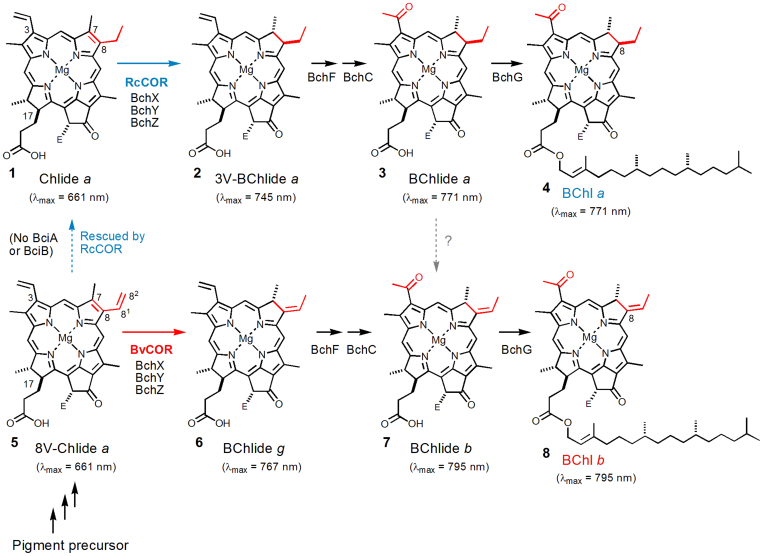
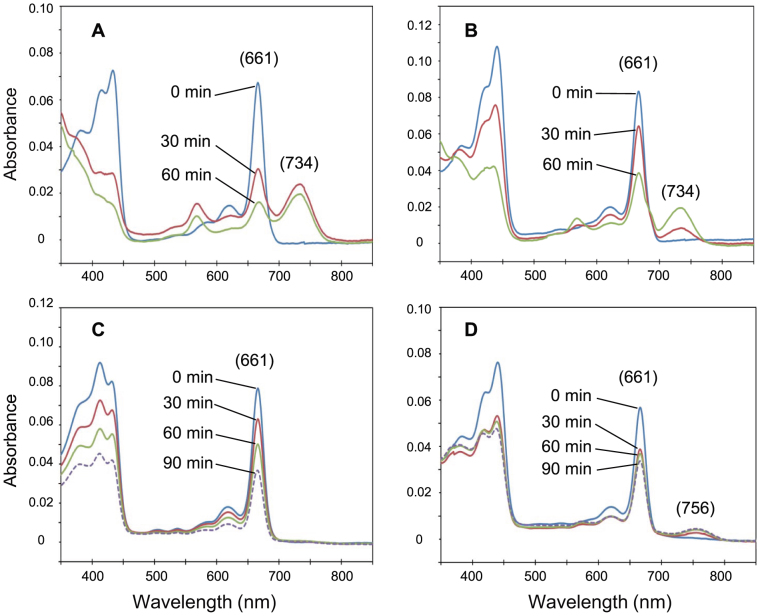
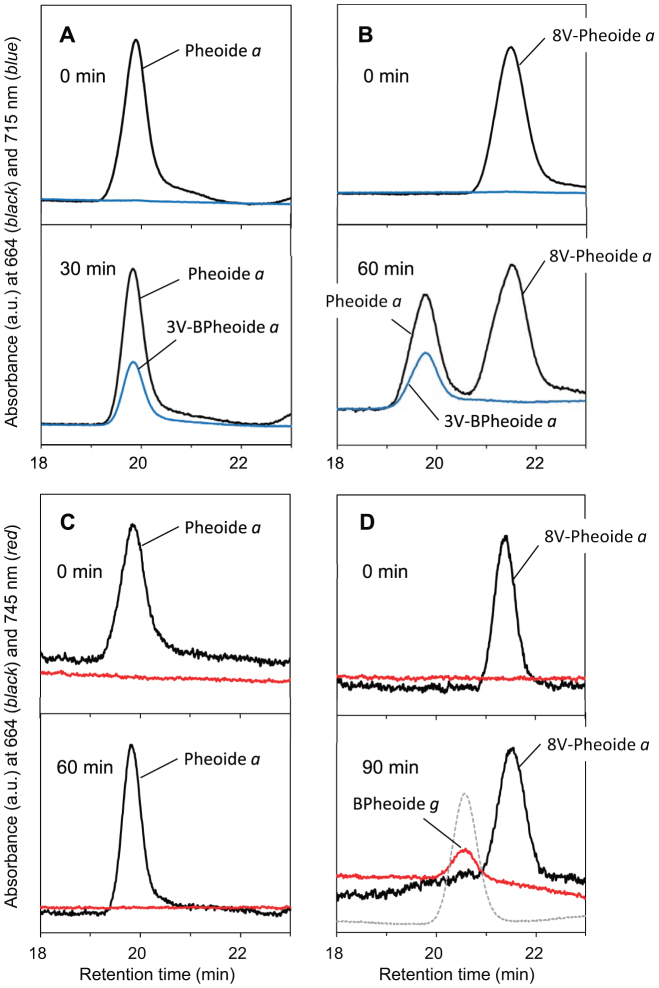
Chlorophyllous pigments are essential for photosynthesis. Bacteriochlorophyll (BChl) b has the characteristic C8-ethylidene group and therefore is the sole naturally occurring pigment having an absorption maximum at near-infrared light wavelength. Here we report that chlorophyllide a oxidoreductase (COR), a nitrogenase-like enzyme, showed distinct substrate recognition and catalytic reaction between BChl a- and b-producing proteobacteria. COR from BChl b-producing Blastochloris viridis synthesized the C8-ethylidene group from 8-vinyl-chlorophyllide a. In contrast, despite the highly conserved primary structures, COR from BChl a-producing Rhodobacter capsulatus catalyzes the C8-vinyl reduction as well as the previously known reaction of the C7 = C8 double bond reduction on 8-vinyl-chlorophyllide a. The present data indicate that the plasticity of the nitrogenase-like enzyme caused the branched pathways of BChls a and b biosynthesis, ultimately leading to ecologically different niches of BChl a- and b-based photosynthesis differentiated by more than 150 nm wavelength.
叶绿素是光合作用必不可少的。细菌叶绿素(BChl)b 具有特征性的 C8-亚乙基基团,因此是唯一具有近红外光波长吸收最大值的天然存在的色素。在这里,我们报告说,叶绿素 a 氧化还原酶(COR),一种氮酶样酶,在产 BChl a 和 b 的变形菌之间表现出明显的底物识别和催化反应。来自产 BChl b 的 Blastochloris viridis 的 COR 从 8-乙烯基叶绿素 a 合成 C8-亚乙基基团。相比之下,尽管具有高度保守的一级结构,但来自产 BChl a 的 Rhodobacter capsulatus 的 COR 不仅催化 C7 = C8 双键的 C8-乙烯基还原,还催化以前已知的 8-乙烯基叶绿素 a 的 C7 = C8 双键还原反应。目前的数据表明,氮酶样酶的可塑性导致了 BChl a 和 b 生物合成的分支途径,最终导致基于 BChl a 和 b 的光合作用在生态上的不同,其波长差异超过 150nm。