Meyer T, Stryer L
Department of Cell Biology, Stanford University School of Medicine, CA 94305.
Proc Natl Acad Sci U S A. 1990 May;87(10):3841-5. doi: 10.1073/pnas.87.10.3841.
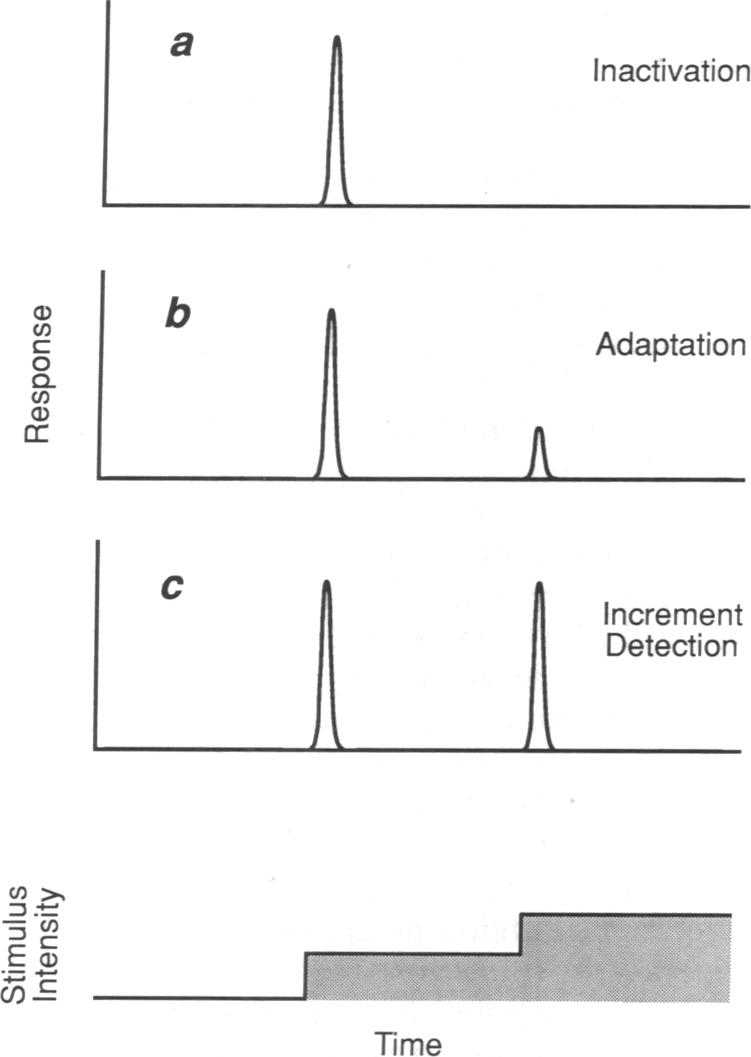
Many hormonal, neurotransmitter, and sensory stimuli trigger the formation of inositol 1,4,5-trisphosphate, which in turn releases calcium from intracellular stores. We report here that inositol 1,4,5-trisphosphate-induced calcium release from saponin-permeabilized rat basophilic leukemia cells at 37 degrees C is markedly biphasic, in contrast with nearly monophasic release kinetics at 11 degrees C. Hepatoma, PC-12 neuronal cells, and several other cell types exhibit similar biphasic release at 37 degrees C. The biphasic kinetics are not due to degradation of inositol 1,4,5-trisphosphate or to increased Ca2(+)-ATPase pump activity. Biphasic calcium release was also seen when ATP was quenched to less than 0.4 microM by adding hexokinase and glucose, suggesting that phosphorylation is not involved. External calcium (100 nM-600 nM) range had little influence on the biphasic kinetics. Rapid-mixing experiments revealed that rapid efflux of calcium is followed in approximately 0.5 s by a 30-fold slower efflux. Most striking, successive additions of the same amount of inositol 1,4,5-trisphosphate induced short bursts of calcium release of similar size. This retention of responsiveness, which we term increment detection, may be a distinct mode of signal transduction. Like inactivation and adaptation, increment detection gives rise to transient responses to sustained stimuli. Systems exhibiting inactivation, adaptation, and increment detection differ in their responsiveness (none, partial, and full, respectively) to stepwise increases in stimulus intensity. Increment detection could be advantageous in generating receptor-triggered calcium oscillations.
许多激素、神经递质和感觉刺激都会触发肌醇1,4,5 -三磷酸的形成,进而从细胞内储存库中释放钙。我们在此报告,在37℃下,肌醇1,4,5 -三磷酸诱导皂素通透的大鼠嗜碱性白血病细胞释放钙的过程明显呈双相性,这与在11℃时几乎呈单相的释放动力学形成对比。肝癌细胞、PC - 12神经细胞以及其他几种细胞类型在37℃时也表现出类似的双相释放。这种双相动力学并非由于肌醇1,4,5 -三磷酸的降解或Ca2(+) - ATP酶泵活性的增加。当通过添加己糖激酶和葡萄糖将ATP淬灭至低于0.4微摩尔时,也观察到了双相钙释放,这表明磷酸化不参与其中。外部钙(100纳摩尔 - 600纳摩尔)范围对双相动力学影响很小。快速混合实验表明,钙的快速外流之后大约0.5秒会出现速度慢30倍的外流。最引人注目的是,连续添加相同量的肌醇1,4,5 -三磷酸会诱导大小相似的钙释放短脉冲。这种反应性的保留,我们称之为增量检测,可能是一种独特的信号转导模式。与失活和适应一样,增量检测会对持续刺激产生瞬时反应。表现出失活、适应和增量检测的系统对刺激强度的逐步增加的反应性(分别为无、部分和完全)有所不同。增量检测在产生受体触发的钙振荡方面可能具有优势。