Department of Pharmacology, University of Cambridge, Tennis Court Road, Cambridge CB2 1PD, UK.
Drug Discovery and Medicinal Chemistry, Department of Pharmacology, University of Oxford, Mansfield Road, Oxford OX1 3QT, UK.
Cell Rep. 2021 Nov 2;37(5):109932. doi: 10.1016/j.celrep.2021.109932.
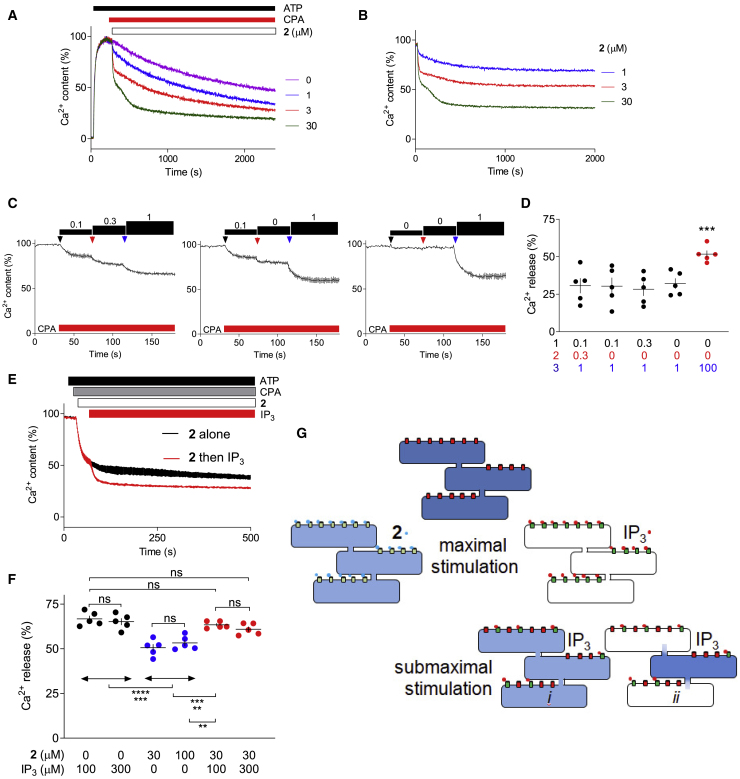
Inositol 1,4,5-trisphosphate receptors (IPRs) are intracellular Ca channels that link extracellular stimuli to Ca signals. Ca release from intracellular stores is "quantal": low IP concentrations rapidly release a fraction of the stores. Ca release then slows or terminates without compromising responses to further IP additions. The mechanisms are unresolved. Here, we synthesize a high-affinity partial agonist of IPRs and use it to demonstrate that quantal responses do not require heterogenous Ca stores. IPRs respond incrementally to IP and close after the initial response to low IP concentrations. Comparing functional responses with IP binding shows that only a tiny fraction of a cell's IPRs mediate incremental Ca release; inactivation does not therefore affect most IPRs. We conclude, and test by simulations, that Ca signals evoked by IP pulses arise from rapid activation and then inactivation of very few IPRs. This allows IPRs to behave as increment detectors mediating graded Ca release.
肌醇 1,4,5-三磷酸受体 (IPRs) 是一种细胞内 Ca 通道,它将细胞外刺激与 Ca 信号联系起来。细胞内储存的 Ca 释放是“量子化”的:低浓度的 IP 迅速释放一部分储存的 Ca。然后,Ca 释放会减缓或终止,而不会影响对进一步 IP 添加的反应。这些机制尚未得到解决。在这里,我们合成了 IPR 的高亲和力部分激动剂,并使用它来证明量子化反应不需要异质 Ca 储存。IPRs 对 IP 呈递增反应,并在低 IP 浓度的初始反应后关闭。将功能反应与 IP 结合进行比较表明,细胞中只有一小部分 IPR 介导递增的 Ca 释放;因此,失活不会影响大多数 IPR。我们的结论是,通过模拟测试,由 IP 脉冲引起的 Ca 信号来自极少数 IPR 的快速激活和随后失活。这使得 IPR 能够作为介导分级 Ca 释放的增量探测器。