Department of Neurosurgery, National Institute of Mental Health & Neuro Sciences, Bangalore, India.
Indian J Med Res. 2012 Dec;136(6):1039-43.
BACKGROUND & OBJECTIVES: Pedestrians contribute to 30-40 per cent of all road traffic injuries in India. However, there is a paucity of literature on pedestrian head injury as compared to two wheeler trauma. The purpose of the present study was to study the pattern of pedestrian injuries and their outcome with a special focus on head injuries.
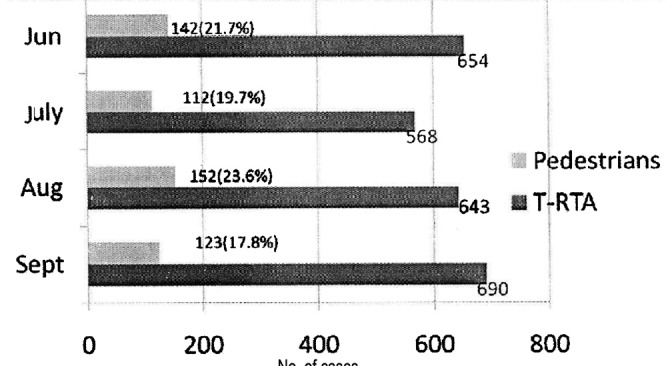
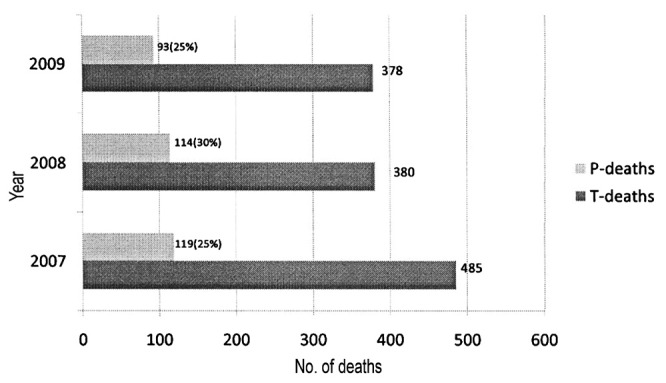
The study was conducted in two parts in the Trauma Center at National Institute of Mental Health & Neuro Sciences, Bangalore. A retrospective study was conducted at the casualty services of the hospital in which 529 consecutive pedestrians who sustained injury in a road traffic accident were studied from June to September 2009. In the second part, records from the hospital mortuary were retrospectively analyzed from 2007 to 2009. An analysis of 326 patients who died as a pedestrian in road accidents during this period was performed.
Patients in both paediatric and elderly age groups constituted 47.6 per cent (252/529) of all casualty admissions. Majority of the pedestrian injuries (41.7%, 221/529) occurred between 1600 - 2100 h; 87.1 per cent of all patients received some primary care before admission. The most common offending vehicle was a two wheeler (49.1%, 260/529). At the time of admission, 55.2 per cent (292/529) patients had sustained a moderate or severe head injury (GCS 3-13), and 40.5 per cent (214/529) had an abnormal CT scan. In addition, 90.4 per cent (478/529) patients had also sustained associated injuries. Major thoracoabdominal trauma was seen in 4 per cent and spine injury in 2.3 per cent of the patients. The mortality rate was 6.6 per cent. In the postmortem group, pedestrian deaths constituted 26.2 per cent of all the postmortems conducted. Two wheelers were the offending vehicle in the majority of the fatal crashes (39.9%).
INTERPRETATION & CONCLUSIONS: Pedestrian injuries form a major part of the workload of a neurotrauma emergency. Majority of them sustained moderate to severe head injury. More attention, infrastructure and strict implementation of rules may help reduce this burden.
在印度,行人造成的道路交通伤害约占 30-40%。然而,与两轮车创伤相比,行人头部损伤的文献相对较少。本研究的目的是研究行人损伤的模式及其结果,特别关注头部损伤。
本研究在班加罗尔国家心理健康与神经科学研究所的创伤中心分两部分进行。在医院的急救部门进行了一项回顾性研究,其中研究了 2009 年 6 月至 9 月期间在道路交通事故中受伤的 529 例连续行人。在第二部分,对 2007 年至 2009 年医院太平间的记录进行了回顾性分析。对这期间因行人在道路交通事故中死亡的 326 例患者进行了分析。
儿科和老年患者在所有患者中占 47.6%(252/529)。大多数行人损伤(41.7%,221/529)发生在 1600-2100 小时之间;87.1%的患者在入院前接受了一些初级护理。最常见的肇事车辆是两轮车(49.1%,260/529)。入院时,55.2%(292/529)的患者有中度或重度头部损伤(GCS 3-13),40.5%(214/529)的患者 CT 扫描异常。此外,90.4%(478/529)的患者还伴有其他损伤。主要的胸腹外伤发生率为 4%,脊柱损伤发生率为 2.3%。死亡率为 6.6%。在尸检组中,行人死亡占所有尸检的 26.2%。在大多数致命事故中,两轮车是肇事车辆(39.9%)。
行人损伤是神经创伤急诊的主要工作内容之一。他们大多患有中度至重度头部损伤。更多的关注、基础设施和严格执行规则可能有助于减轻这一负担。