School of Computer Science and Software Engineering, University of Western Australia, Stirling Highway, Crawley, Western Australia 6009, Australia.
BMC Infect Dis. 2013 Feb 11;13:81. doi: 10.1186/1471-2334-13-81.
A critical issue in planning pandemic influenza mitigation strategies is the delay between the arrival of the pandemic in a community and the availability of an effective vaccine. The likely scenario, born out in the 2009 pandemic, is that a newly emerged influenza pandemic will have spread to most parts of the world before a vaccine matched to the pandemic strain is produced. For a severe pandemic, additional rapidly activated intervention measures will be required if high mortality rates are to be avoided.
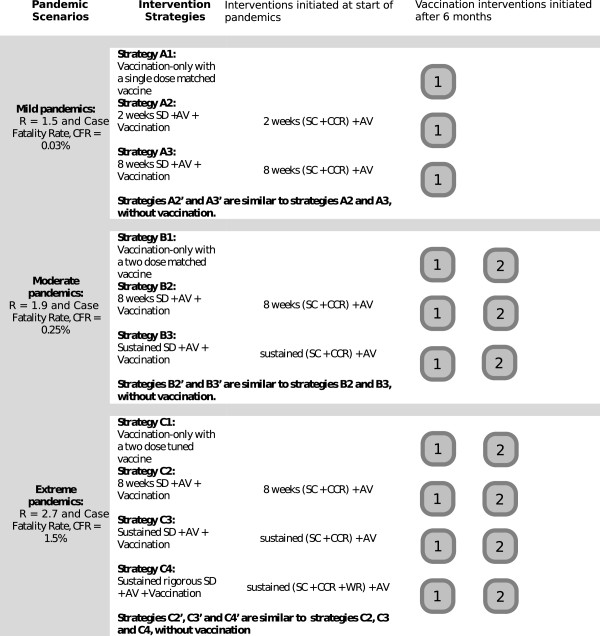
A simulation modelling study was conducted to examine the effectiveness and cost effectiveness of plausible combinations of social distancing, antiviral and vaccination interventions, assuming a delay of 6-months between arrival of an influenza pandemic and first availability of a vaccine. Three different pandemic scenarios were examined; mild, moderate and extreme, based on estimates of transmissibility and pathogenicity of the 2009, 1957 and 1918 influenza pandemics respectively. A range of different durations of social distancing were examined, and the sensitivity of the results to variation in the vaccination delay, ranging from 2 to 6 months, was analysed.
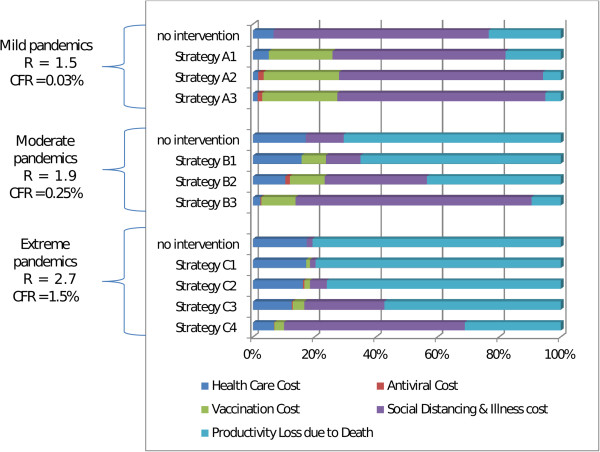
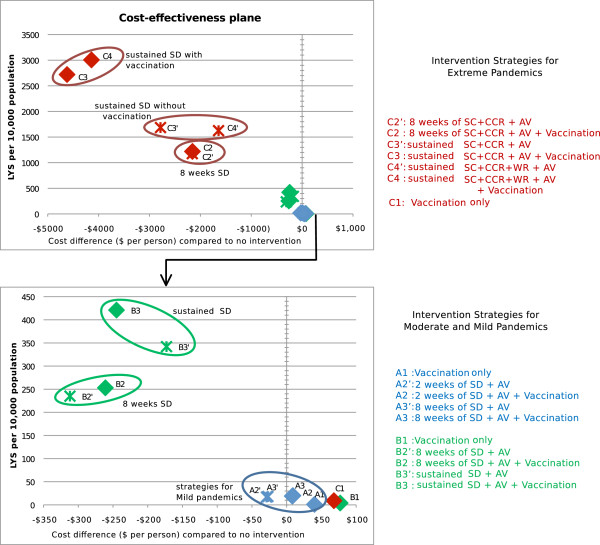
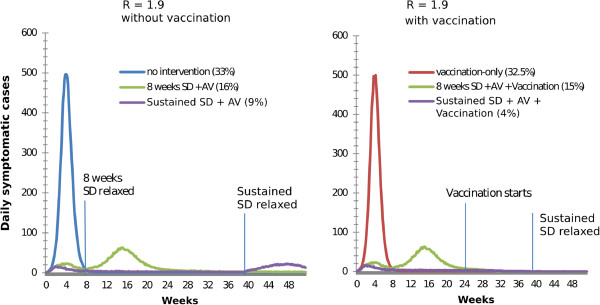
Vaccination-only strategies were not cost effective for any pandemic scenario, saving few lives and incurring substantial vaccination costs. Vaccination coupled with long duration social distancing, antiviral treatment and antiviral prophylaxis was cost effective for moderate pandemics and extreme pandemics, where it saved lives while simultaneously reducing the total pandemic cost. Combined social distancing and antiviral interventions without vaccination were significantly less effective, since without vaccination a resurgence in case numbers occurred as soon as social distancing interventions were relaxed. When social distancing interventions were continued until at least the start of the vaccination campaign, attack rates and total costs were significantly lower, and increased rates of vaccination further improved effectiveness and cost effectiveness.
The effectiveness and cost effectiveness consequences of the time-critical interplay of pandemic dynamics, vaccine availability and intervention timing has been quantified. For moderate and extreme pandemics, vaccination combined with rapidly activated antiviral and social distancing interventions of sufficient duration is cost effective from the perspective of life years saved.
规划大流行性流感缓解策略的一个关键问题是大流行在社区出现与有效疫苗可用之间的延迟。在 2009 年大流行中已经出现的可能情况是,一种新出现的流感大流行将在生产出与大流行株匹配的疫苗之前传播到世界大部分地区。对于严重的大流行,如果要避免高死亡率,则需要采取其他快速激活的干预措施。
进行了一项模拟模型研究,以检查在假设流感大流行到达后 6 个月才首次提供疫苗的情况下,社会隔离、抗病毒和疫苗接种干预措施的合理组合的有效性和成本效益。根据对 2009 年、1957 年和 1918 年流感大流行的传染性和致病性的估计,研究了三种不同的大流行情况;轻度、中度和重度。考察了不同持续时间的社会隔离措施,并分析了疫苗接种延迟变化(范围为 2 至 6 个月)对结果的敏感性。
对于任何大流行情况,仅接种疫苗的策略都不具有成本效益,因为它节省的生命很少,并且会产生大量的疫苗接种成本。在中度和重度大流行中,接种疫苗加上长时间的社会隔离、抗病毒治疗和抗病毒预防是具有成本效益的,因为它可以挽救生命,同时降低总大流行成本。没有接种疫苗的联合社会隔离和抗病毒干预措施效果显著降低,因为一旦放松社会隔离干预措施,病例数就会再次增加。如果继续实施社会隔离干预措施,直到至少开始疫苗接种运动,那么发病和总成本将显著降低,并且增加疫苗接种率将进一步提高有效性和成本效益。
已经量化了大流行动态、疫苗供应和干预时机之间的时间关键相互作用的效果和成本效益后果。对于中度和重度大流行,接种疫苗结合快速激活的抗病毒和足够持续时间的社会隔离干预措施从挽救生命的角度来看是具有成本效益的。