Department of Medicine, Johns Hopkins University School of Medicine, Baltimore, MD.
Department of Epidemiology, Johns Hopkins Bloomberg School of Public Health, Baltimore, MD.
Am J Transplant. 2013 Apr;13(4):1012-1018. doi: 10.1111/ajt.12143. Epub 2013 Feb 7.
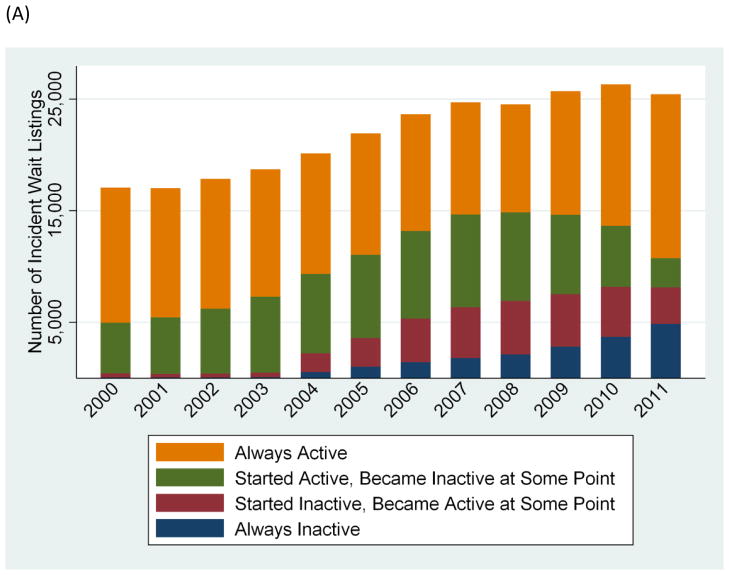
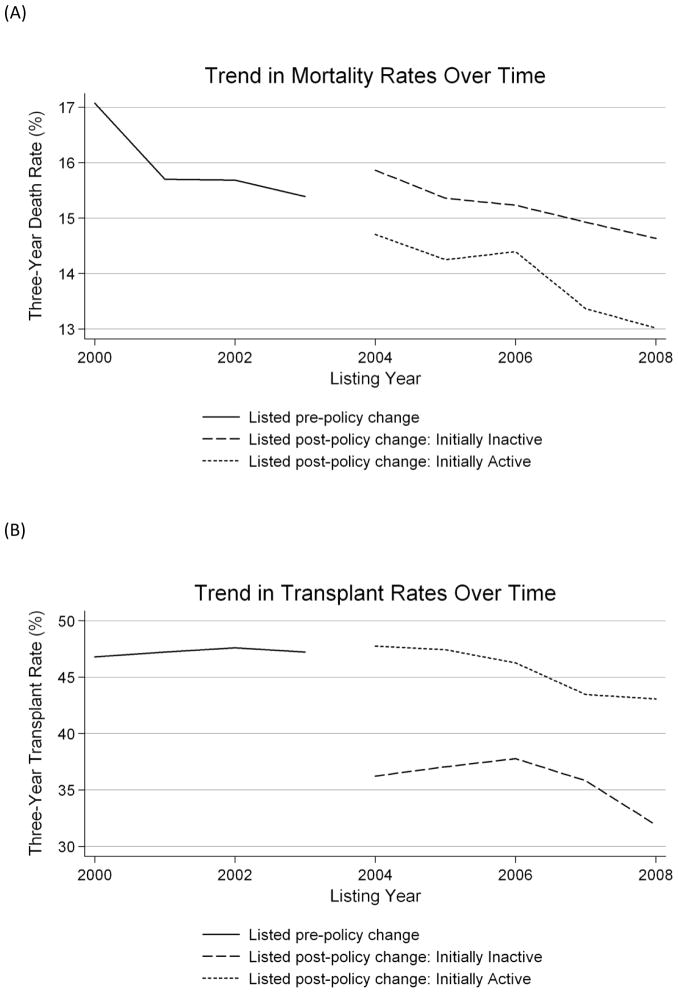
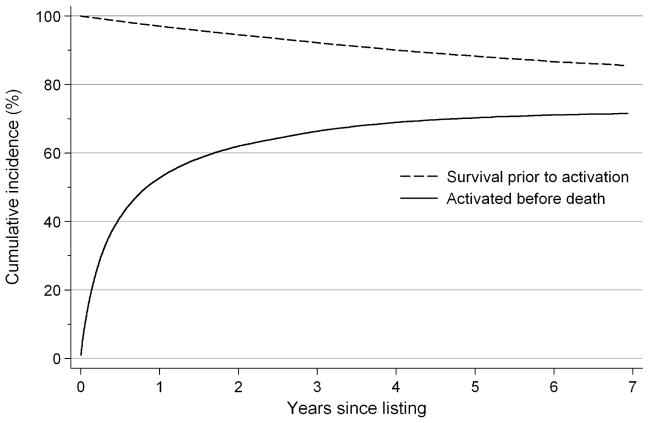
In November 2003, OPTN policy was amended to allow kidney transplant candidates to accrue waiting time while registered as status 7, or inactive. We evaluated trends in inactive listings and the association of inactive status with transplantation and survival, studying 262,824 adult first-time KT candidates listed between 2000 and 2011. The proportion of waitlist candidates initially listed as inactive increased from 2.3% prepolicy change to 31.4% in 2011. Candidates initially listed as inactive were older, more often female, African American, and with higher body mass index. Postpolicy change, conversion from initially inactive to active status generally occurred early if at all: at 1 year after listing, 52.7% of initially inactive candidates had been activated; at 3 years, only 66.3% had been activated. Inactive status was associated with a substantially higher waitlist mortality (aHR 2.21, 95%CI:2.15-2.28, p<0.001) and lower rates of eventual transplantation (aRR 0.68, 95%CI:0.67-0.70, p<0.001). In summary, waitlist practice has changed significantly since November 2003, with a sharp increase in the number of inactive candidates. Using the full waitlist to estimate organ shortage or as a comparison group in transplant outcome studies is less appropriate in the current era.
2003 年 11 月,OPTN 政策进行了修订,允许肾移植候选者在登记为状态 7 或非活跃状态时累计等待时间。我们评估了非活跃名单的趋势以及非活跃状态与移植和生存的关联,研究了 2000 年至 2011 年间登记的 262824 名成人首次肾移植候选者。最初列为非活跃状态的候补名单候选人的比例从政策变更前的 2.3%增加到 2011 年的 31.4%。最初列为非活跃状态的候选人年龄更大,女性、非裔美国人更多,体重指数更高。政策变更后,从最初的非活跃状态转变为活跃状态的情况通常发生得较早:在列出后 1 年,52.7%的最初非活跃候选人已被激活;3 年后,只有 66.3%的候选人被激活。非活跃状态与候补名单死亡率显著升高(aHR 2.21,95%CI:2.15-2.28,p<0.001)和最终移植率降低有关(aRR 0.68,95%CI:0.67-0.70,p<0.001)。总之,自 2003 年 11 月以来,候补名单实践发生了重大变化,非活跃候选人的数量急剧增加。在当前时代,使用完整的候补名单来估计器官短缺或作为移植结果研究的比较组不太合适。