Department of Adult and Elderly Nursing, College of Nursing, University of Florida, Gainesville, FL 32610-0197, USA.
BMC Geriatr. 2013 Feb 11;13:14. doi: 10.1186/1471-2318-13-14.
Nursing home residents with dementia gradually lose the ability to process information so that they are less likely to express pain in typical ways. These residents may express pain through disruptive behaviors because they cannot appropriately verbalize their pain experience. The objective of this study was to investigate the effect of pain on disruptive behaviors in nursing home residents with dementia.
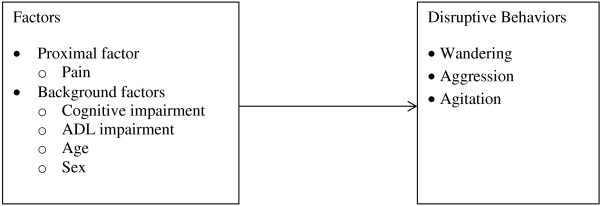
This is a secondary analysis of the Minimum Data Set (MDS 2.0) assessment data on long-term care from the state of Florida. The data used in this study were the first comprehensive assessment data from NH residents with dementia aged 65 and older (N = 56,577) in Medicare- or Medicaid-certified nursing homes between January 1, 2009 and December 31, 2009. Variables examined were pain, wandering, aggression, agitation, cognitive impairment, activities of daily living impairments, and demographic characteristics. Ordinal logistic regression was used to evaluate the effect of pain on disruptive behaviors.
Residents with more severe pain are less likely to display wandering behaviors (OR = .77, 95% CI for OR = [0.73, 0.81]), but more likely to display aggressive and agitated behaviors (OR = 1.04, 95% CI for OR = [1.01, 1.08]; OR = 1.17, 95% CI for OR = [1.13, 1.20]).
The relationship between pain and disruptive behaviors depends on the type of behaviors. Pain is positively correlated with disruptive behaviors that do not involve locomotion (e.g., aggression and agitation), but negatively related to disruptive behaviors that are accompanied by locomotion (e.g., wandering). These findings indicate that effective pain management may help to reduce aggression and agitation, and to promote mobility in persons with dementia.
患有痴呆症的养老院居民逐渐丧失处理信息的能力,因此他们不太可能以典型方式表达疼痛。这些居民可能会通过破坏性行为来表达疼痛,因为他们无法恰当地说出自己的疼痛体验。本研究的目的是调查痴呆症养老院居民的疼痛对破坏性行为的影响。
这是对佛罗里达州长期护理最低数据集(MDS 2.0)评估数据的二次分析。本研究使用的数据是 Medicare 或 Medicaid 认证的养老院中年龄在 65 岁及以上的患有痴呆症的 NH 居民的第一次全面评估数据(N=56577),这些居民在 2009 年 1 月 1 日至 2009 年 12 月 31 日之间入住。检查的变量包括疼痛、徘徊、攻击、躁动、认知障碍、日常生活活动障碍和人口统计学特征。使用有序逻辑回归评估疼痛对破坏性行为的影响。
疼痛程度越严重的居民,出现徘徊行为的可能性越低(OR=.77,OR 的 95%CI 为 [0.73, 0.81]),但出现攻击和躁动行为的可能性越高(OR=1.04,OR 的 95%CI 为 [1.01, 1.08];OR=1.17,OR 的 95%CI 为 [1.13, 1.20])。
疼痛与破坏性行为之间的关系取决于行为的类型。疼痛与不涉及运动的破坏性行为呈正相关(例如攻击和躁动),但与伴有运动的破坏性行为呈负相关(例如徘徊)。这些发现表明,有效的疼痛管理可能有助于减少攻击和躁动,并促进痴呆症患者的活动能力。