Dar es Salaam University College of Education, PO Box 2329, Dar es Salaam, Tanzania.
Malar J. 2013 Feb 11;12:60. doi: 10.1186/1475-2875-12-60.
Tanzania adopted artemether-lumefantrine (AL) as first-line drug for uncomplicated malaria in 2006. Recently, there was an anecdotal report on high malaria recurrence rate following AL treatment in in the (urban and peri-urban), western part of Tanzania. The current report is an exploratory study to carefully and systematically assess AL efficacy in the area.
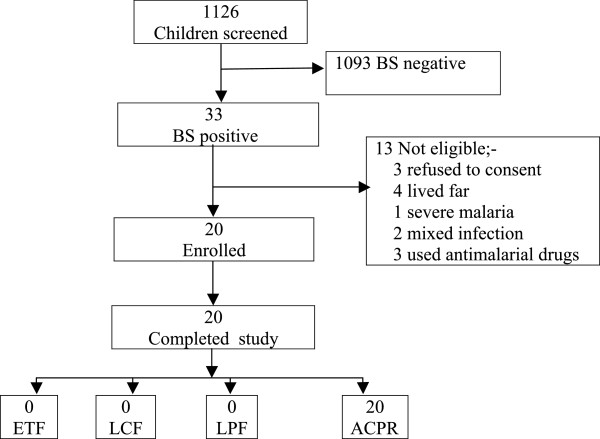
Between June and August 2011, a total of 1,126 patients were screened for malaria, 33 had malaria, of which 20 patients met inclusion criteria and were enrolled and treated with standard dose of AL as recommended in the WHO protocol. Treated patients were followed up for 28 days to assess treatment responses. Before treatment (Day 0) and post-treatment (Day 7) plasma lumefantrine levels were determined to assess prior AL use and ascertain parasites exposure to adequate plasma leveles of lumefantrine, respectively.
The cure rate was 100%. All Day 0 plasma lumefantrine were below HPLC detectable level. The median Day 7 lumefantrine concentration was 404, (range, 189-894 ng/ml). Six out of 20 patients (30%) were gametocytaemic and all cleared gametocytes by Day 14. One patient showed an increase in gametocytes from four on Day 0 to 68, per 500 WBC on Day 2.
Artemether lumefantrine is highly efficacious against uncomplicated Plasmodium falciparum malaria. The elevation of gametocytaemia despite AL treatment needs to be evaluated in a larger study.
坦桑尼亚于 2006 年将青蒿琥酯-本芴醇(AL)作为治疗无并发症疟疾的一线药物。最近,有报道称在坦桑尼亚西部(城市和城郊地区),使用 AL 治疗后疟疾复发率很高。本报告是一项探索性研究,旨在仔细和系统地评估该地区 AL 的疗效。
2011 年 6 月至 8 月期间,共筛查了 1126 例疟疾患者,其中 33 例疟疾患者,20 例符合纳入标准并接受标准剂量 AL 治疗,剂量按世界卫生组织方案推荐。治疗后随访 28 天评估治疗效果。在治疗前(第 0 天)和治疗后(第 7 天)测定血浆青蒿琥酯浓度,以评估先前是否使用过 AL,并确定寄生虫是否暴露于足够的青蒿琥酯血浆浓度。
治愈率为 100%。所有第 0 天的血浆青蒿琥酯均低于高效液相色谱检测水平。第 7 天的中位数青蒿琥酯浓度为 404ng/ml(范围,189-894ng/ml)。20 例患者中有 6 例(30%)为配子体血症,所有患者的配子体均在第 14 天清除。1 例患者的配子体从第 0 天的 4 个增加到第 2 天的 68 个/500 白细胞。
青蒿琥酯-本芴醇对无并发症恶性疟原虫感染具有高度疗效。尽管使用 AL 治疗,但配子体血症的升高需要在更大的研究中进行评估。