Pharmacogenomics and Genomic Medicine Group, Department of Medical Biochemistry, School of Medical Sciences, College of Health and Allied Sciences, University of Cape Coast, Cape Coast, Ghana.
Division of Human Genetics, Department of Pathology, Faculty of Health Sciences, University of Cape Town, Anzio Road, Observatory, Cape Town, 7925, South Africa.
Malar J. 2024 Apr 29;23(1):125. doi: 10.1186/s12936-024-04930-1.
Despite efforts made to reduce morbidity and mortality associated with malaria, especially in sub-Saharan Africa, malaria continues to be a public health concern that requires innovative efforts to reach the WHO-set zero malaria agenda. Among the innovations is the use of artemisinin-based combination therapy (ACT) that is effective against Plasmodium falciparum. Generic artemether-lumefantrine (AL) is used to treat uncomplicated malaria after appropriate diagnosis. AL is metabolized by the cytochrome P450 family of enzymes, such as CYP2B6, CYP3A4 and CYP3A5, which can be under pharmacogenetic influence. Pharmacogenetics affecting AL metabolism, significantly influence the overall anti-malarial activity leading to variable therapeutic efficacy. This study focused on generic AL drugs used in malarial treatment as prescribed at health facilities and evaluated pharmacogenomic influences on their efficacy.
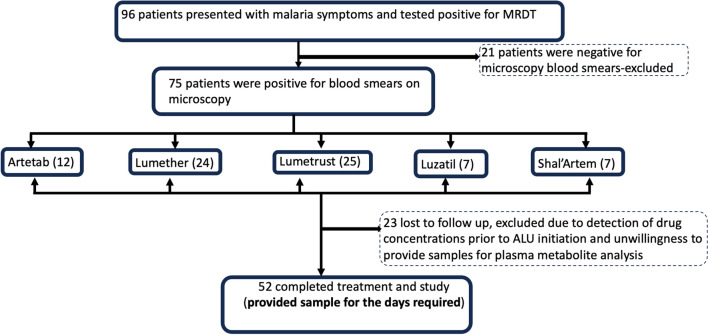
Patients who have been diagnosed with malaria and confirmed through RDT and microscopy were recruited in this study. Blood samples were taken on days 1, 2, 3 and 7 for parasite count and blood levels of lumefantrine, artemisinin, desbutyl-lumefantrine (DBL), and dihydroartemisinin (DHA), the active metabolites of lumefantrine and artemether, respectively, were analysed using established methods. Pharmacogene variation analysis was undertaken using iPLEX microarray and PCR-RFLP.
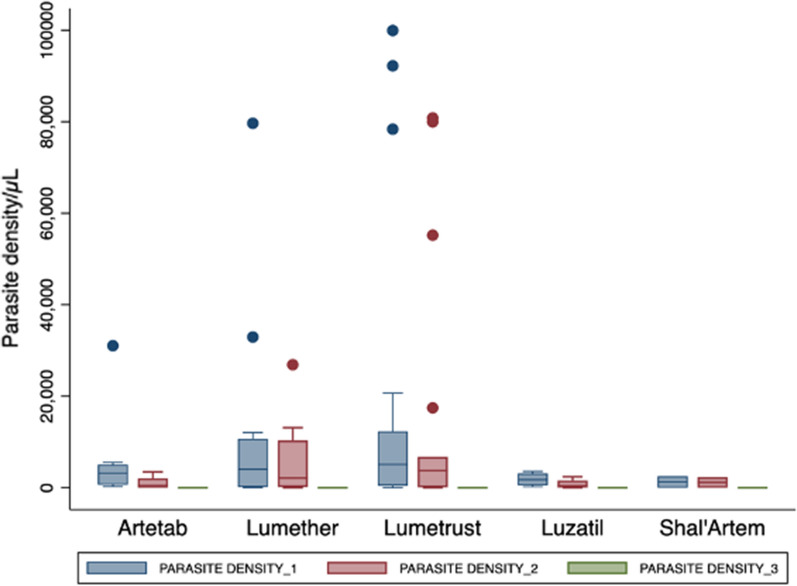
A total of 52 patients completed the study. Median parasite density from day 1 to 7 ranged from 0-2666/μL of blood, with days 3 and 7 recording 0 parasite density. Highest median plasma concentration for lumefantrine and desbutyl lumefantrine, which are the long-acting components of artemisinin-based combinations, was 4123.75 ng/mL and 35.87 ng/mL, respectively. Day 7 plasma lumefantrine concentration across all generic ACT brands was ≥ 200 ng/mL which potentially accounted for the parasitaemia profile observed. Monomorphism was observed for CYP3A4 variants, while there were observed variations in CYP2B6 and CYP3A5 alleles. Among the CYP3A5 genotypes, significant differences in genotypes and plasma concentration for DBL were seen on day 3 between 1/*1 versus *1/*6 (p = 0.002), *1/*3 versus *1/*6 (p = 0.006) and *1/*7 versus *1/*6 (p = 0.008). Day 7 plasma DBL concentrations showed a significant difference between *1/*6 and *1/*3 (p = 0.026) expressors.
The study findings show that CYP2B6 and CYP3A5 pharmacogenetic variations may lead to higher plasma exposure of AL metabolites.
尽管在降低疟疾发病率和死亡率方面做出了努力,特别是在撒哈拉以南非洲地区,但疟疾仍然是一个公共卫生关注点,需要创新努力来实现世界卫生组织设定的无疟疾议程。创新之一是使用青蒿素为基础的联合疗法(ACT),该疗法对恶性疟原虫有效。青蒿琥酯-咯萘啶(AL)在适当诊断后用于治疗无并发症疟疾。AL 由细胞色素 P450 酶家族代谢,如 CYP2B6、CYP3A4 和 CYP3A5,这些酶可能受到遗传药理学的影响。影响 AL 代谢的遗传药理学,显著影响整体抗疟活性,导致治疗效果的差异。本研究集中在疟疾治疗中使用的通用 AL 药物,并评估其疗效的遗传药理学影响。
本研究招募了在卫生机构确诊为疟疾并通过 RDT 和显微镜确认的患者。在第 1、2、3 和 7 天采集血液样本进行寄生虫计数,并使用已建立的方法分析青蒿琥酯、青蒿素、去丁基青蒿琥酯(DBL)和二氢青蒿素(DHA)的血药浓度,分别为青蒿琥酯和青蒿素的活性代谢物。采用 iPLEX 微阵列和 PCR-RFLP 进行遗传变异分析。
共有 52 名患者完成了研究。第 1 至 7 天的中位寄生虫密度范围为 0-2666/μL 血液,第 3 天和第 7 天记录为 0 寄生虫密度。青蒿琥酯和去丁基青蒿琥酯(ART 的长效成分)的最高中位血浆浓度分别为 4123.75ng/mL 和 35.87ng/mL。所有通用 ACT 品牌的第 7 天血浆青蒿琥酯浓度均≥200ng/mL,这可能是观察到的寄生虫血症谱的原因。CYP3A4 变体观察到单体型,而 CYP2B6 和 CYP3A5 等位基因观察到变异。在 CYP3A5 基因型中,第 3 天观察到 1/*1 与 *1/*6(p=0.002)、*1/*3 与 *1/*6(p=0.006)和 *1/*7 与 *1/*6(p=0.008)之间 DBL 基因型和血浆浓度存在显著差异。第 7 天血浆 DBL 浓度在 *1/*6 和 *1/*3 表达者之间存在显著差异(p=0.026)。
研究结果表明,CYP2B6 和 CYP3A5 遗传药理学变异可能导致 AL 代谢物的血浆暴露增加。