Institute of Sport Medicine, Bispebjerg Hospital, Bldg. 8, 1. floor, Bispebjerg Bakke 23, 2400 Copenhagen NV, Denmark.
FASEB J. 2013 May;27(5):2074-9. doi: 10.1096/fj.12-225599. Epub 2013 Feb 11.
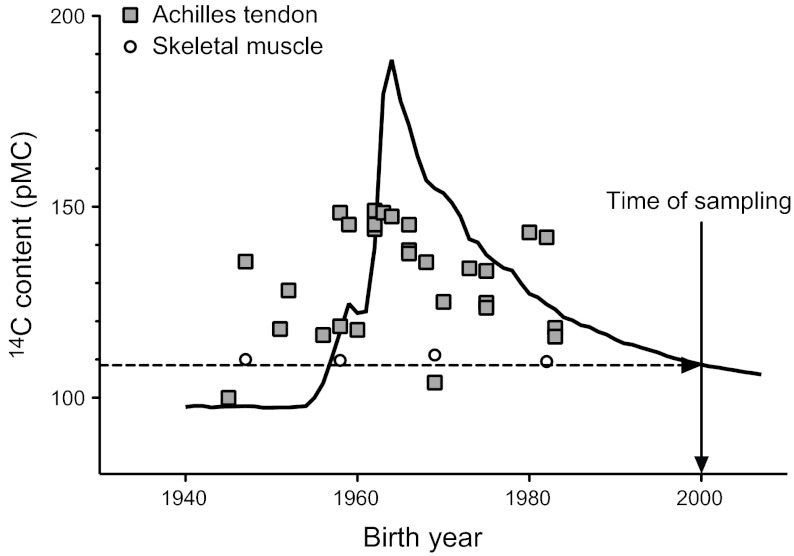
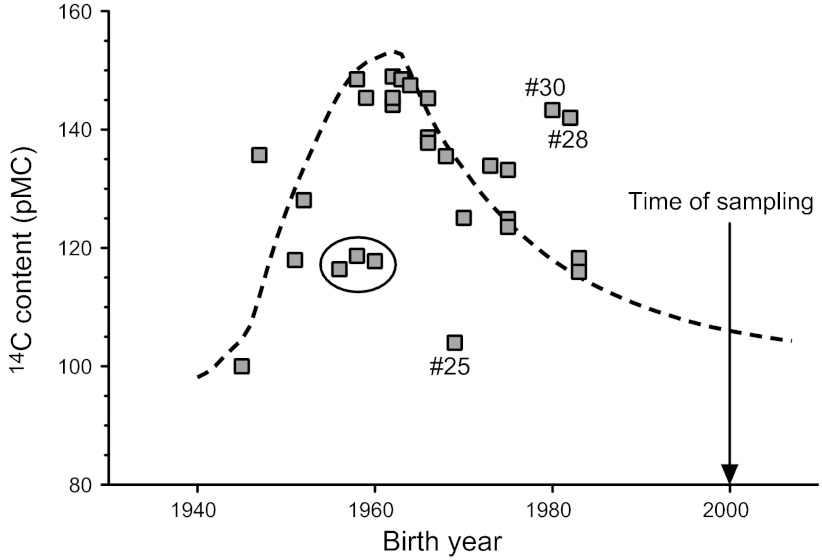
Tendons are often injured and heal poorly. Whether this is caused by a slow tissue turnover is unknown, since existing data provide diverging estimates of tendon protein half-life that range from 2 mo to 200 yr. With the purpose of determining life-long turnover of human tendon tissue, we used the (14)C bomb-pulse method. This method takes advantage of the dramatic increase in atmospheric levels of (14)C, produced by nuclear bomb tests in 1955-1963, which is reflected in all living organisms. Levels of (14)C were measured in 28 forensic samples of Achilles tendon core and 4 skeletal muscle samples (donor birth years 1945-1983) with accelerator mass spectrometry (AMS) and compared to known atmospheric levels to estimate tissue turnover. We found that Achilles tendon tissue retained levels of (14)C corresponding to atmospheric levels several decades before tissue sampling, demonstrating a very limited tissue turnover. The tendon concentrations of (14)C approximately reflected the atmospheric levels present during the first 17 yr of life, indicating that the tendon core is formed during height growth and is essentially not renewed thereafter. In contrast, (14)C levels in muscle indicated continuous turnover. Our observation provides a fundamental premise for understanding tendon function and pathology, and likely explains the poor regenerative capacity of tendon tissue.
肌腱经常受伤且愈合不良。目前尚不清楚这是否是由于组织更新缓慢所致,因为现有数据对肌腱蛋白半衰期的估计存在分歧,范围从 2 个月到 200 年不等。为了确定人类肌腱组织的终身更新率,我们使用了(14)C 炸弹脉冲法。该方法利用了 1955-1963 年核试验导致的大气(14)C 水平的急剧增加,这反映在所有生物中。我们使用加速器质谱法(AMS)测量了 28 份法医样本的跟腱芯和 4 份骨骼肌样本(供体出生年份为 1945-1983 年)中的(14)C 水平,并与已知的大气水平进行比较,以估计组织更新率。我们发现跟腱组织保留了与组织采样前几十年相当的(14)C 水平,表明组织更新非常有限。肌腱中的(14)C 浓度大致反映了生命前 17 年存在的大气水平,表明跟腱芯是在身高增长过程中形成的,此后基本上不会更新。相比之下,肌肉中的(14)C 水平表明持续更新。我们的观察结果为理解肌腱功能和病理学提供了一个基本前提,并且可能解释了肌腱组织再生能力差的原因。