School of Plant Science, University of Tasmania Private Bag 55, Hobart, Tasmania, 7001, Australia ; CRC for Forestry Private Bag 12, Hobart, Tasmania, 7001, Australia.
Ecol Evol. 2012 Jan;3(1):1-17. doi: 10.1002/ece3.421. Epub 2012 Nov 23.
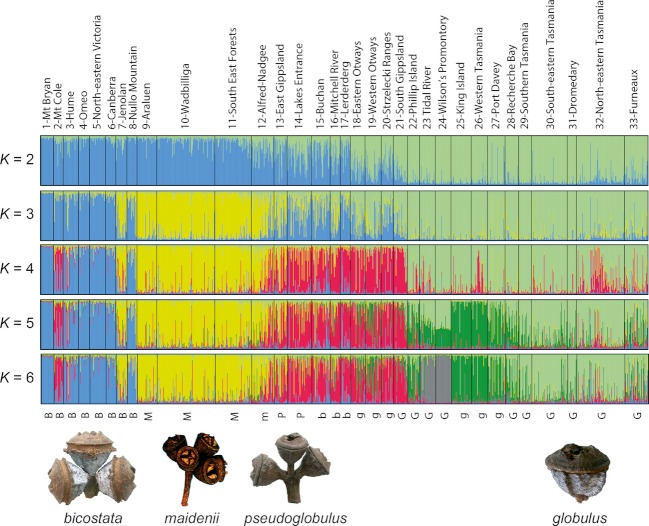
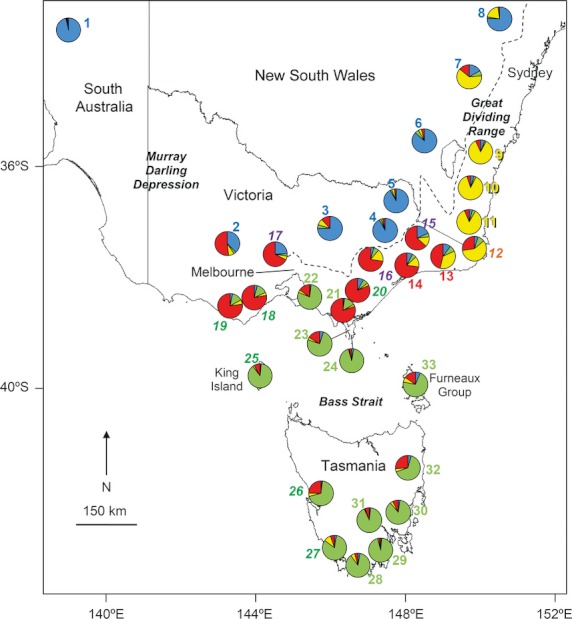
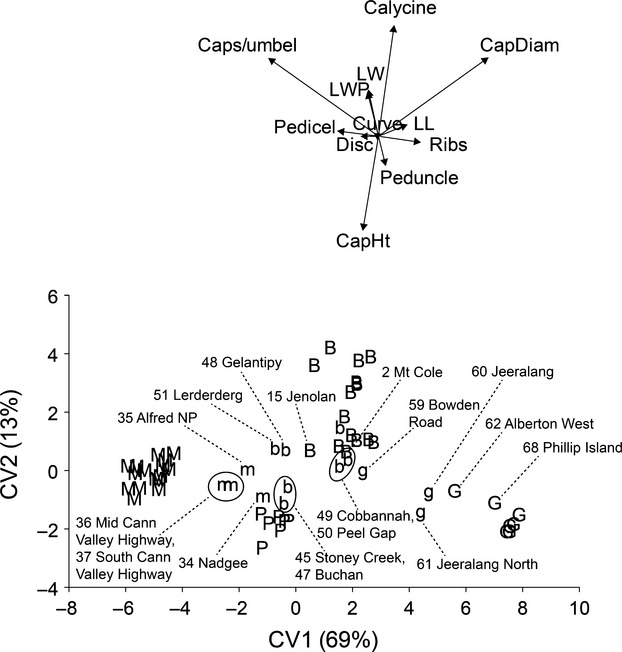
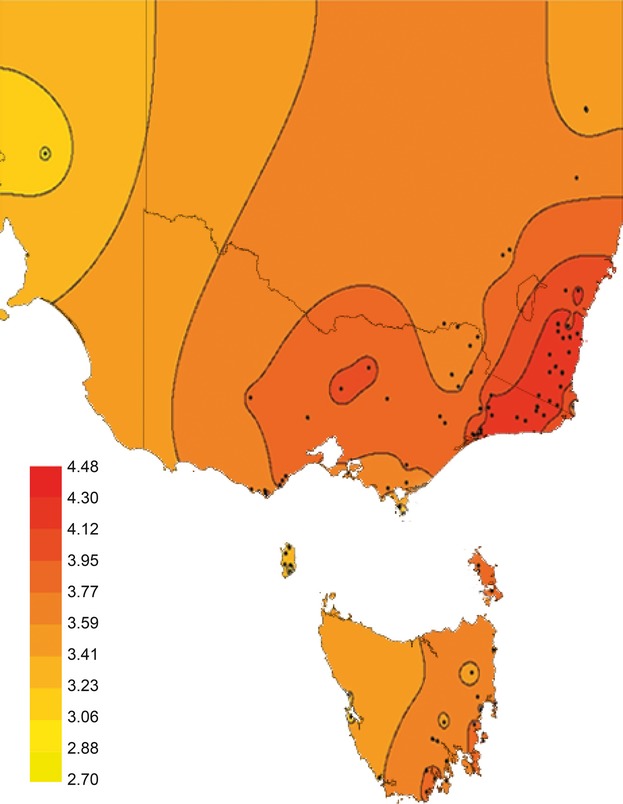
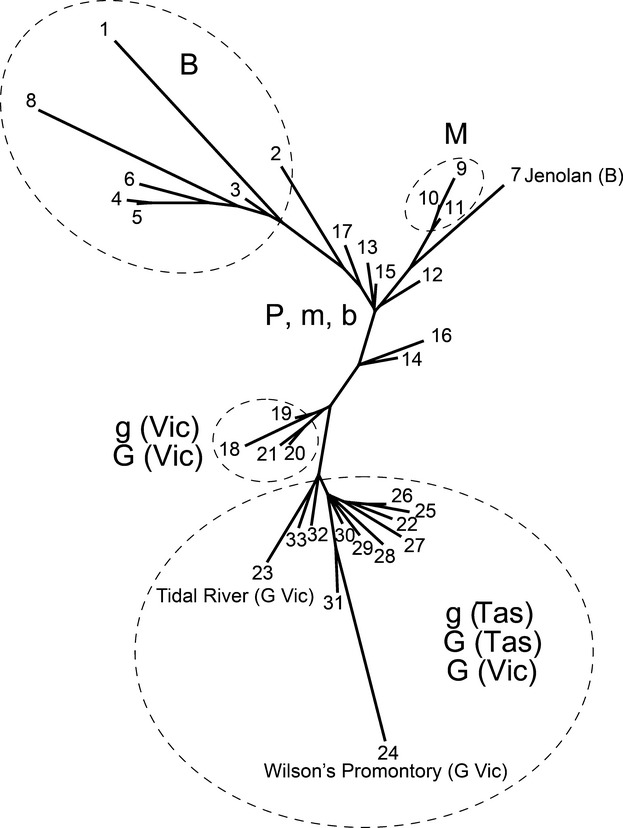
Forest trees frequently form species complexes, complicating taxonomic classification and gene pool management. This is certainly the case in Eucalyptus, and well exemplified by the Eucalyptus globulus complex. This ecologically and economically significant complex comprises four taxa (sspp. bicostata, globulus, maidenii, pseudoglobulus) that are geographically and morphologically distinct, but linked by extensive "intergrade" populations. To resolve their genetic affinities, nine microsatellites were used to genotype 1200 trees from throughout the natural range of the complex in Australia, representing 33 morphological core and intergrade populations. There was significant spatial genetic structure (F(ST) = 0.10), but variation was continuous. High genetic diversity in southern ssp. maidenii indicates that this region is the center of origin. Genetic diversity decreases and population differentiation increases with distance from this area, suggesting that drift is a major evolutionary process. Many of the intergrade populations, along with other populations morphologically classified as ssp. pseudoglobulus or ssp. globulus, belong to a "cryptic genetic entity" that is genetically and geographically intermediate between core ssp. bicostata, ssp. maidenii, and ssp. globulus. Geography, rather than morphology, therefore, is the best predictor of overall genetic affinities within the complex and should be used to classify germplasm into management units for conservation and breeding purposes.
森林树木经常形成物种复合体,使分类学分类和基因库管理变得复杂。桉树就是这种情况,桉树 globulus 复合体就是一个很好的例子。这个具有生态和经济重要性的复合体包括四个分类群(sspp. bicostata、globulus、maidenii、pseudoglobulus),它们在地理和形态上是不同的,但通过广泛的“中间”种群联系在一起。为了确定它们的遗传亲缘关系,使用了九个微卫星来对来自澳大利亚自然范围内的 1200 棵树进行基因型分析,这些树代表了 33 个形态核心和中间种群。存在显著的空间遗传结构(F(ST) = 0.10),但变异是连续的。南部 ssp. maidenii 的高遗传多样性表明该地区是起源中心。遗传多样性随着与该地区的距离的增加而降低,种群分化增加,表明漂移是一个主要的进化过程。许多中间种群,以及其他形态上被归类为 ssp. pseudoglobulus 或 ssp. globulus 的种群,属于一个“隐生遗传实体”,在遗传和地理上介于核心 ssp. bicostata、ssp. maidenii 和 ssp. globulus 之间。因此,地理而不是形态是复合体中整体遗传亲缘关系的最佳预测因子,应用于根据保护和繁殖目的将种质分类为管理单位。