Department of Medical Statistics and Epidemiology, Hamad Medical Corporation, Doha, Qatar ; Department of Public Health, Weill Cornell Medical College, Doha, Qatar ; Department of Evidence for Population Health Unit, School of Epidemiology and Health Sciences, The University of Manchester, Manchester, UK.
J Pain Res. 2013;6:95-101. doi: 10.2147/JPR.S40740. Epub 2013 Feb 4.
To determine the prevalence of low back pain (LBP), investigate the sociodemographic characteristics of patients with LBP, and examine its association with psychological distress such as anxiety, depression, and somatization.
Of the 2742 patients approached, 2180 agreed to participate in this cross-sectional study (79.5% response rate). The survey was conducted among primary health care visitors from March to October 2012 and collected sociodemographic details and LBP characteristics. General Health Questionnaire-12 was used to identify the probable cases. Anxiety was assessed with Generalized Anxiety Disorder-7, depression was assessed with Patient Health Questionnaire-9, and somatization was measured with Patient Health Questionnaire-15.
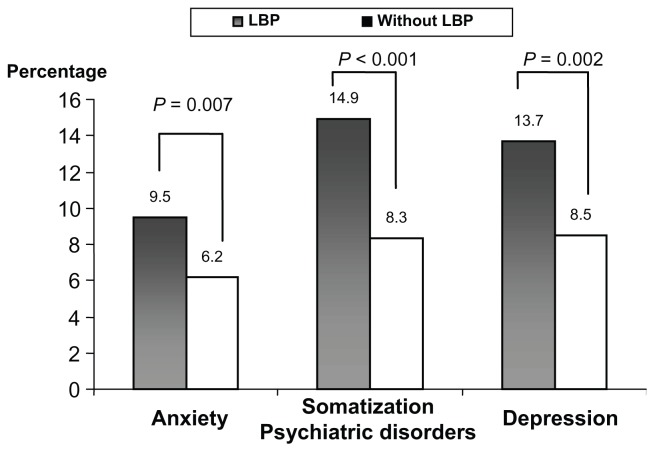
The study sample consisted of 52.9% males and 47.1% females. The prevalence of LBP was 59.2%, comprising 46.1% men and 53.9% women. LBP was significantly higher in Qataris (57.9%), women (53.9%), housewives (40.1%), and individuals with higher monthly income (53.9%). Somatization (14.9%) was observed more in LBP patients, followed by depression (13.7%) and anxiety disorders (9.5%). The most frequently reported symptoms were "headaches" (41.1%) and "pain in your arms, legs, or joints" (38.5%) in LBP patients with somatization. The most frequent symptoms among depressed LBP patients were "thinking of suicide or wanting to hurt yourself" (51.4%) and "feeling down, depressed, or hopeless" (49.2%). "Not being able to stop or control worrying" (40.2%), "worrying too much about different things" (40.2%), and "feeling afraid as if something awful might happen" (40.2%) were the most common anxiety symptoms in LBP patients. Psychological distress such as anxiety (9.5% versus 6.2%), depression (13.7% versus 8.5%), and somatization (14.9% versus 8.3%) were significantly higher in LBP patients.
The prevalence of LBP in this study sample was comparable with other studies. Furthermore, psychological distress such as anxiety, depression, and somatization were more prevalent in LBP patients compared to patients without LBP.
确定腰痛(LBP)的患病率,调查 LBP 患者的社会人口学特征,并研究其与焦虑、抑郁和躯体化等心理困扰的关系。
在 2742 名被调查者中,2180 名同意参与这项横断面研究(79.5%的应答率)。这项调查于 2012 年 3 月至 10 月期间在初级保健访问者中进行,收集了社会人口学详细信息和 LBP 特征。使用一般健康问卷-12 来确定可能的病例。使用广泛性焦虑障碍-7 评估焦虑,使用患者健康问卷-9 评估抑郁,使用患者健康问卷-15 评估躯体化。
研究样本包括 52.9%的男性和 47.1%的女性。LBP 的患病率为 59.2%,其中 46.1%为男性,53.9%为女性。卡塔尔人(57.9%)、女性(53.9%)、家庭主妇(40.1%)和月收入较高的人(53.9%)中 LBP 发生率更高。躯体化(14.9%)在 LBP 患者中更为常见,其次是抑郁(13.7%)和焦虑障碍(9.5%)。报告最多的症状是 LBP 伴躯体化患者的“头痛”(41.1%)和“手臂、腿部或关节疼痛”(38.5%)。抑郁性 LBP 患者最常见的症状是“有自杀或伤害自己的想法”(51.4%)和“情绪低落、沮丧或绝望”(49.2%)。“无法停止或控制担忧”(40.2%)、“过度担心不同的事情”(40.2%)和“感到害怕,好像可怕的事情可能会发生”(40.2%)是 LBP 患者中最常见的焦虑症状。与无 LBP 的患者相比,LBP 患者的心理困扰(焦虑 9.5%比 6.2%、抑郁 13.7%比 8.5%、躯体化 14.9%比 8.3%)更高。
本研究样本中 LBP 的患病率与其他研究相似。此外,与无 LBP 的患者相比,LBP 患者的焦虑、抑郁和躯体化等心理困扰更为常见。