Institute of Botany of the Academy of Sciences of the Czech Republic, Průhonice, Czech Republic.
PLoS One. 2013;8(2):e55770. doi: 10.1371/journal.pone.0055770. Epub 2013 Feb 6.
Coppicing was one of the most important forest management systems in Europe documented in prehistory as well as in the Middle Ages. However, coppicing was gradually abandoned by the mid-20(th) century, which has altered the ecosystem structure, diversity and function of coppice woods.
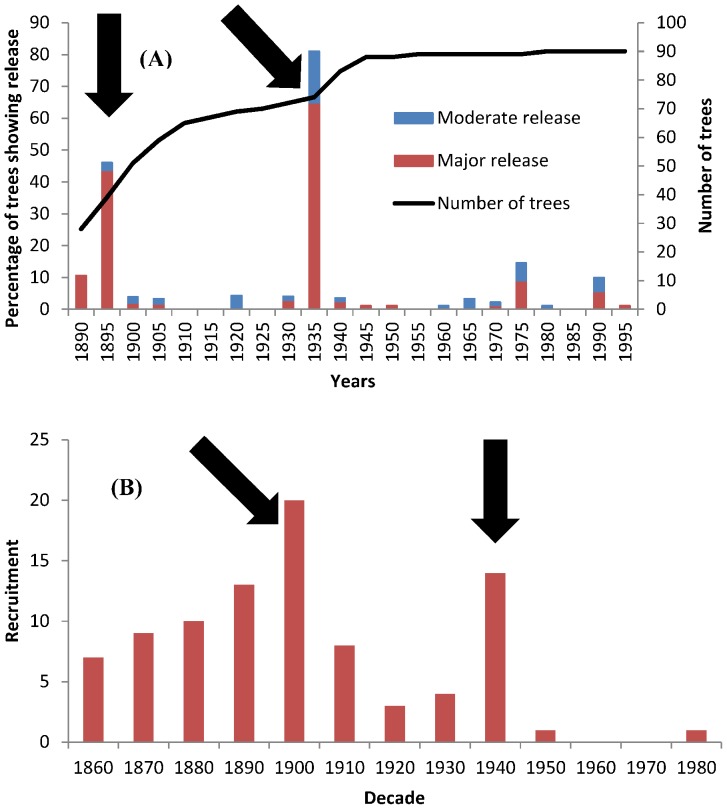
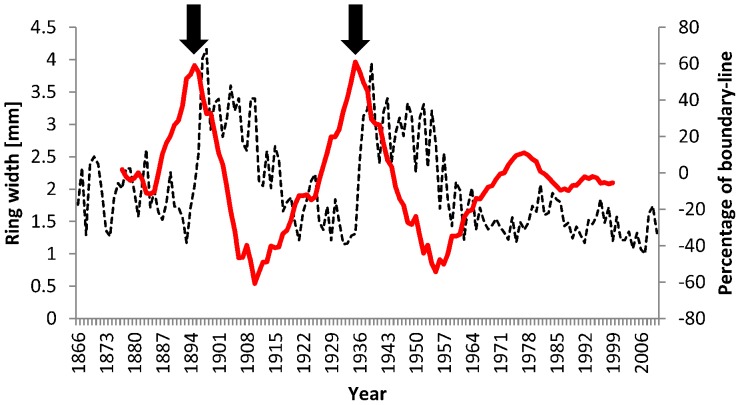
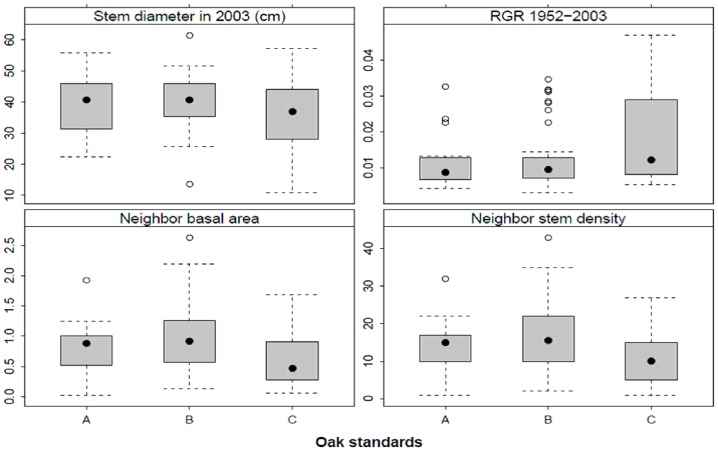
METHODOLOGY/PRINCIPAL FINDINGS: Our aim was to disentangle factors shaping the historical growth dynamics of oak standards (i.e. mature trees growing through several coppice cycles) in a former coppice-with-standards in Central Europe. Specifically, we tried to detect historical coppicing events from tree-rings of oak standards, to link coppicing events with the recruitment of mature oaks, and to determine the effects of neighbouring trees on the stem increment of oak standards. Large peaks in radial growth found for the periods 1895-1899 and 1935-1939 matched with historical records of coppice harvests. After coppicing, the number of newly recruited oak standards markedly grew in comparison with the preceding or following periods. The last significant recruitment of oak standards was after the 1930s following the last regular coppicing event. The diameter increment of oak standards from 1953 to 2003 was negatively correlated with competition indices, suggesting that neighbouring trees (mainly resprouting coppiced Tilia platyphyllos) partly suppressed the growth of oak standards. Our results showed that improved light conditions following historical coppicing events caused significant increase in pulses of radial growth and most probably maintained oak recruitment.
CONCLUSIONS/SIGNIFICANCE: Our historical perspective carries important implications for oak management in Central Europe and elsewhere. Relatively intense cutting creating open canopy woodlands, either as in the coppicing system or in the form of selective cutting, is needed to achieve significant radial growth in mature oaks. It is also critical for the successful regeneration and long-term maintenance of oak populations.
萌生是欧洲最重要的森林管理系统之一,在史前和中世纪都有记载。然而,萌生在 20 世纪中叶逐渐被放弃,这改变了萌生林的生态系统结构、多样性和功能。
方法/主要发现: 我们的目的是梳理出影响中欧一个曾经的萌生林里的橡树标准木(即经历了几次萌生周期的成熟树木)历史生长动态的因素。具体来说,我们试图从橡树标准木的年轮中检测到历史上的萌生事件,将萌生事件与成熟橡树的繁殖联系起来,并确定相邻树木对橡树标准木茎增量的影响。在 1895-1899 年和 1935-1939 年期间发现的径向生长大峰值与萌生收获的历史记录相吻合。萌生后,新繁殖的橡树标准木的数量明显多于之前或之后的时期。橡树标准木的最后一次重要繁殖是在 20 世纪 30 年代之后,即最后一次定期萌生之后。1953 年至 2003 年期间,橡树标准木的直径增量与竞争指数呈负相关,表明相邻树木(主要是萌生的椴树)部分抑制了橡树标准木的生长。我们的研究结果表明,历史上的萌生事件改善了光照条件,导致径向生长脉冲显著增加,并且很可能维持了橡树的繁殖。
结论/意义: 我们的历史视角对中欧及其他地区的橡树管理具有重要意义。为了实现成熟橡树的显著径向生长,需要相对密集的采伐来创造开阔的林冠林地,无论是在萌生系统中还是在选择性采伐的形式下。这对于橡树种群的成功再生和长期维持也是至关重要的。