Department of Oncology, Immunology and Hematopoiesis Division, Sidney Kimmel Comprehensive Cancer Center, Johns Hopkins University School of Medicine, Baltimore, MD, USA.
Immunol Rev. 2013 Mar;252(1):52-77. doi: 10.1111/imr.12029.
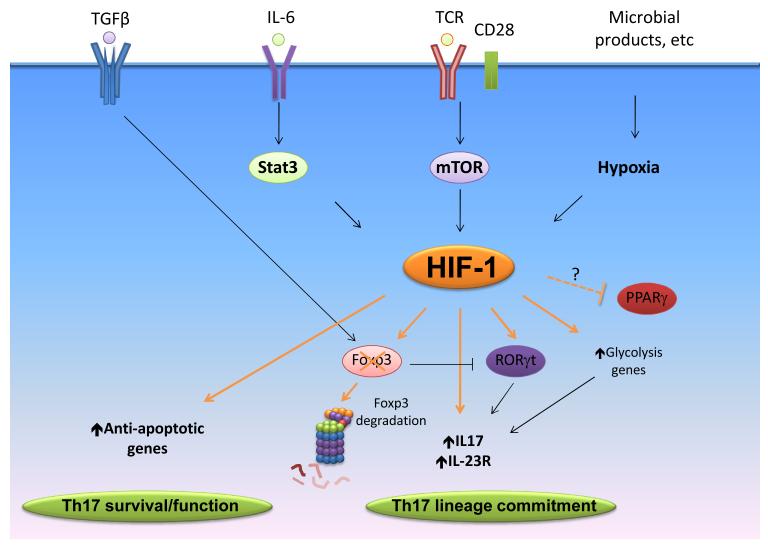
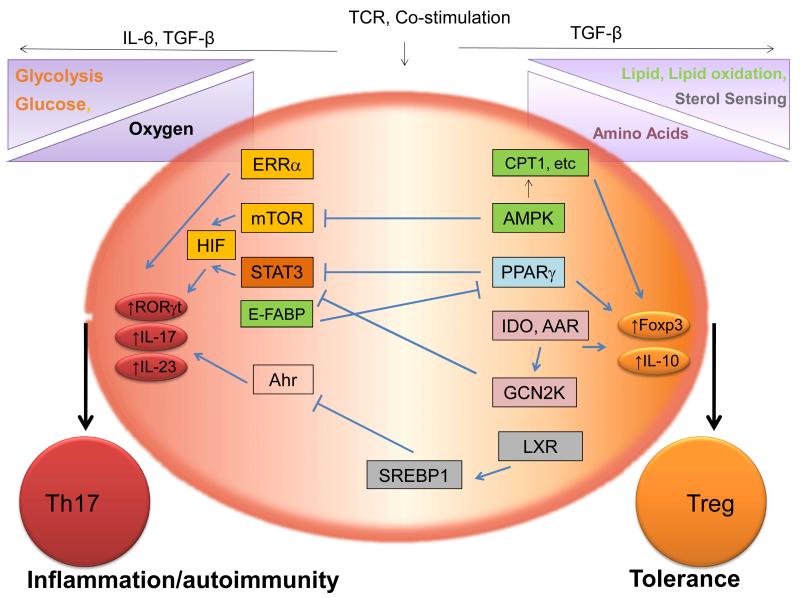
The interplay of the immune system with other aspects of physiology is continually being revealed and in some cases studied in considerable mechanistic detail. A prime example is the influence of metabolic cues on immune responses. It is well appreciated that upon activation, T cells take on a metabolic profile profoundly distinct from that of their quiescent and anergic counterparts; however, a number of recent breakthroughs have greatly expanded our knowledge of how aspects of cellular metabolism can shape a T-cell response. Particularly important are findings that certain environmental cues can tilt the delicate balance between inflammation and immune tolerance by skewing T-cell fate decisions toward either the T-helper 17 (Th17) or T-regulatory (Treg) cell lineage. Recognizing the unappreciated immune-modifying potential of metabolic factors and particularly those involved in the generation of these functionally opposing T-cell subsets will likely add new and potent therapies to our repertoire for treating immune mediated pathologies. In this review, we summarize and discuss recent findings linking certain metabolic pathways, enzymes, and by-products to shifts in the balance between Th17 and Treg cell populations. These advances highlight numerous opportunities for immune modulation.
免疫系统与其他生理方面的相互作用不断被揭示,在某些情况下,其机制细节也得到了相当程度的研究。一个主要的例子是代谢线索对免疫反应的影响。人们充分认识到,T 细胞在激活后,其代谢特征与静息和无能的对应物有很大的不同;然而,最近的一些突破极大地扩展了我们对细胞代谢的各个方面如何影响 T 细胞反应的理解。特别重要的是发现,某些环境线索可以通过使 T 细胞命运决定向 Th17(Th17)或 T 调节(Treg)细胞谱系倾斜,来打破炎症和免疫耐受之间的微妙平衡。认识到代谢因素,特别是参与生成这些功能相反的 T 细胞亚群的代谢因素的未被重视的免疫调节潜力,可能会为我们治疗免疫介导的病理提供新的、有效的治疗方法。在这篇综述中,我们总结和讨论了最近将某些代谢途径、酶和副产物与 Th17 和 Treg 细胞群之间平衡的变化联系起来的发现。这些进展突出了许多免疫调节的机会。