• 文献检索
  • 文档翻译
  • 深度研究
  • 学术资讯
  • Suppr Zotero 插件Zotero 插件
  • 邀请有礼
  • 套餐&价格
  • 历史记录
应用&插件
Suppr Zotero 插件Zotero 插件浏览器插件Mac 客户端Windows 客户端微信小程序
定价
高级版会员购买积分包购买API积分包
服务
文献检索文档翻译深度研究API 文档MCP 服务
关于我们
关于 Suppr公司介绍联系我们用户协议隐私条款
关注我们

Suppr 超能文献

核心技术专利:CN118964589B侵权必究
粤ICP备2023148730 号-1Suppr @ 2026

文献检索

告别复杂PubMed语法,用中文像聊天一样搜索,搜遍4000万医学文献。AI智能推荐,让科研检索更轻松。

立即免费搜索

文件翻译

保留排版,准确专业,支持PDF/Word/PPT等文件格式,支持 12+语言互译。

免费翻译文档

深度研究

AI帮你快速写综述,25分钟生成高质量综述,智能提取关键信息,辅助科研写作。

立即免费体验

“红绿灯”临床决策规则对发热幼儿严重细菌感染的准确性:一项回顾性队列研究。

Accuracy of the "traffic light" clinical decision rule for serious bacterial infections in young children with fever: a retrospective cohort study.

机构信息

Screening and Test Evaluation Program, School of Public Health, University of Sydney, Sydney 2006, Australia.

出版信息

BMJ. 2013 Feb 13;346:f866. doi: 10.1136/bmj.f866.

DOI:10.1136/bmj.f866
PMID:23407730
原文链接:https://pmc.ncbi.nlm.nih.gov/articles/PMC3571679/
Abstract

OBJECTIVES

To determine the accuracy of a clinical decision rule (the traffic light system developed by the National Institute for Health and Clinical Excellence (NICE)) for detecting three common serious bacterial infections (urinary tract infection, pneumonia, and bacteraemia) in young febrile children.

DESIGN

Retrospective analysis of data from a two year prospective cohort study

SETTING

A paediatric emergency department.

PARTICIPANTS

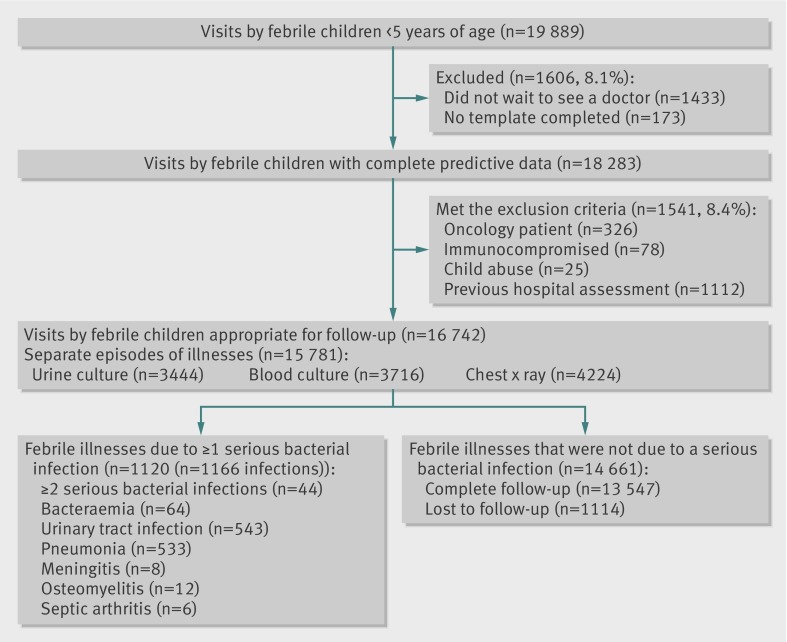
15,781 cases of children under 5 years of age presenting with a febrile illness.

MAIN OUTCOME MEASURES

Clinical features were used to categorise each febrile episodes as low, intermediate, or high probability of serious bacterial infection (green, amber, and red zones of the traffic light system); these results were checked (using standard radiological and microbiological tests) for each of the infections of interest and for any serious bacterial infection.

RESULTS

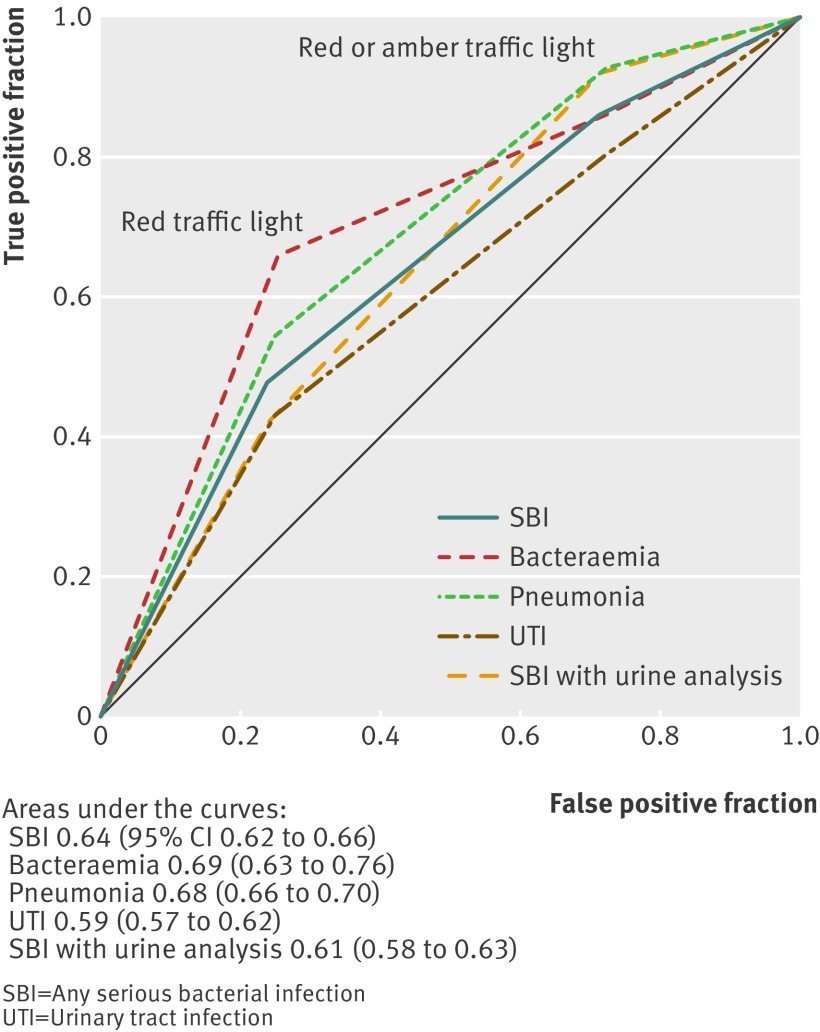
After combination of the intermediate and high risk categories, the NICE traffic light system had a test sensitivity of 85.8% (95% confidence interval 83.6% to 87.7%) and specificity of 28.5% (27.8% to 29.3%) for the detection of any serious bacterial infection. Of the 1140 cases of serious bacterial infection, 157 (13.8%) were test negative (in the green zone), and, of these, 108 (68.8%) were urinary tract infections. Adding urine analysis (leucocyte esterase or nitrite positive), reported in 3653 (23.1%) episodes, to the traffic light system improved the test performance: sensitivity 92.1% (89.3% to 94.1%), specificity 22.3% (20.9% to 23.8%), and relative positive likelihood ratio 1.10 (1.06 to 1.14).

CONCLUSION

The NICE traffic light system failed to identify a substantial proportion of serious bacterial infections, particularly urinary tract infections. The addition of urine analysis significantly improved test sensitivity, making the traffic light system a more useful triage tool for the detection of serious bacterial infections in young febrile children.

摘要

目的

确定国家卫生与临床优化研究所(NICE)开发的临床决策规则(红绿灯系统)用于检测年轻发热儿童三种常见严重细菌感染(尿路感染、肺炎和菌血症)的准确性。

设计

对一项为期两年的前瞻性队列研究数据的回顾性分析。

设置

儿科急诊室。

参与者

15781 例 5 岁以下发热儿童。

主要观察指标

临床特征用于将每个发热病例分类为低、中、高严重细菌感染概率(红绿灯系统的绿、黄、红区);对于所有感兴趣的感染和任何严重细菌感染,都检查了这些结果(使用标准放射学和微生物学检查)。

结果

将中间风险和高风险类别合并后,NICE 红绿灯系统检测任何严重细菌感染的敏感度为 85.8%(95%置信区间 83.6%至 87.7%),特异性为 28.5%(27.8%至 29.3%)。在 1140 例严重细菌感染中,有 157 例(13.8%)检测结果为阴性(在绿区),其中 108 例(68.8%)为尿路感染。将红绿灯系统中报告的 3653 例(23.1%)尿液分析(白细胞酯酶或亚硝酸盐阳性)纳入其中,提高了检测性能:敏感度 92.1%(89.3%至 94.1%),特异性 22.3%(20.9%至 23.8%),相对阳性似然比 1.10(1.06 至 1.14)。

结论

NICE 红绿灯系统未能识别出相当一部分严重细菌感染,尤其是尿路感染。添加尿液分析显著提高了检测敏感度,使红绿灯系统成为检测年轻发热儿童严重细菌感染更有用的分诊工具。
https://cdn.ncbi.nlm.nih.gov/pmc/blobs/0c70/4790768/96295b7d42c8/sukd008023.f2_default.jpg
https://cdn.ncbi.nlm.nih.gov/pmc/blobs/0c70/4790768/d33e8803b204/sukd008023.f1_default.jpg
https://cdn.ncbi.nlm.nih.gov/pmc/blobs/0c70/4790768/96295b7d42c8/sukd008023.f2_default.jpg
https://cdn.ncbi.nlm.nih.gov/pmc/blobs/0c70/4790768/d33e8803b204/sukd008023.f1_default.jpg
https://cdn.ncbi.nlm.nih.gov/pmc/blobs/0c70/4790768/96295b7d42c8/sukd008023.f2_default.jpg

相似文献

1
Accuracy of the "traffic light" clinical decision rule for serious bacterial infections in young children with fever: a retrospective cohort study.“红绿灯”临床决策规则对发热幼儿严重细菌感染的准确性:一项回顾性队列研究。
BMJ. 2013 Feb 13;346:f866. doi: 10.1136/bmj.f866.
2
The accuracy of clinical symptoms and signs for the diagnosis of serious bacterial infection in young febrile children: prospective cohort study of 15 781 febrile illnesses.临床症状和体征对诊断发热儿童严重细菌感染的准确性:15781 例发热疾病的前瞻性队列研究。
BMJ. 2010 Apr 20;340:c1594. doi: 10.1136/bmj.c1594.
3
Value of white cell count in predicting serious bacterial infection in febrile children under 5 years of age.白细胞计数在预测 5 岁以下发热儿童严重细菌感染中的价值。
Arch Dis Child. 2014 Jun;99(6):493-9. doi: 10.1136/archdischild-2013-304754. Epub 2014 Jan 9.
4
Analysis of emergency department prediction tools in evaluating febrile young infants at risk for serious infections.分析评估有严重感染风险的发热婴幼儿的急诊科预测工具。
Emerg Med J. 2019 Dec;36(12):729-735. doi: 10.1136/emermed-2018-208210. Epub 2019 Oct 25.
5
Is the NICE traffic light system fit-for-purpose for children presenting with undifferentiated acute illness in primary care?英国国家卫生与临床优化研究所(NICE)的交通信号灯系统是否适用于基层医疗中出现未分化急性疾病的儿童?
Arch Dis Child. 2022 May;107(5):444-449. doi: 10.1136/archdischild-2021-322768. Epub 2021 Sep 21.
6
A Clinical Prediction Rule to Identify Febrile Infants 60 Days and Younger at Low Risk for Serious Bacterial Infections.一种用于识别 60 天及以下发热婴儿中患有严重细菌感染低风险的临床预测规则。
JAMA Pediatr. 2019 Apr 1;173(4):342-351. doi: 10.1001/jamapediatrics.2018.5501.
7
Clinical prediction model to aid emergency doctors managing febrile children at risk of serious bacterial infections: diagnostic study.临床预测模型辅助急诊医生管理有严重细菌感染风险的发热儿童:诊断研究。
BMJ. 2013 Apr 2;346:f1706. doi: 10.1136/bmj.f1706.
8
Predictors of fever-related admissions to a paediatric assessment unit, ward and reattendances in a South London emergency department: the CABIN 2 study.伦敦南部急诊科儿科评估单元、病房发热相关入院及再就诊的预测因素:CABIN 2研究
Arch Dis Child. 2017 Jan;102(1):22-28. doi: 10.1136/archdischild-2016-310494. Epub 2016 Aug 22.
9
Value of parental concern and clinician's gut feeling in recognition of serious bacterial infections: a prospective observational study.父母的关注和临床医生的直觉在识别严重细菌感染中的价值:一项前瞻性观察研究。
BMC Pediatr. 2019 Jul 3;19(1):219. doi: 10.1186/s12887-019-1591-7.
10
Neutrophil CD64 expression is not a useful biomarker for detecting serious bacterial infections in febrile children at the emergency department.中性粒细胞CD64表达并非用于检测急诊科发热儿童严重细菌感染的有效生物标志物。
Infect Dis (Lond). 2016;48(5):331-7. doi: 10.3109/23744235.2015.1118156. Epub 2015 Dec 16.

引用本文的文献

1
Aspects of triage for infants: a narrative review.婴儿分诊的各个方面:一篇叙述性综述。
Eur J Pediatr. 2025 Apr 12;184(5):294. doi: 10.1007/s00431-025-06127-3.
2
Pediatric simple triage score: A simplified approach for triaging pediatric patients with fever in the emergency department.儿科简易分诊评分:急诊科对发热儿科患者进行分诊的一种简化方法。
Turk J Emerg Med. 2025 Jan 2;25(1):25-31. doi: 10.4103/tjem.tjem_101_24. eCollection 2025 Jan-Mar.
3
Identifying serious bacterial illness in children: is it time to show the red card to NICE's red flags?

本文引用的文献

1
Changing epidemiology of serious bacterial infections in febrile infants without localizing signs.发热而无局部体征的婴儿严重细菌感染的流行病学变化。
PLoS One. 2010 Aug 27;5(8):e12448. doi: 10.1371/journal.pone.0012448.
2
The accuracy of clinical symptoms and signs for the diagnosis of serious bacterial infection in young febrile children: prospective cohort study of 15 781 febrile illnesses.临床症状和体征对诊断发热儿童严重细菌感染的准确性:15781 例发热疾病的前瞻性队列研究。
BMJ. 2010 Apr 20;340:c1594. doi: 10.1136/bmj.c1594.
3
Absolute and relative accuracy of rapid urine tests for urinary tract infection in children: a meta-analysis.
识别儿童严重细菌性疾病:是时候对英国国家卫生与临床优化研究所(NICE)的警示信号亮出红牌了吗?
Br J Gen Pract. 2023 Aug 31;73(734):426-427. doi: 10.3399/bjgp23X734937. Print 2023 Sep.
4
Differentiating vaccine reactions from invasive bacterial infections in young infants presenting to the emergency department in the 4CMenB era: a retrospective observational comparison.在 4CMenB 时代,将幼儿在急诊科就诊时的疫苗反应与侵袭性细菌感染区分开来:一项回顾性观察比较。
BMJ Paediatr Open. 2022 Oct;6(1). doi: 10.1136/bmjpo-2022-001559.
5
Accuracy of the NICE traffic light system in children presenting to general practice: a retrospective cohort study.NICE 交通灯系统在普通科诊所就诊儿童中的准确性:一项回顾性队列研究。
Br J Gen Pract. 2022 May 26;72(719):e398-e404. doi: 10.3399/BJGP.2021.0633. Print 2022 Jun.
6
Integrating Clinical Signs at Presentation and Clinician's Non-analytical Reasoning in Prediction Models for Serious Bacterial Infection in Febrile Children Presenting to Emergency Department.将就诊时的临床体征与临床医生的非分析性推理纳入急诊科发热儿童严重细菌感染预测模型中。
Front Pediatr. 2022 Apr 25;10:786795. doi: 10.3389/fped.2022.786795. eCollection 2022.
7
Diagnostic value of biomarkers for paediatric urinary tract infections in primary care: systematic review and meta-analysis.基层医疗中生物标志物对小儿尿路感染的诊断价值:系统评价与Meta分析
BMC Fam Pract. 2021 Sep 27;22(1):193. doi: 10.1186/s12875-021-01530-9.
8
A NICE combination for predicting hospitalisation at the Emergency Department: a European multicentre observational study of febrile children.预测急诊科住院情况的理想组合:一项针对发热儿童的欧洲多中心观察性研究
Lancet Reg Health Eur. 2021 Jul 12;8:100173. doi: 10.1016/j.lanepe.2021.100173. eCollection 2021 Sep.
9
Clinical Features for the Diagnosis of Pediatric Urinary Tract Infections: Systematic Review and Meta-Analysis.临床特征用于儿科尿路感染诊断:系统评价和荟萃分析。
Ann Fam Med. 2021 Sep-Oct;19(5):437-446. doi: 10.1370/afm.2684.
10
Prevalence of Bacterial Meningitis Among Febrile Infants Aged 29-60 Days With Positive Urinalysis Results: A Systematic Review and Meta-analysis.29-60 天发热婴儿尿检阳性者中细菌性脑膜炎的流行率:系统评价和荟萃分析。
JAMA Netw Open. 2021 May 3;4(5):e214544. doi: 10.1001/jamanetworkopen.2021.4544.
快速尿液检测在儿童尿路感染中的绝对和相对准确性:荟萃分析。
Lancet Infect Dis. 2010 Apr;10(4):240-50. doi: 10.1016/S1473-3099(10)70031-1.
4
Appropriate statistical methods are required to assess diagnostic tests for replacement, add-on, and triage.需要适当的统计方法来评估替代、附加和分诊诊断测试。
J Clin Epidemiol. 2010 Aug;63(8):883-91. doi: 10.1016/j.jclinepi.2009.08.024. Epub 2010 Jan 15.
5
How well do vital signs identify children with serious infections in paediatric emergency care?在儿科急诊护理中,生命体征对识别患有严重感染的儿童效果如何?
Arch Dis Child. 2009 Nov;94(11):888-93. doi: 10.1136/adc.2009.159095. Epub 2009 Jul 15.
6
Occult bacteremia in the post-pneumococcal conjugate vaccine era: does the blood culture stop here?肺炎球菌结合疫苗时代的隐匿性菌血症:血培养就此止步了吗?
Acad Emerg Med. 2009 Mar;16(3):258-60. doi: 10.1111/j.1553-2712.2008.00345.x. Epub 2009 Jan 9.
7
Management of infants and young children with fever without source.不明原因发热婴幼儿的管理
Pediatr Ann. 2008 Oct;37(10):673-9. doi: 10.3928/00904481-20081001-01.
8
Outcomes of febrile children without localising signs after pneumococcal conjugate vaccine.肺炎球菌结合疫苗接种后无定位体征的发热儿童的结局
Arch Dis Child. 2009 Feb;94(2):144-7. doi: 10.1136/adc.2007.130583. Epub 2008 Jun 6.
9
Procalcitonin and C-reactive protein as diagnostic markers of severe bacterial infections in febrile infants and children in the emergency department.降钙素原和C反应蛋白作为急诊科发热婴幼儿严重细菌感染的诊断标志物
Pediatr Infect Dis J. 2007 Aug;26(8):672-7. doi: 10.1097/INF.0b013e31806215e3.
10
Assessment and initial management of feverish illness in children younger than 5 years: summary of NICE guidance.5岁以下儿童发热性疾病的评估与初始管理:英国国家卫生与临床优化研究所指南摘要
BMJ. 2007 Jun 2;334(7604):1163-4. doi: 10.1136/bmj.39218.495255.AE.