Department of Cardiology and Angiology I, University Heart Center Freiburg, Freiburg, Germany.
PLoS One. 2013;8(2):e53103. doi: 10.1371/journal.pone.0053103. Epub 2013 Feb 7.
The endothelial protein C-receptor (EPCR) is an endothelial transmembrane protein that binds protein C and activated protein C (APC) with equal affinity, thereby facilitating APC formation. APC has anticoagulant, antiapoptotic and antiinflammatory properties. Soluble EPCR, released by the endothelium, may bind activated neutrophils, thereby modulating cell adhesion. EPCR is therefore considered as a possible link between the anticoagulant properties of protein C and the inflammatory response of neutrophils. In the present study, we aimed to provide proof of concept for a direct binding of EPCR to the β2-integrin Mac-1 on monocytic cells under static and physiological flow conditions.
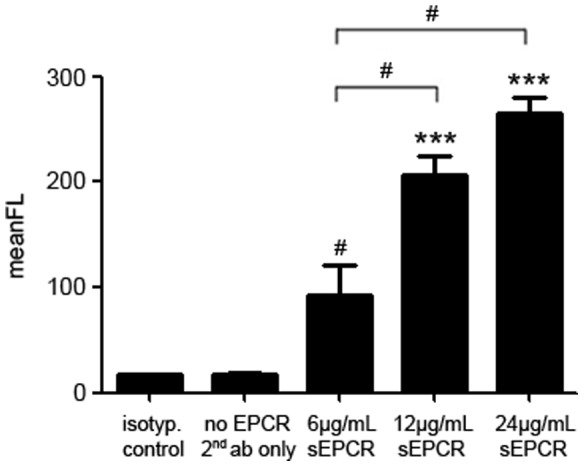
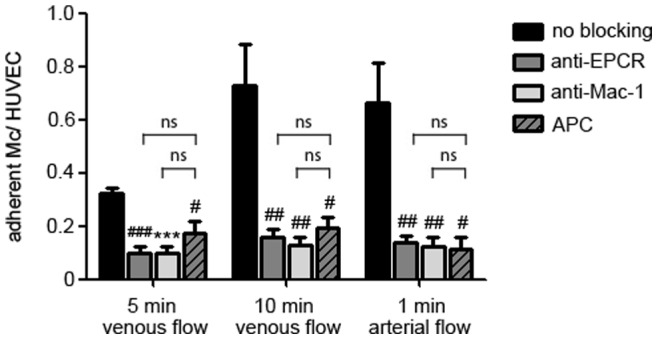
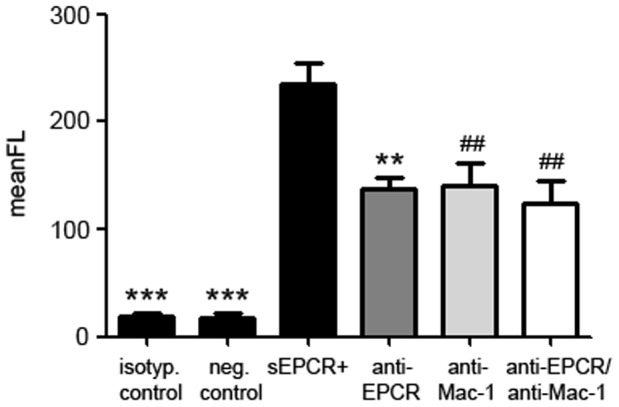
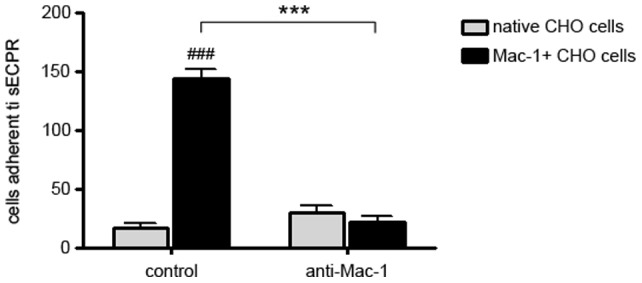
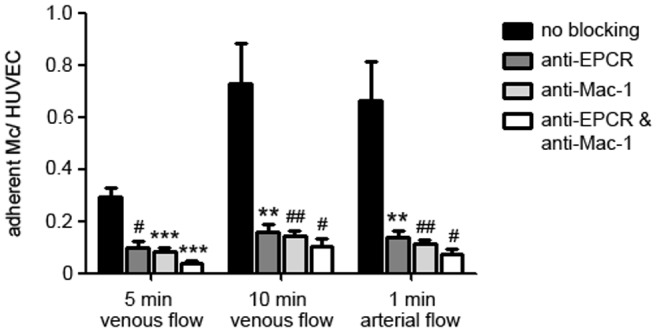
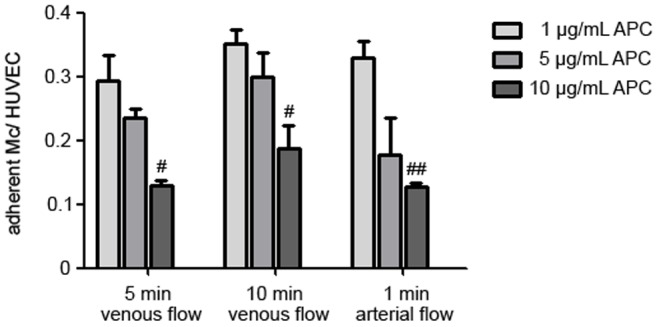
Under static conditions, human monocytes bind soluble EPCR in a concentration dependent manner, as demonstrated by flow cytometry. Binding can be inhibited by specific antibodies (anti-EPCR and anti-Mac-1). Specific binding was confirmed by a static adhesion assay, where a transfected Mac-1 expressing CHO cell line (Mac-1+ cells) bound significantly more recombinant EPCR compared to Mac-1+ cells blocked by anti-Mac-1-antibody and native CHO cells. Under physiological flow conditions, monocyte binding to the endothelium could be significantly blocked by both, anti-EPCR and anti-Mac-1 antibodies in a dynamic adhesion assay at physiological flow conditions. Pre-treatment of endothelial cells with APC (drotrecogin alfa) diminished monocyte adhesion significantly in a comparable extent to anti-EPCR.
In the present study, we demonstrate a direct binding of Mac-1 on monocytes to the endothelial protein C receptor under static and flow conditions. This binding suggests a link between the protein C anticoagulant pathway and inflammation at the endothelium side, such as in acute vascular inflammation or septicaemia.
内皮蛋白 C 受体(EPCR)是一种内皮跨膜蛋白,它以相等的亲和力结合蛋白 C 和激活蛋白 C(APC),从而促进 APC 的形成。APC 具有抗凝、抗凋亡和抗炎特性。内皮细胞释放的可溶性 EPCR 可能与激活的中性粒细胞结合,从而调节细胞黏附。因此,EPCR 被认为是蛋白 C 的抗凝特性与中性粒细胞炎症反应之间的可能联系。在本研究中,我们旨在提供证据证明在静态和生理流动条件下,EPCR 直接与单核细胞上的β2-整合素 Mac-1 结合。
在静态条件下,如流式细胞术所示,人单核细胞以浓度依赖的方式结合可溶性 EPCR。结合可以被特异性抗体(抗 EPCR 和抗 Mac-1)抑制。通过静态黏附测定证实了特异性结合,其中转染的表达 Mac-1 的 CHO 细胞系(Mac-1+细胞)与被抗 Mac-1 抗体阻断的 Mac-1+细胞和天然 CHO 细胞相比,显著结合更多的重组 EPCR。在生理流动条件下,在生理流动条件下的动态黏附测定中,单核细胞与内皮细胞的结合可以被抗 EPCR 和抗 Mac-1 抗体显著阻断。内皮细胞用 APC(重组人活化蛋白 C)预处理可显著减少单核细胞黏附,与抗 EPCR 相似。
在本研究中,我们在静态和流动条件下证明了单核细胞上的 Mac-1 与内皮蛋白 C 受体的直接结合。这种结合表明,在急性血管炎症或败血症等情况下,蛋白 C 抗凝途径与内皮侧炎症之间存在联系。