Division of Allergy and Respiratory Medicine, Department of Internal Medicine, Soonchunhyang University Bucheon Hospital, Bucheon, Gyeonggi-Do, South Korea.
PLoS One. 2013;8(2):e55827. doi: 10.1371/journal.pone.0055827. Epub 2013 Feb 8.
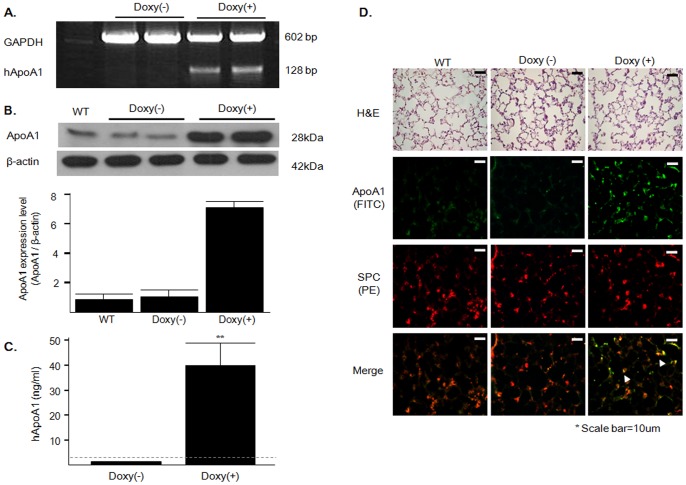
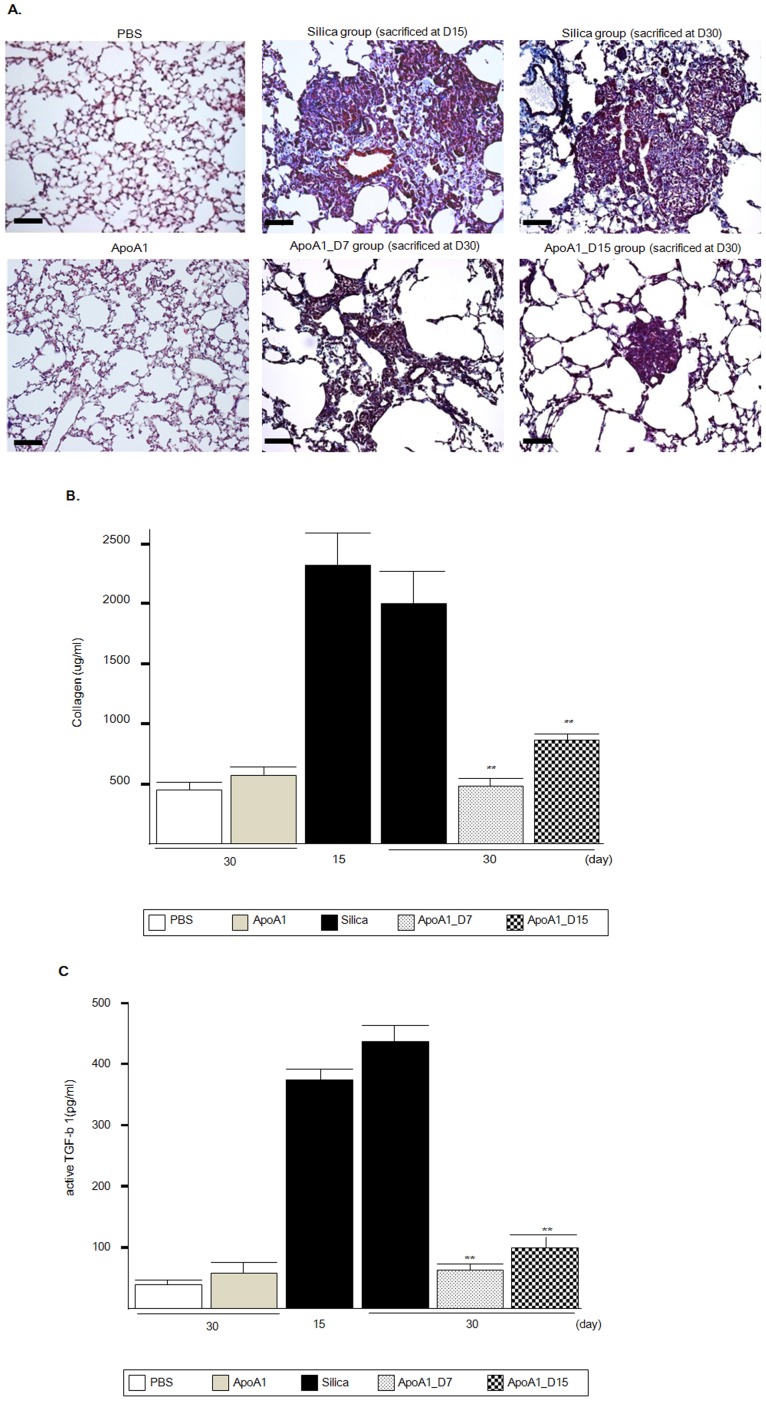
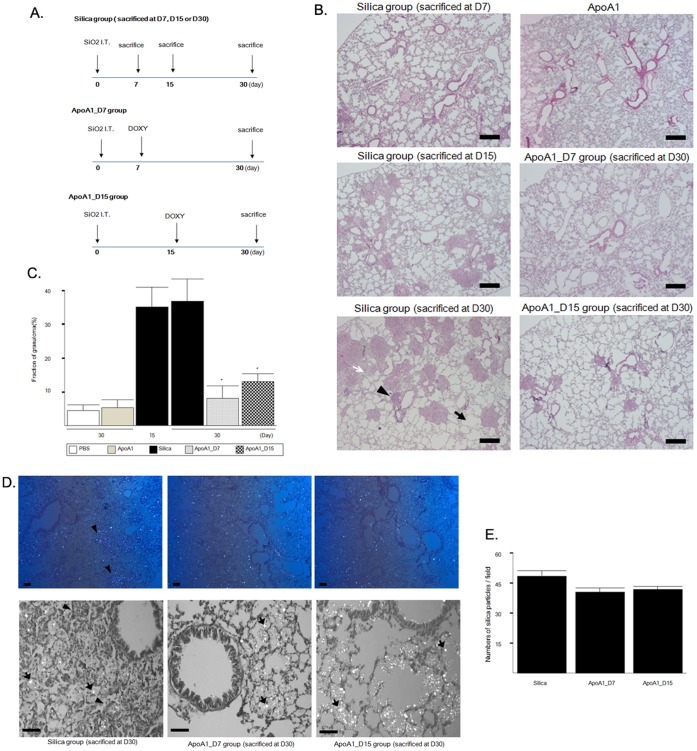
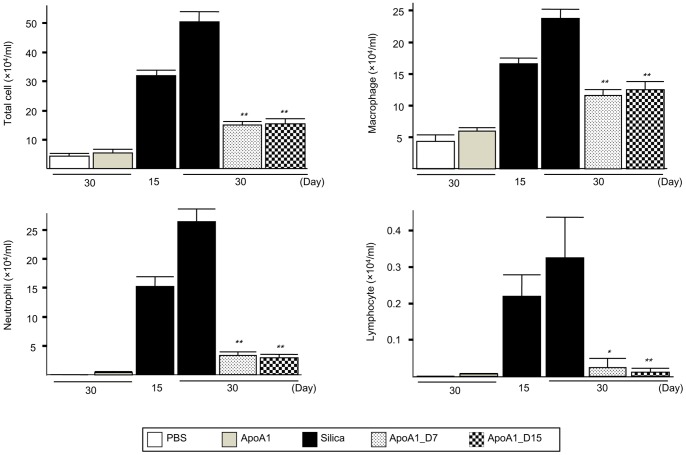
The inhalation of silica particles induces silicosis, an inflammatory and fibrotic lung disease characterized by the early accumulation of macrophages and neutrophils in the airspace and subsequent appearance of silicotic nodules as a result of progressive fibrosis. This study evaluated whether apolipoprotein A1 (ApoA1) protects against ongoing fibrosis and promotes the resolution of established experimental lung silicosis. Crystallized silica was intratracheally administered to 6- to 8-week-old transgenic mice expressing human ApoA1 in their alveolar epithelial cells (day 0). ApoA1 was overexpressed beginning on day 7 (ApoA1_D7 group) or day 15 (ApoA1_D15 group). The mice were sacrificed on day 30 for an evaluation of lung histology; the measurement of collagen, transforming growth factor-b1 and lipoxin A4; and a TUNEL assay for apoptotic cells. The ApoA1_D7 and D15 groups showed significant reductions in the silica-induced increase in inflammatory cells, silicotic nodule area, and collagen deposition compared with the silica-treated ApoA1 non-overexpressing mice. The level of transforming growth factor-b1 decreased in the bronchoalveolar lavage fluid, whereas lipoxin A4 was increased in the ApoA1_D7 and D15 groups compared with the silica-treated ApoA1 non-overexpressing mice. The silica-induced increase in the number of apoptotic cells was significantly reduced in the lungs of mice overexpressing ApoA1. Overexpression of ApoA1 decreased silica-induced lung inflammation and fibrotic nodule formation. The restoration of lipoxin A4 may contribute to the protective effect of ApoA1 overexpression against silica-induced lung fibrosis.
吸入二氧化硅颗粒会导致矽肺,这是一种炎症性和纤维化的肺部疾病,其特征是早期在气腔中积累巨噬细胞和中性粒细胞,随后由于进行性纤维化而出现矽肺结节。本研究评估了载脂蛋白 A1(ApoA1)是否能预防进行性纤维化,并促进已建立的实验性肺矽肺的消退。将结晶二氧化硅通过气管内给药到肺泡上皮细胞中表达人 ApoA1 的 6-8 周龄转基因小鼠(第 0 天)。从第 7 天(ApoA1_D7 组)或第 15 天(ApoA1_D15 组)开始过表达 ApoA1。第 30 天处死小鼠,评估肺组织学;测量胶原、转化生长因子-b1 和脂氧素 A4;以及 TUNEL 法检测凋亡细胞。与未过表达 ApoA1 的二氧化硅处理组相比,ApoA1_D7 和 D15 组显示出炎症细胞、矽肺结节面积和胶原沉积的显著减少。转化生长因子-b1 的水平在支气管肺泡灌洗液中降低,而脂氧素 A4 在 ApoA1_D7 和 D15 组中增加。与未过表达 ApoA1 的二氧化硅处理组相比,过表达 ApoA1 可显著减少二氧化硅诱导的细胞凋亡增加。ApoA1 的过表达可减少二氧化硅引起的肺部炎症和纤维性结节形成。脂氧素 A4 的恢复可能有助于 ApoA1 过表达对二氧化硅诱导的肺纤维化的保护作用。