
群体感应诱导的噬菌体防御机制。
A quorum-sensing-induced bacteriophage defense mechanism.
机构信息
Institute of Biology, University of Copenhagen, Copenhagen, Denmark.
出版信息
mBio. 2013 Feb 19;4(1):e00362-12. doi: 10.1128/mBio.00362-12.
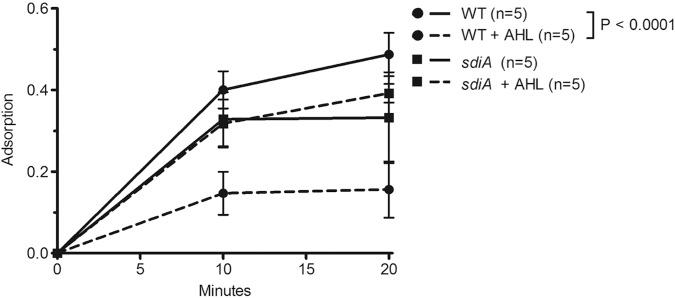
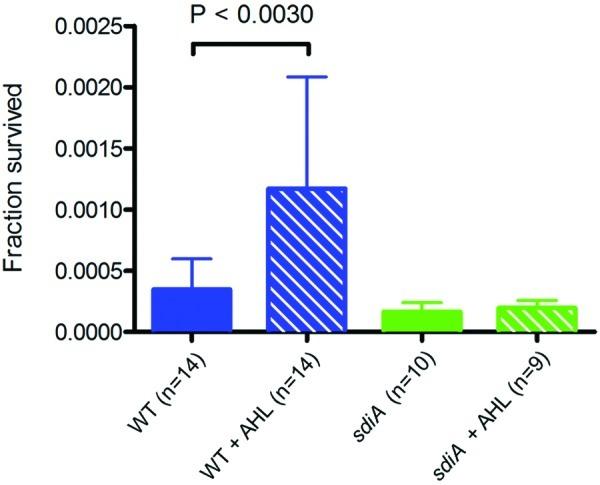
One of the key determinants of the size, composition, structure, and development of a microbial community is the predation pressure by bacteriophages. Accordingly, bacteria have evolved a battery of antiphage defense strategies. Since maintaining constantly elevated defenses is costly, we hypothesize that some bacteria have additionally evolved the abilities to estimate the risk of phage infection and to adjust their strategies accordingly. One risk parameter is the density of the bacterial population. Hence, quorum sensing, i.e., the ability to regulate gene expression according to population density, may be an important determinant of phage-host interactions. This hypothesis was investigated in the model system of Escherichia coli and phage λ. We found that, indeed, quorum sensing constitutes a significant, but so far overlooked, determinant of host susceptibility to phage attack. Specifically, E. coli reduces the numbers of λ receptors on the cell surface in response to N-acyl-l-homoserine lactone (AHL) quorum-sensing signals, causing a 2-fold reduction in the phage adsorption rate. The modest reduction in phage adsorption rate leads to a dramatic increase in the frequency of uninfected survivor cells after a potent attack by virulent phages. Notably, this mechanism may apply to a broader range of phages, as AHLs also reduce the risk of χ phage infection through a different receptor. IMPORTANCE To enable the successful manipulation of bacterial populations, a comprehensive understanding of the factors that naturally shape microbial communities is required. One of the key factors in this context is the interactions between bacteria and the most abundant biological entities on Earth, namely, the bacteriophages that prey on bacteria. This proof-of-principle study shows that quorum sensing plays an important role in determining the susceptibility of E. coli to infection by bacteriophages λ and χ. On the basis of our findings in the classical Escherichia coli-λ model system, we suggest that quorum sensing may serve as a general strategy to protect bacteria specifically under conditions of high risk of infection.
噬菌体的捕食压力是决定微生物群落大小、组成、结构和发展的关键因素之一。相应地,细菌已经进化出了一系列抗噬菌体防御策略。由于维持不断提高的防御水平是有代价的,我们假设一些细菌还进化出了估计噬菌体感染风险并相应调整其策略的能力。一个风险参数是细菌种群的密度。因此,群体感应,即根据种群密度调节基因表达的能力,可能是噬菌体-宿主相互作用的一个重要决定因素。在大肠杆菌和噬菌体 λ 的模型系统中,我们研究了这一假说。我们发现,事实上,群体感应确实是宿主对噬菌体攻击易感性的一个重要但迄今为止被忽视的决定因素。具体来说,大肠杆菌会根据 N-酰基高丝氨酸内酯 (AHL) 群体感应信号减少细胞表面上的 λ 受体数量,导致噬菌体吸附率降低 2 倍。这种温和的噬菌体吸附率降低会导致在强毒性噬菌体攻击后,未感染存活细胞的频率显著增加。值得注意的是,这种机制可能适用于更广泛的噬菌体,因为 AHL 还通过不同的受体降低 χ 噬菌体感染的风险。
重要性
为了成功地操纵细菌种群,需要全面了解自然塑造微生物群落的因素。在这方面的一个关键因素是细菌与地球上最丰富的生物实体(即捕食细菌的噬菌体)之间的相互作用。这项原理验证研究表明,群体感应在决定大肠杆菌对噬菌体 λ 和 χ 的易感性方面起着重要作用。基于我们在经典大肠杆菌-λ 模型系统中的发现,我们认为群体感应可能是一种保护细菌的通用策略,特别是在高感染风险的情况下。


 Zotero 插件