Department of Neurosciences, Medical University of South Carolina, 173 Ashley Avenue, 403 BSB, Charleston, SC 29425, USA.
Curr Opin Neurobiol. 2013 Aug;23(4):546-52. doi: 10.1016/j.conb.2013.01.026. Epub 2013 Feb 18.
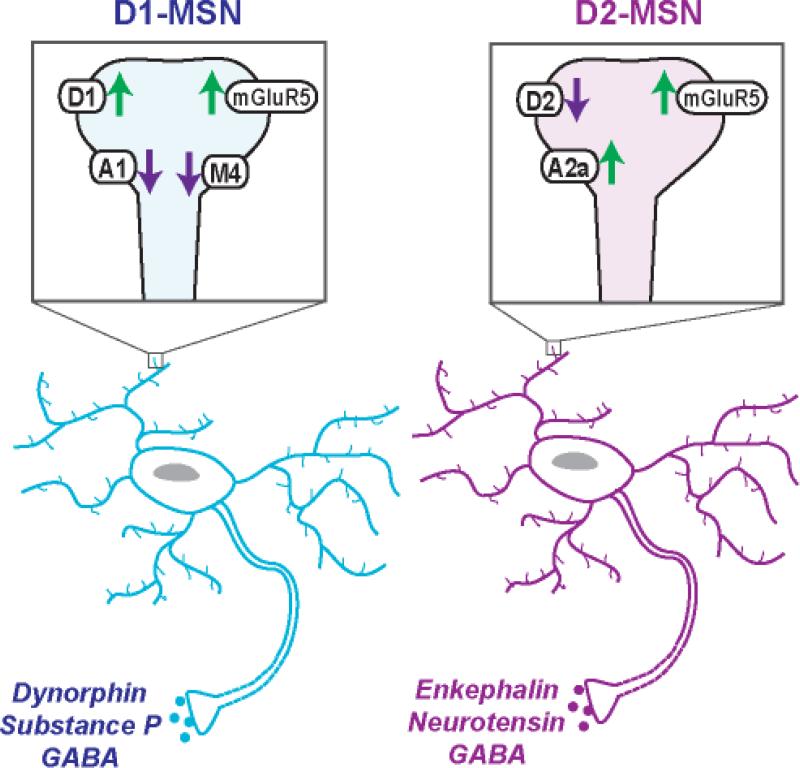
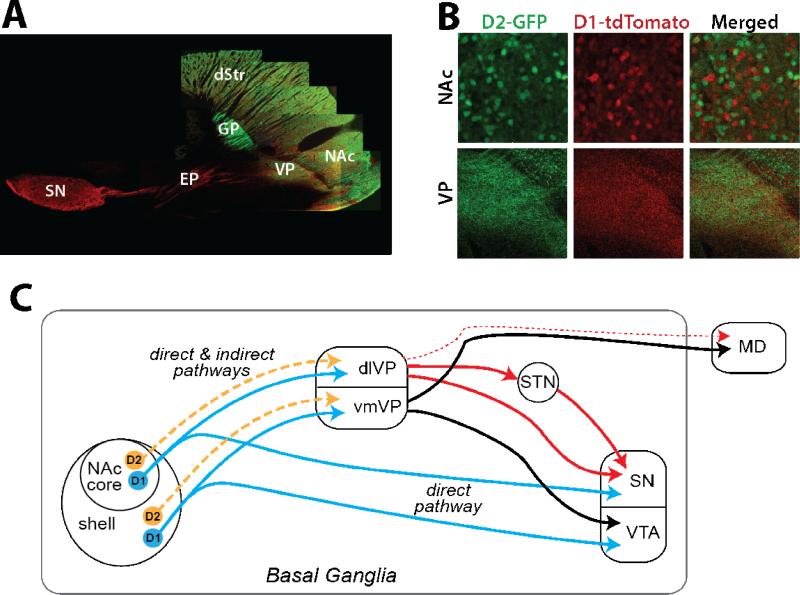
Cocaine exposure causes enduring neuroadaptations in ventral striatum, or nucleus accumbens (NAc), an area critically involved in reward learning and relapse of drug seeking. Medium spiny neurons (MSNs) in striatum are dichotomous in their expression of either D1 or D2 dopamine receptors, along with other receptors and neuropeptides. In dorsal striatum, these two subpopulations show non-overlapping innervation of distinct terminal fields via the direct or indirect pathways. However, NAc D1-MSNs and D2-MSNs are not fully segregated in this manner, with both cell types innervating ventral pallidum. Recent studies show that D1-MSNs and D2-MSNs play opposing roles in cocaine-associated behaviors. Further, cocaine induces differential adaptations in these two subpopulations in NAc, including changes to synaptic plasticity, glutamatergic signaling, and spine morphology.
可卡因暴露会导致腹侧纹状体(或伏隔核)产生持久的神经适应,腹侧纹状体是一个与奖励学习和药物寻求复发密切相关的区域。纹状体中的中间神经元(MSNs)在表达 D1 或 D2 多巴胺受体以及其他受体和神经肽方面存在二分法。在背侧纹状体中,这两种亚群通过直接或间接途径,对不同的终端场进行非重叠的神经支配。然而,NAc 中的 D1-MSNs 和 D2-MSNs 并没有以这种方式完全分离,这两种细胞类型都支配腹侧苍白球。最近的研究表明,D1-MSNs 和 D2-MSNs 在可卡因相关行为中发挥着相反的作用。此外,可卡因在 NAc 中诱导这两个亚群的不同适应,包括对突触可塑性、谷氨酸能信号和棘突形态的改变。