1] Department of Human Genetics, Leiden University Medical Center, Leiden, The Netherlands [2] Department of Gerontology and Geriatrics, Leiden University Medical Center, Leiden, The Netherlands.
Eur J Hum Genet. 2013 Oct;21(10):1134-9. doi: 10.1038/ejhg.2013.12. Epub 2013 Feb 27.
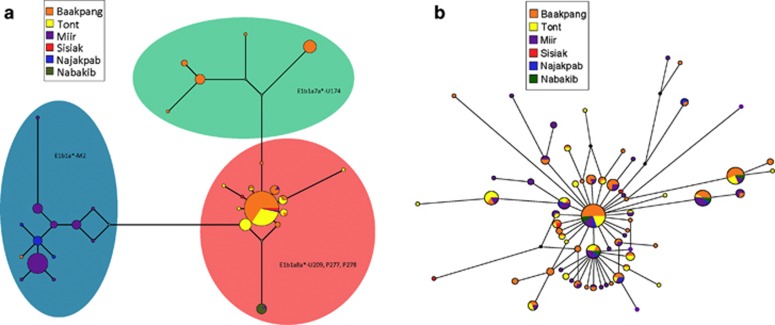
Socioeconomic and cultural factors are thought to have an important role in influencing human population genetic structure. To explain such population structure differences, most studies analyse genetic differences among widely dispersed human populations. In contrast, we have studied the genetic structure of an ethnic group occupying a single village in north-eastern Ghana. We found a markedly skewed male population substructure because of an almost complete lack of male gene flow among Bimoba clans in this village. We also observed a deep male substructure within one of the clans in this village. Among all males, we observed only three Y-single-nucleotide polymorphism (SNP) haplogroups: E1b1a*-M2, E1b1a7a*-U174 and E1b1a8a*-U209, P277, P278. In contrast to the marked Y-chromosomal substructure, mitochondrial DNA HVS-1 sequence variation and autosomal short-tandem repeats variation patterns indicate high genetic diversities and a virtually random female-mediated gene flow among clans. On the extreme micro-geographical scale of this single Bimoba village, correspondence between the Y-chromosome lineages and clan membership could be due to the combined effects of the strict patrilocal and patrilineal structure. If translated to larger geographic scales, our results would imply that the extent of variation in uniparentally inherited genetic markers, which are typically associated with historical migration on a continental scale, could equally likely be the result of many small and different cumulative effects of social factors such as clan membership that act at a local scale. Such local scale effects should therefore be considered in genetic studies, especially those that use uniparental markers, before making inferences about human history at large.
社会经济和文化因素被认为在影响人类群体遗传结构方面起着重要作用。为了解释这种人口结构差异,大多数研究分析了广泛分布的人类群体之间的遗传差异。相比之下,我们研究了一个居住在加纳东北部一个村庄的族群的遗传结构。我们发现,由于这个村庄的比莫巴部落之间几乎完全缺乏男性基因流动,男性人口亚结构明显偏斜。我们还观察到这个村庄的一个部落内部存在很深的男性亚结构。在所有男性中,我们只观察到三个 Y 单核苷酸多态性(SNP)单倍群:E1b1a*-M2、E1b1a7a*-U174 和 E1b1a8a*-U209、P277、P278。与明显的 Y 染色体亚结构形成鲜明对比的是,线粒体 DNA HVS-1 序列变异和常染色体短串联重复变异模式表明,各个部落之间存在高度的遗传多样性和几乎随机的女性介导的基因流动。在这个比莫巴村庄的极端微观地理尺度上,Y 染色体谱系与部落成员之间的对应关系可能是由于严格的父居和父系结构的综合影响。如果将我们的结果转化到更大的地理尺度上,这意味着在典型上与大陆范围内历史迁徙相关的单倍体遗传标记的变异程度,同样可能是部落成员等社会因素在局部尺度上的许多不同的累积效应的结果。因此,在进行遗传研究时,尤其是在使用单倍体标记进行研究时,应该考虑到这些局部尺度的影响,然后再对人类历史进行推断。