Australian Centre for Ancient DNA, School of Earth and Environmental Sciences, University of Adelaide, Adelaide, Australia.
PLoS Biol. 2010 Nov 9;8(11):e1000536. doi: 10.1371/journal.pbio.1000536.
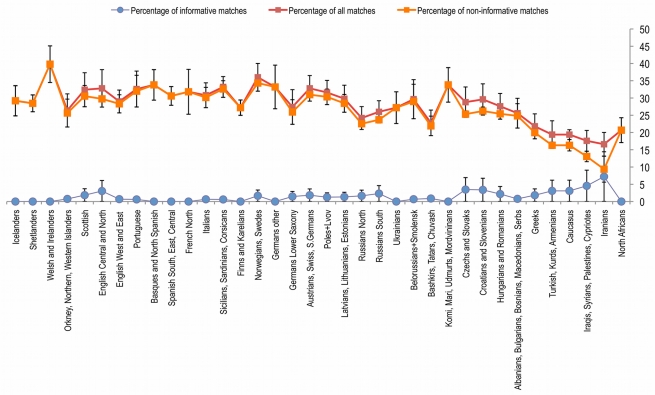
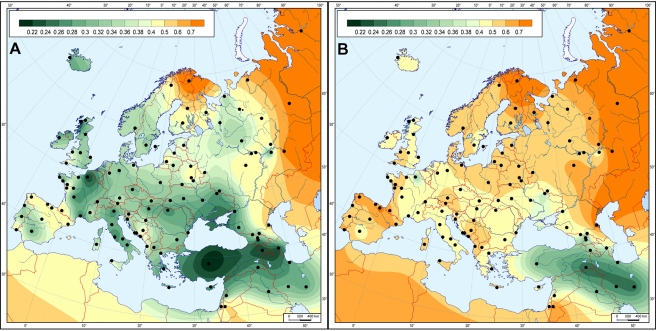
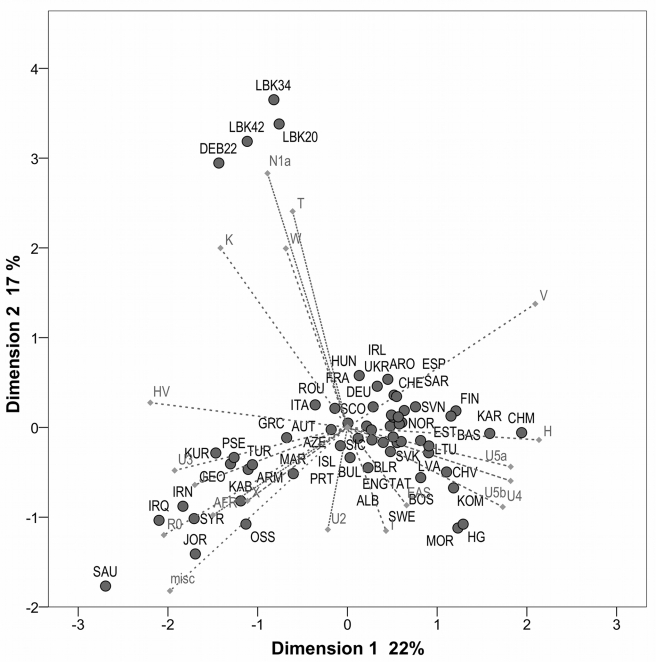
In Europe, the Neolithic transition (8,000-4,000 B.C.) from hunting and gathering to agricultural communities was one of the most important demographic events since the initial peopling of Europe by anatomically modern humans in the Upper Paleolithic (40,000 B.C.). However, the nature and speed of this transition is a matter of continuing scientific debate in archaeology, anthropology, and human population genetics. To date, inferences about the genetic make up of past populations have mostly been drawn from studies of modern-day Eurasian populations, but increasingly ancient DNA studies offer a direct view of the genetic past. We genetically characterized a population of the earliest farming culture in Central Europe, the Linear Pottery Culture (LBK; 5,500-4,900 calibrated B.C.) and used comprehensive phylogeographic and population genetic analyses to locate its origins within the broader Eurasian region, and to trace potential dispersal routes into Europe. We cloned and sequenced the mitochondrial hypervariable segment I and designed two powerful SNP multiplex PCR systems to generate new mitochondrial and Y-chromosomal data from 21 individuals from a complete LBK graveyard at Derenburg Meerenstieg II in Germany. These results considerably extend the available genetic dataset for the LBK (n = 42) and permit the first detailed genetic analysis of the earliest Neolithic culture in Central Europe (5,500-4,900 calibrated B.C.). We characterized the Neolithic mitochondrial DNA sequence diversity and geographical affinities of the early farmers using a large database of extant Western Eurasian populations (n = 23,394) and a wide range of population genetic analyses including shared haplotype analyses, principal component analyses, multidimensional scaling, geographic mapping of genetic distances, and Bayesian Serial Simcoal analyses. The results reveal that the LBK population shared an affinity with the modern-day Near East and Anatolia, supporting a major genetic input from this area during the advent of farming in Europe. However, the LBK population also showed unique genetic features including a clearly distinct distribution of mitochondrial haplogroup frequencies, confirming that major demographic events continued to take place in Europe after the early Neolithic.
在欧洲,从狩猎采集到农业社区的新石器时代转型(公元前 8000 年至 4000 年)是自解剖学上的现代人在旧石器时代晚期(公元前 40000 年)最初进入欧洲以来最重要的人口事件之一。然而,这一转型的性质和速度在考古学、人类学和人类群体遗传学中仍然是一个持续的科学争论点。迄今为止,关于过去人口遗传构成的推断主要是根据对现代欧亚人群的研究得出的,但越来越多的古代 DNA 研究提供了对遗传过去的直接观察。我们对中欧最早的农业文化——线性陶器文化(LBK;公元前 5500 年至 4900 年校准)的一个人群进行了遗传特征分析,并利用综合的系统地理学和群体遗传学分析,在更广泛的欧亚地区确定了其起源,并追溯了潜在的向欧洲扩散的路线。我们克隆并测序了线粒体高变区 I,并设计了两个强大的 SNP 多重 PCR 系统,从德国德伦堡梅伦施泰格二世(Denburg Meerenstieg II)的一个完整的 LBK 墓地的 21 个人中生成了新的线粒体和 Y 染色体数据。这些结果大大扩展了 LBK 的现有遗传数据集(n=42),并允许对中欧最早的新石器时代文化(公元前 5500 年至 4900 年校准)进行首次详细的遗传分析。我们使用一个包含大量现存西欧人群(n=23394)的大型数据库,以及一系列广泛的群体遗传分析,包括共享单倍型分析、主成分分析、多维尺度分析、遗传距离地理映射和贝叶斯序列模拟分析,来描述新石器时代线粒体 DNA 序列多样性和早期农民的地理亲缘关系。结果表明,LBK 人群与现代近东和安纳托利亚地区有亲缘关系,支持在欧洲农业出现时期,该地区对农业人口的形成有重大的遗传贡献。然而,LBK 人群也表现出独特的遗传特征,包括线粒体单倍群频率的明显不同分布,这证实了在新石器时代早期之后,欧洲仍继续发生重大人口事件。