Watkins W S, Thara R, Mowry B J, Zhang Y, Witherspoon D J, Tolpinrud W, Bamshad M J, Tirupati S, Padmavati R, Smith H, Nancarrow D, Filippich C, Jorde L B
Department of Human Genetics, University of Utah, Salt Lake City, UT 84112, USA.
BMC Genet. 2008 Dec 12;9:86. doi: 10.1186/1471-2156-9-86.
Major population movements, social structure, and caste endogamy have influenced the genetic structure of Indian populations. An understanding of these influences is increasingly important as gene mapping and case-control studies are initiated in South Indian populations.
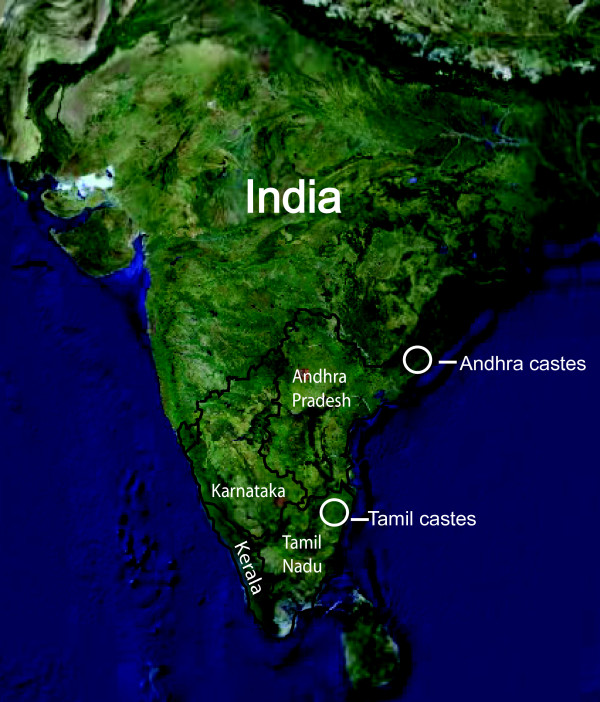
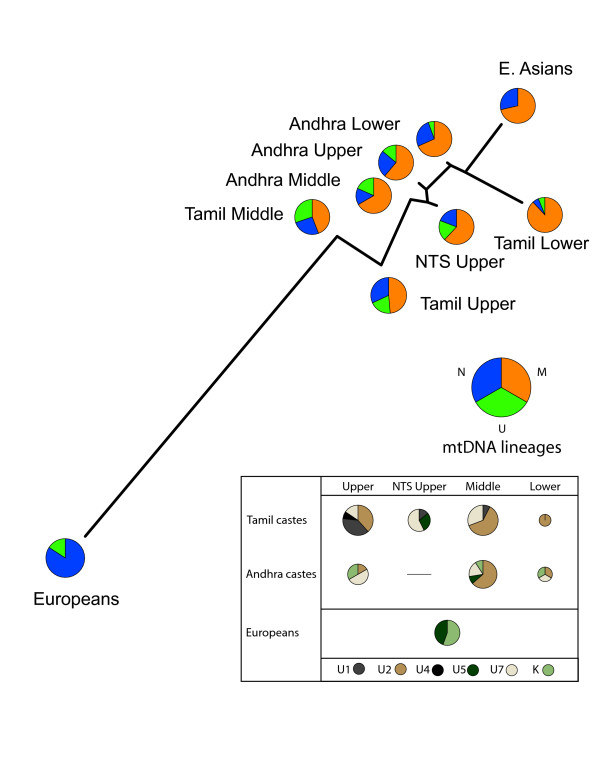
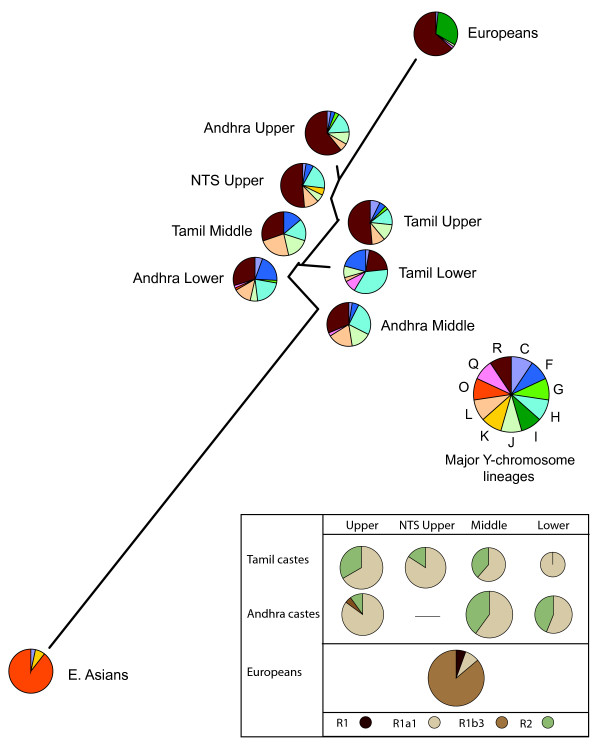
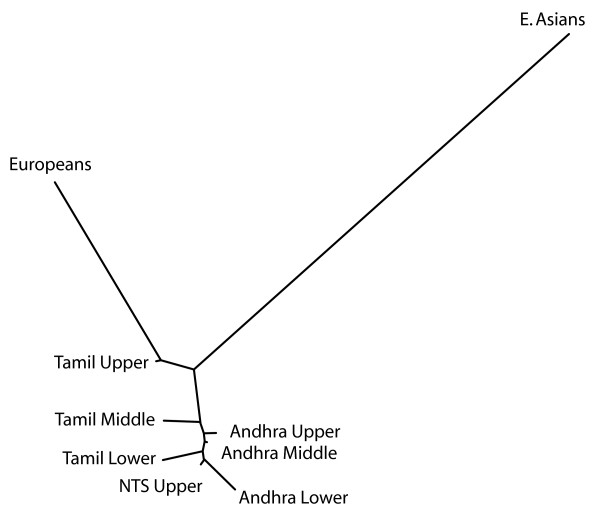
We report new data on 155 individuals from four Tamil caste populations of South India and perform comparative analyses with caste populations from the neighboring state of Andhra Pradesh. Genetic differentiation among Tamil castes is low (RST = 0.96% for 45 autosomal short tandem repeat (STR) markers), reflecting a largely common origin. Nonetheless, caste- and continent-specific patterns are evident. For 32 lineage-defining Y-chromosome SNPs, Tamil castes show higher affinity to Europeans than to eastern Asians, and genetic distance estimates to the Europeans are ordered by caste rank. For 32 lineage-defining mitochondrial SNPs and hypervariable sequence (HVS) 1, Tamil castes have higher affinity to eastern Asians than to Europeans. For 45 autosomal STRs, upper and middle rank castes show higher affinity to Europeans than do lower rank castes from either Tamil Nadu or Andhra Pradesh. Local between-caste variation (Tamil Nadu RST = 0.96%, Andhra Pradesh RST = 0.77%) exceeds the estimate of variation between these geographically separated groups (RST = 0.12%). Low, but statistically significant, correlations between caste rank distance and genetic distance are demonstrated for Tamil castes using Y-chromosome, mtDNA, and autosomal data.
Genetic data from Y-chromosome, mtDNA, and autosomal STRs are in accord with historical accounts of northwest to southeast population movements in India. The influence of ancient and historical population movements and caste social structure can be detected and replicated in South Indian caste populations from two different geographic regions.
大规模人口迁移、社会结构和种姓内婚制影响了印度人群的基因结构。随着在南印度人群中开展基因定位和病例对照研究,了解这些影响变得愈发重要。
我们报告了来自印度南部四个泰米尔种姓人群的155名个体的新数据,并与相邻安得拉邦的种姓人群进行了比较分析。泰米尔种姓之间的基因分化程度较低(对于45个常染色体短串联重复序列(STR)标记,RST = 0.96%),这反映出它们在很大程度上有着共同的起源。尽管如此,种姓和大陆特异性模式仍很明显。对于32个定义谱系的Y染色体单核苷酸多态性(SNP),泰米尔种姓与欧洲人的亲缘关系高于与东亚人的亲缘关系,并且与欧洲人的遗传距离估计值按种姓等级排序。对于32个定义谱系的线粒体SNP和高变序列(HVS)1,泰米尔种姓与东亚人的亲缘关系高于与欧洲人的亲缘关系。对于45个常染色体STR,高种姓和中等种姓与欧洲人的亲缘关系高于来自泰米尔纳德邦或安得拉邦的低种姓。种姓间的局部变异(泰米尔纳德邦RST = 0.96%,安得拉邦RST = 0.77%)超过了对这些地理上分隔群体之间变异的估计值(RST = 0.12%)。利用Y染色体、线粒体DNA和常染色体数据,在泰米尔种姓中证明了种姓等级距离与遗传距离之间存在低但具有统计学意义的相关性。
来自Y染色体、线粒体DNA和常染色体STR的基因数据与印度从西北向东南人口迁移的历史记载相符。古代和历史人口迁移以及种姓社会结构的影响可以在来自两个不同地理区域的南印度种姓人群中被检测到并得到印证。