Program in Computational Biology, Fred Hutchinson Cancer Research Center, Seattle, Washington 98109, USA.
Proteins. 2013 Aug;81(8):1318-29. doi: 10.1002/prot.24272. Epub 2013 Apr 22.
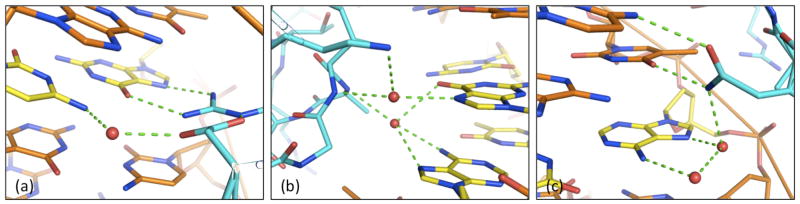
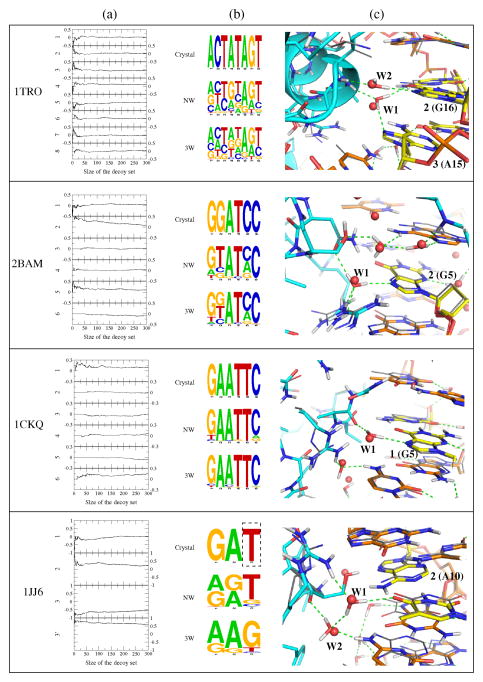
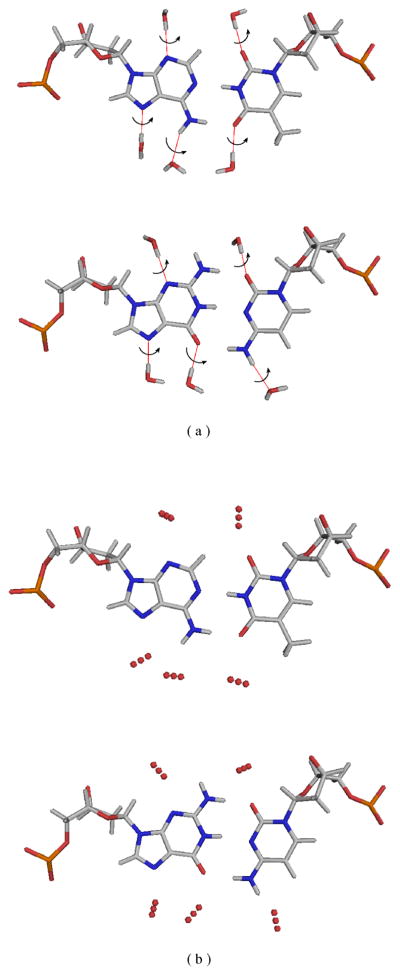
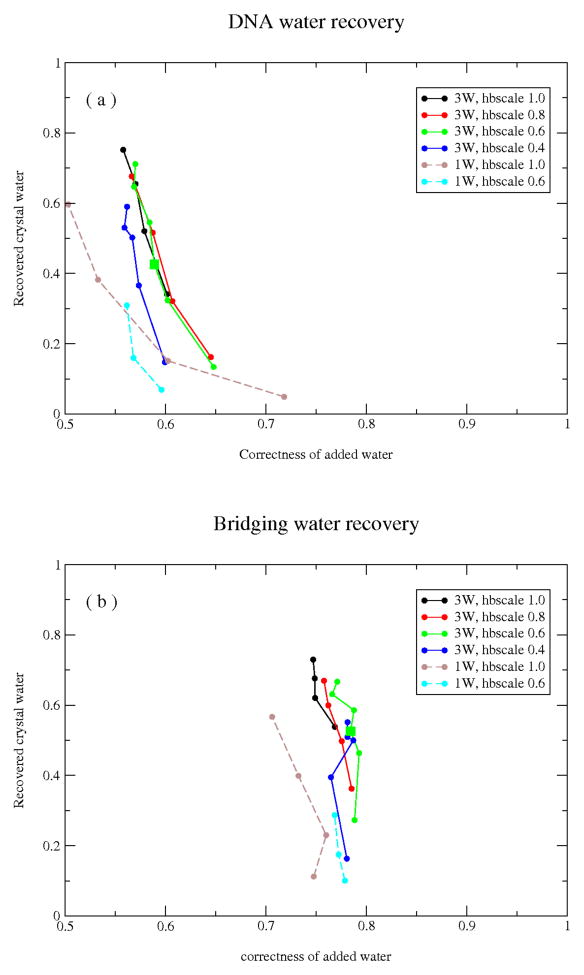
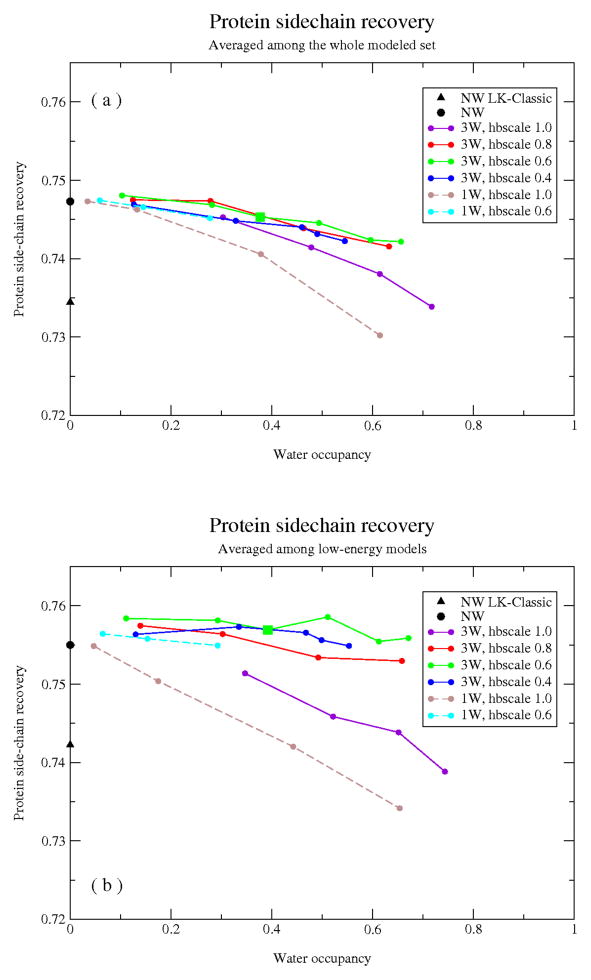
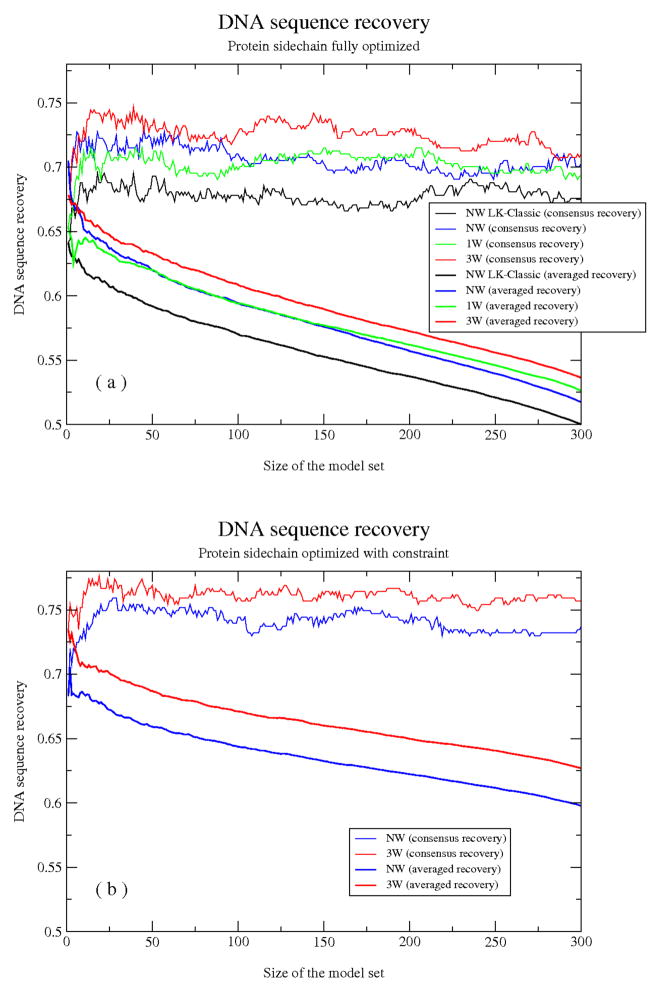
When proteins bind to their DNA target sites, ordered water molecules are often present at the protein-DNA interface bridging protein and DNA through hydrogen bonds. What is the role of these ordered interfacial waters? Are they important determinants of the specificity of DNA sequence recognition, or do they act in binding in a primarily nonspecific manner, by improving packing of the interface, shielding unfavorable electrostatic interactions, and solvating unsatisfied polar groups that are inaccessible to bulk solvent? When modeling details of structure and binding preferences, can fully implicit solvent models be fruitfully applied to protein-DNA interfaces, or must the individualistic properties of these interfacial waters be accounted for? To address these questions, we have developed a hybrid implicit/explicit solvation model that specifically accounts for the locations and orientations of small numbers of DNA-bound water molecules, while treating the majority of the solvent implicitly. Comparing the performance of this model with that of its fully implicit counterpart, we find that explicit treatment of interfacial waters results in a modest but significant improvement in protein side-chain placement and DNA sequence recovery. Base-by-base comparison of the performance of the two models highlights DNA sequence positions whose recognition may be dependent on interfacial water. Our study offers large-scale statistical evidence for the role of ordered water for protein-DNA recognition, together with detailed examination of several well-characterized systems. In addition, our approach provides a template for modeling explicit water molecules at interfaces that should be extensible to other systems.
当蛋白质与它们的 DNA 靶标结合时,有序的水分子经常存在于蛋白质-DNA 界面中,通过氢键将蛋白质和 DNA 连接起来。这些有序的界面水的作用是什么?它们是 DNA 序列识别特异性的重要决定因素,还是通过改善界面的堆积、屏蔽不利的静电相互作用以及溶剂化无法进入体相溶剂的未满足的极性基团,以主要非特异性的方式发挥作用?在模拟结构和结合偏好的细节时,完全隐式溶剂模型可以成功地应用于蛋白质-DNA 界面,还是必须考虑这些界面水的个体特性?为了解决这些问题,我们开发了一种混合隐式/显式溶剂化模型,该模型专门考虑了少量与 DNA 结合的水分子的位置和取向,同时隐式处理大部分溶剂。比较该模型与完全隐式模型的性能,我们发现显式处理界面水可适度但显著改善蛋白质侧链位置和 DNA 序列恢复。两种模型性能的碱基对比较突出了可能依赖界面水的 DNA 序列位置。我们的研究提供了大规模的统计证据,证明有序水在蛋白质-DNA 识别中的作用,同时还对几个特征明确的系统进行了详细检查。此外,我们的方法为在界面处显式水分子建模提供了模板,该模板应该可以扩展到其他系统。