Novartis Pharmaceuticals Corporation, One Health Plaza, East Hanover, NJ 07936, USA.
BMC Fam Pract. 2013 Feb 27;14:30. doi: 10.1186/1471-2296-14-30.
Fragmentation within health care systems may negatively impact the quality of chronic disease patient care. We sought to evaluate the relationship between care management processes (CMP), integration of services, and blood pressure (BP) control among diabetic patients.
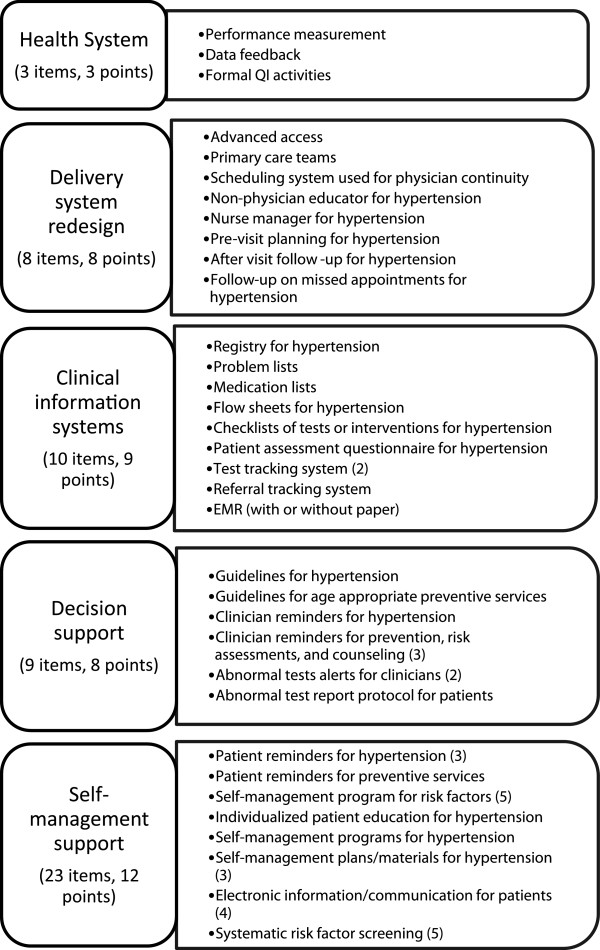
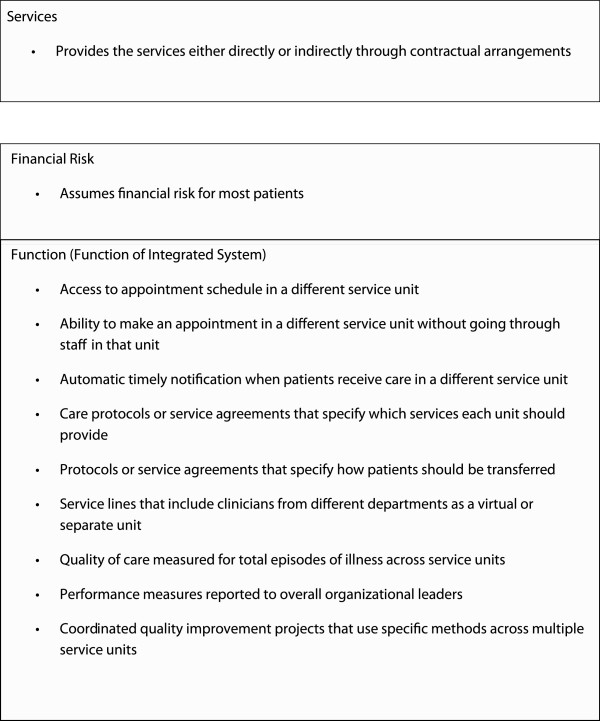
Retrospective chart reviews were performed for a random sample of adult diabetic hypertensive patients (n = 2,162) from 28 physician organizations in the United States (US). A modified version of the Physician Practice Connection Readiness Survey (PPC-RS) was completed by the chief medical officer at each site. The PPC-RS measured health system organization, delivery system redesign, decision support, clinical information systems, and self-management support, and an integration scale measured structure, functions, and financial risk. Correlations between PPC and integration scores and BP outcomes were assessed using Spearman correlation coefficients.
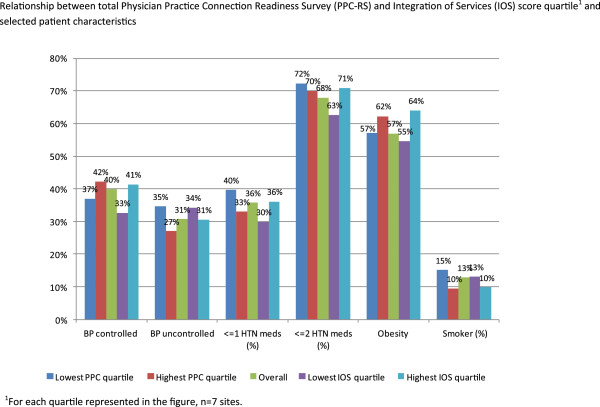
Approximately 39.9% of diabetic patients had controlled BP. Mean total PPC score across sites was 55, with highest mean scores for health system organization (81), followed by design support (60), clinical information systems (57), self-management support (39), and delivery system redesign (39). Mean integration score was 46 (SD 27, range 4-93), and means of subscores were 64 for structure, 33 for financial risk, and 42 for function. Clinical information systems subscore was correlated with uncontrolled BP (r = -0.38, p < 0.05), while association with total PPC score was strong but not significant at p < 0.05 (r = -0.32). Total integration score and the structure subscore were significantly correlated with BP control (r = 0.38, p < 0.05, and r = 0.49, p < 0.01).
This study suggests that CMP and service integration may be associated with better outcomes in diabetes, though results were mixed and limited by a small number of participating sites. Primary care implementation of integrated electronic medical records may have a beneficial effect on patient outcomes for diabetes and other chronic diseases.
医疗体系的碎片化可能会对慢性病患者的护理质量产生负面影响。我们旨在评估服务整合和管理流程(CMP)与糖尿病患者血压控制之间的关系。
对来自美国 28 个医疗组织的 2162 名成年糖尿病高血压患者进行回顾性图表审查。每个地点的首席医疗官填写了 Physician Practice Connection Readiness Survey(PPC-RS)的修改版本。PPC-RS 衡量了医疗体系组织、交付系统重新设计、决策支持、临床信息系统和自我管理支持,以及一个整合衡量结构、功能和财务风险的量表。使用 Spearman 相关系数评估 PPC 和整合评分与血压结果之间的相关性。
约 39.9%的糖尿病患者血压得到控制。各站点的平均总 PPC 评分约为 55,健康体系组织的平均得分最高(81),其次是设计支持(60)、临床信息系统(57)、自我管理支持(39)和交付系统重新设计(39)。平均整合评分 46(SD 27,范围 4-93),子分数均值分别为 64 结构、33 财务风险和 42 功能。临床信息系统子分数与未控制血压呈负相关(r = -0.38,p < 0.05),与总 PPC 评分的相关性较强,但在 p < 0.05 时无统计学意义(r = -0.32)。总整合评分和结构子评分与血压控制显著相关(r = 0.38,p < 0.05,r = 0.49,p < 0.01)。
本研究表明,CMP 和服务整合可能与糖尿病的更好结果相关,尽管结果存在差异且受到参与站点数量有限的限制。初级保健中整合电子病历的应用可能对糖尿病和其他慢性病患者的治疗结果产生有益影响。