Division of Pediatric Gastroenterology and Nutrition, Johns Hopkins University School of Medicine, 600 North Wolfe Street, Brady 320, Baltimore, MD, USA.
BMC Gastroenterol. 2013 Feb 28;13:40. doi: 10.1186/1471-230X-13-40.
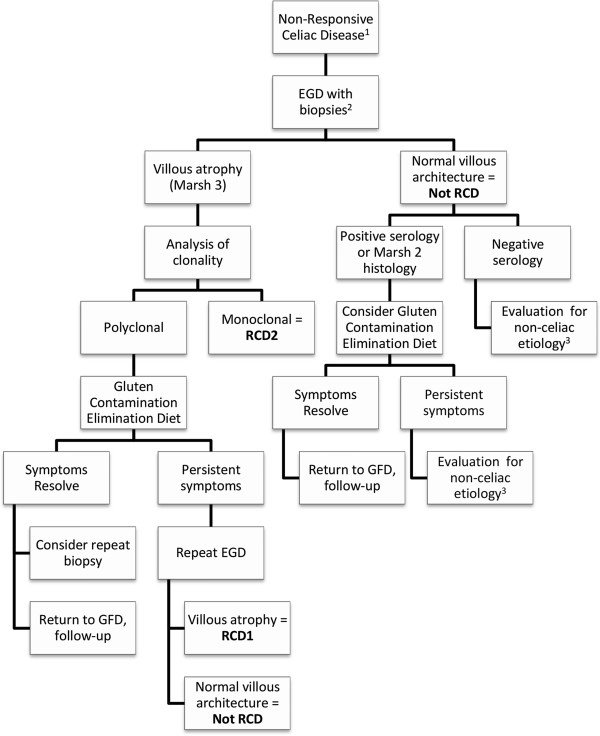
Patients with persistent symptoms and/or villous atrophy despite strict adherence to a gluten-free diet (GFD) have non-responsive celiac disease (NRCD). A subset of these patients has refractory celiac disease (RCD), yet some NRCD patients may simply be reacting to gluten cross-contamination. Here we describe the effects of a 3-6 month diet of whole, unprocessed foods, termed the Gluten Contamination Elimination Diet (GCED), on NRCD. We aim to demonstrate that this diet reclassifies the majority of patients thought to have RCD type 1 (RCD1).
We reviewed the records of all GFD-adherent NRCD patients cared for in our celiac center from 2005-2011 who were documented to have started the GCED. Response to the GCED was defined as being asymptomatic after the diet, with normal villous architecture on repeat biopsy, if performed.
Prior to the GCED, all patients were interviewed by an experienced dietitian and no sources of hidden gluten ingestion were identified. 17 patients completed the GCED; 15 were female (88%). Median age at start of the GCED was 42 years (range 6-73). Fourteen patients (82%) responded to the GCED. Six patients met criteria for RCD prior to the GCED; 5 (83%) were asymptomatic after the GCED and no longer meet RCD criteria. Of the 14 patients who responded to the GCED, 11 (79%) successfully returned to a traditional GFD without resurgence of symptoms.
The GCED may be an effective therapeutic option for GFD-adherent NRCD patients. Response to this diet identifies a subgroup of patients, previously classified as RCD1, that is not truly refractory to dietary treatment. Preventing an inaccurate diagnosis of RCD1 avoids immunotherapy. Most patients are able to return to a traditional GFD without return of symptoms.
尽管严格遵循无麸质饮食(GFD),但仍有持续性症状和/或绒毛萎缩的患者患有无反应性乳糜泻(NRCD)。这些患者中有一部分患有难治性乳糜泻(RCD),但一些 NRCD 患者可能只是对麸质交叉污染有反应。在这里,我们描述了一种为期 3-6 个月的全谷物、未加工食品饮食,称为麸质污染消除饮食(GCED),对 NRCD 的影响。我们旨在证明这种饮食可重新分类大多数被认为患有 RCD 1 型(RCD1)的患者。
我们回顾了 2005-2011 年间在我们的乳糜泻中心接受治疗的所有 GFD 依从性 NRCD 患者的记录,这些患者的病历中记录了他们开始接受 GCED。对 GCED 的反应定义为饮食后无症状,且如果进行了重复活检,则绒毛结构正常。
在开始 GCED 之前,所有患者均由经验丰富的营养师进行了访谈,未发现隐藏的麸质摄入源。17 名患者完成了 GCED;15 名女性(88%)。开始 GCED 的中位年龄为 42 岁(范围 6-73 岁)。14 名患者(82%)对 GCED 有反应。在 GCED 之前,有 6 名患者符合 RCD 的标准;5 名(83%)患者在 GCED 后无症状,不再符合 RCD 标准。在对 GCED 有反应的 14 名患者中,有 11 名(79%)成功地恢复了传统 GFD,且症状未复发。
GCED 可能是 GFD 依从性 NRCD 患者的有效治疗选择。对这种饮食的反应确定了一组先前被归类为 RCD1 的患者,他们并非真正对饮食治疗无反应。避免对 RCD1 的不准确诊断可避免免疫治疗。大多数患者能够恢复传统 GFD,且无症状复发。