Department of Biology, Queen's University, Kingston, ON, K7L 3N6, Canada.
BMC Evol Biol. 2013 Mar 1;13:58. doi: 10.1186/1471-2148-13-58.
The Neotropics are exceptionally diverse, containing roughly one third of all extant bird species on Earth. This remarkable species richness is thought to be a consequence of processes associated with both Andean orogenesis throughout the Tertiary, and climatic fluctuations during the Quaternary. Phylogeographic studies allow insights into how such events might have influenced evolutionary trajectories of species and ultimately contribute to a better understanding of speciation. Studies on continentally distributed species are of particular interest because different populations of such taxa may show genetic signatures of events that impacted the continent-wide biota. Here we evaluate the genealogical history of one of the world's most broadly-distributed and polytypic passerines, the rufous-collared sparrow (Zonotrichia capensis).
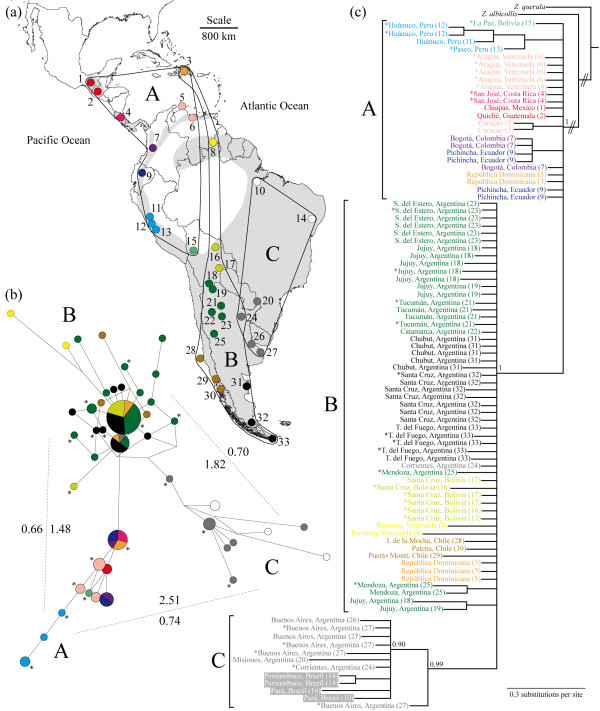
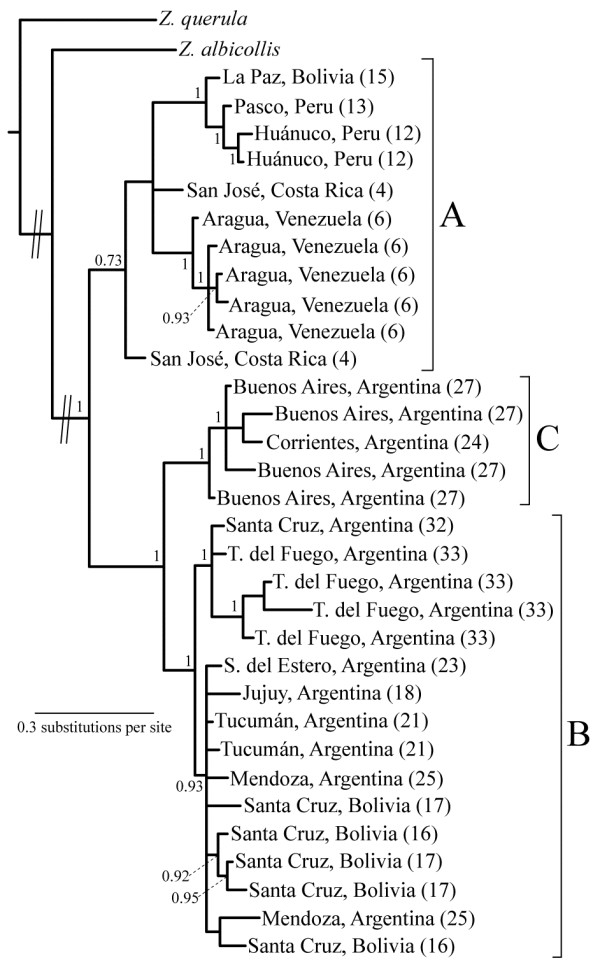
We obtained control region DNA sequences from 92 Zonotrichia capensis individuals sampled across the species' range (Central and South America). Six additional molecular markers, both nuclear and mitochondrial, were sequenced for a subset of individuals with divergent control region haplotypes. Median-joining network analysis, and Bayesian and maximum parsimony phylogenetic analyses all recovered three lineages: one spanning Middle America, the Dominican Republic, and north-western South America; one encompassing the Dominican Republic, Roraima (Venezuela) and La Paz (Bolivia) south to Tierra del Fuego, Argentina; and a third, including eastern Argentina and Brazil. Phylogenetic analyses suggest that the Middle American/north-western South American clade is sister to the remaining two. Bayesian and maximum likelihood coalescent simulations used to study lineage demographic history, diversification times, migration rates and population expansion together suggested that diversification of the three lineages occurred rapidly during the Pleistocene, with negligible gene flow, leaving genetic signatures of population expansions.
The Pleistocene history of the rufous-collared sparrow involved extensive range expansion from a probable Central American origin. Its remarkable morphological and behavioral diversity probably represents recent responses to local conditions overlying deeper patterns of lineage diversity, which are themselves produced by isolation and the history of colonization of South America.
新热带地区的生物多样性异常丰富,大约包含了地球上现存鸟类物种的三分之一。这种显著的物种丰富度被认为是与第三纪安第斯造山运动以及第四纪气候波动相关过程的结果。系统地理学研究可以深入了解这些事件如何影响物种的进化轨迹,并最终有助于更好地理解物种形成。对分布于大陆的物种进行研究尤其具有意义,因为这些类群的不同种群可能显示出对影响整个大陆生物区系的事件的遗传特征。在这里,我们评估了世界上分布最广、多态性最强的雀形目鸟类之一——红颈丛雀(Zonotrichia capensis)的系统发育历史。
我们从该物种分布范围内(中美洲和南美洲)的 92 只红颈丛雀个体中获得了控制区 DNA 序列。对具有不同控制区单倍型的个体子集,我们还测序了另外 6 个核和线粒体的分子标记。中位数连接网络分析、贝叶斯和最大简约系统发育分析都恢复了三个谱系:一个谱系跨越中美洲、多米尼加共和国和南美洲西北部;一个谱系包含了多米尼加共和国、罗赖马州(委内瑞拉)和拉巴斯州(玻利维亚),向南延伸至阿根廷的火地岛;第三个谱系包括阿根廷东部和巴西。系统发育分析表明,中美洲/南美洲西北部的分支与其余两个分支是姐妹关系。贝叶斯和最大似然共祖模拟用于研究谱系的种群历史、多样化时间、迁移率和种群扩张,结果共同表明,三个谱系的多样化是在更新世迅速发生的,基因流可忽略不计,留下了种群扩张的遗传特征。
红颈丛雀的更新世历史涉及从中美洲起源的广泛的范围扩张。其显著的形态和行为多样性可能代表了对当地条件的近期响应,而这些条件又掩盖了更深层次的谱系多样性模式,这些模式本身是由隔离和南美洲的殖民历史产生的。