Division of Molecular Imaging and Neuropathology, New York State Psychiatric Institute, New York, NY 10043, USA.
Biol Psychiatry. 2013 Aug 15;74(4):287-95. doi: 10.1016/j.biopsych.2013.01.024. Epub 2013 Mar 1.
Several lines of evidence implicate abnormal serotonergic function in suicidal behavior and completed suicide, including low serotonin transporter binding in postmortem studies of completed suicide. We have also reported low in vivo serotonin transporter binding in major depressive disorder (MDD) during a major depressive episode using positron emission tomography (PET) with [(11)C]McN5652. We quantified regional brain serotonin transporter binding in vivo in depressed suicide attempters, depressed nonattempters, and healthy controls using PET and a superior radiotracer, [(11)C]DASB.
Fifty-one subjects with DSM-IV current MDD, 15 of whom were past suicide attempters, and 32 healthy control subjects underwent PET scanning with [(11)C]DASB to quantify in vivo regional brain serotonin transporter binding. Metabolite-corrected arterial input functions and plasma free-fraction were acquired to improve quantification.
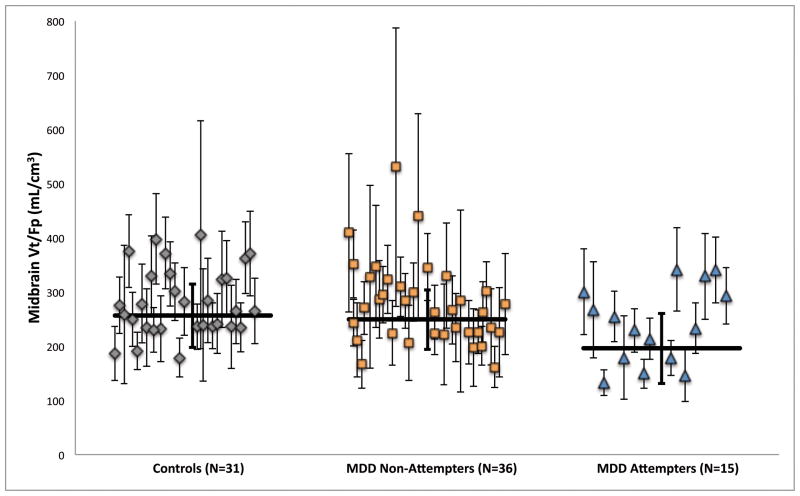
Depressed suicide attempters had lower serotonin transporter binding in midbrain compared with depressed nonattempters (p = .031) and control subjects (p = .0093). There was no difference in serotonin transporter binding comparing all depressed subjects with healthy control subjects considering six a priori regions of interest simultaneously (p = .41).
Low midbrain serotonin transporter binding appears to be related to the pathophysiology of suicidal behavior rather than of major depressive disorder. This is consistent with postmortem work showing low midbrain serotonin transporter binding capacity in depressed suicides and may partially explain discrepant in vivo findings quantifying serotonin transporter in depression. Future studies should investigate midbrain serotonin transporter binding as a predictor of suicidal behavior in MDD and determine the cause of low binding.
有几条证据表明 5-羟色胺能功能异常与自杀行为和自杀死亡有关,包括自杀死亡者的死后研究发现 5-羟色胺转运体结合减少。我们还曾报告过使用 [(11)C]McN5652 进行正电子发射断层扫描(PET)时,在重度抑郁症(MDD)的重度抑郁发作期间体内 5-羟色胺转运体结合减少。我们使用 PET 和一种更优的示踪剂 [(11)C]DASB 对抑郁自杀未遂者、抑郁非未遂者和健康对照者进行了体内区域性大脑 5-羟色胺转运体结合的定量。
51 名 DSM-IV 目前患有 MDD 的患者,其中 15 名是过去的自杀未遂者,32 名健康对照者接受了 [(11)C]DASB 的 PET 扫描,以定量体内区域性大脑 5-羟色胺转运体结合。获取代谢校正的动脉输入函数和血浆游离分数以改善定量。
与抑郁非未遂者(p =.031)和健康对照者(p =.0093)相比,抑郁自杀未遂者的中脑 5-羟色胺转运体结合减少。同时考虑六个预先设定的感兴趣区域,所有抑郁患者与健康对照者的 5-羟色胺转运体结合无差异(p =.41)。
低中脑 5-羟色胺转运体结合似乎与自杀行为的病理生理学有关,而不是与 MDD 有关。这与死后研究一致,表明抑郁自杀者的中脑 5-羟色胺转运体结合能力降低,这可能部分解释了在抑郁症中定量 5-羟色胺转运体的不一致的体内发现。未来的研究应调查中脑 5-羟色胺转运体结合作为 MDD 自杀行为的预测指标,并确定低结合的原因。